DOUMA: Syrian opposition leaders in Eastern Ghouta issued a desperate “distress call” to international organizations on Saturday as the Assad regime tightened its grip on the beleaguered enclave.
“The bomb shelters and basements are full, and people are sleeping in the streets and in public gardens,” said the local council in Douma, the largest town.
“For three days, it has been hard to bury the dead because of the intense bombing on the cemetery.”
Regime forces cut off Douma from the rest of Eastern Ghouta on Saturday in a new blow to fighters defending their last bastion near Damascus.
Regime troops and allied militia have recaptured half of the besieged region in a blistering assault launched on Feb. 18 that has killed more than 1,000 civilians and prompted global outcry. They have pursued a divide-and-conquer strategy, eating away at opposition-held towns and successfully isolating Douma.
Regime fighters seized control of the road linking Douma with the town of Harasta further west, and also captured the town of Misraba. “Regime forces have therefore divided Eastern Ghouta into three parts — Douma and its surroundings, Harasta in the west, and the rest of the towns further south,” the Britain-based Syrian Observatory for Human Rights said.
Shelling and airstrikes slammed into Douma on Saturday, trapping residents inside cellars transformed into makeshift bomb shelters. Rescue workers and medics were struggling to navigate the town’s rubble-littered roads to bring wounded residents back to field clinics.
Eastern Ghouta is the last remaining opposition-controlled zone on the outskirts of the capital, and regime troops have zeroed in on it in order to secure Damascus. It is home to about 400,000 people, in desperate need of humanitarian assistance after the five-year siege made food and medical aid exceedingly rare.
A joint aid convoy of the International Committee of the Red Cross, the UN and the Syrian Arab Red Crescent delivered food aid to hunger-stricken residents on Friday. It was the second convoy in a week, after deliveries on Monday were interrupted by heavy bombardment.
The UN refugee agency’s Syria representative, who entered Ghouta with Monday’s convoy, said the area was “on the verge of a major disaster.”
“I’ve never seen such scared faces in my life,” Sajjad Malik said. He described seeing a five-story building that had been reduced to rubble, with a powerful stench emanating from several bodies trapped underneath.
In addition to clashes around Douma on Saturday, fighting raged to the west near the town of Medeira and further south near Hammuriyeh, Saqba and Efteris.


![]()
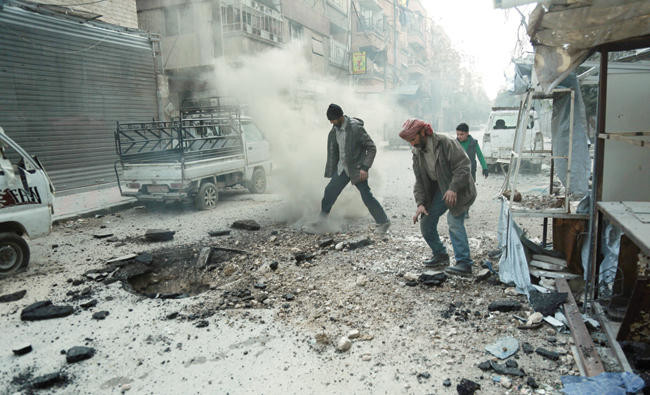
Eastern Ghouta issues desperate ‘distress call’ to the world
Eastern Ghouta issues desperate ‘distress call’ to the world
Latest updates


© 2026 SAUDI RESEARCH & PUBLISHING COMPANY, All Rights Reserved And subject to Terms of Use Agreement.