BRUSSELS: The Trump administration’s decision to impose tariffs on aluminum and steel imports drew warnings on Friday from businesses and US trading partners that the measure could backfire, provoking a trade war without resolving the problems it is intended to address.
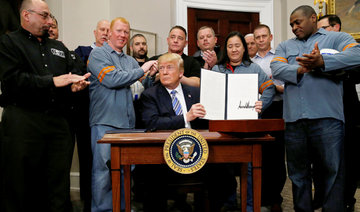
President Donald Trump said the tariffs, due to take effect in 15 days, are needed to protect US workers. Businesses said the 25 percent tariff on imported steel and 10 percent levy on aluminum will jack up costs, raising prices for consumers and potentially putting people out of work.
The move drew consternation outside the US.
China’s Commerce Ministry said it “firmly opposes” the move but gave no indication if Beijing might make good on threats to retaliate.
“These measures could make a significant impact on the economic and cooperative relationship between Japan and the US, who are allies,” Taro Kono, Japan’s foreign minister, said in a statement.
The head of EUROFER, Europe’s main steel federation, said Trump’s reasons for slapping tariffs on steel and aluminum were an absurdity and that the move could cost tens of thousands of jobs across the Continent.
In both Asia and Europe steel producers worry over the loss of market access and also that steel from other exporting nations will flood in.
EUROFER chief Axel Eggert said “the loss of exports to the US, combined with an expected massive import surge in the EU could cost tens of thousands of jobs in the EU steel industry and related sectors.”
Trump has complained over low-cost Chinese exports of steel and aluminum, but the latest move was likely to hit Japan and South Korea harder.
The US bought just 1.1 percent of China’s steel exports last year compared with 12 percent for South Korea and 5 percent for Japan, according to the US International Trade Commission.
“Significant damage in South Korea’s steel exports to the United States seems unavoidable,” South Korean trade minister Paik Un-gyu said in a statement.
A large share of Japanese and Chinese steel goes to Southeast Asia, where booming construction and light industries are fueling strong demand for steel and the region is dependent on imports to meet its needs.
The US tariffs could push producers to sell still more to Southeast Asia, depressing steel prices. That would hurt producers but boost profits of construction and other industries in Southeast Asia.
Hong Kong, which has a busy port handling shipments moving between mainland China and the US, said it “regrets and disapproves” of the decision. The city’s Commerce and Economic Development Bureau said it filed a formal representation with the US on Feb. 27 opposing the tariffs.
Indonesia’s trade minister, Enggartiasto Lukito, expressed concern that industries other than steel and aluminum that are more crucial to Indonesia could eventually be targeted.
“It’s not a big deal for our steel and aluminum industry, but it’s a big problem if the US does a similar policy against palm oil, we are ready for a trade war,” Lukito said.
Indonesia and Malaysia are the world’s biggest producers of palm oil, a commodity that is used in a dizzying number of consumer products.
But Indonesian Vice President Jusuf Kalla said the country had the option of retaliating, with action against imports of US soybeans, wheat and aircraft.
In the US, Gary Shapiro, president and CEO of the Consumer Technology Association, which represents more than 2,200 companies, said the tariffs could cost far more American jobs than they would create.
US automakers are among the businesses with the most at stake, accounting for 38 percent of the aluminum and 15 percent of the steel consumed in the country, according to Ward’s Automotive Reports.
The Alliance of Automobile Manufacturers warned the tariffs will also drive up the price of steel made in the US.
If the entire cost were passed to consumers, which may not be possible, it could add about $300 to the price of the average vehicle, said Kristen Dziczek, director of the Center for Automotive Research’s Industry, Labor & Economics Group.
The tariffs will affect a wide range of products, including high-tech gadgets, food, furniture and beverages. The Beer Institute, a trade group representing the world’s largest brewers, estimates the 10 percent tariff on the aluminum encasing most beer is sold in the US will push costs up by $348 million annually, threatening more than 20,000 jobs in the industry.
“Imported aluminum used to make beer cans is not a threat to national security,” said Jim McGreevy, the Beer Institute’s CEO.
The head of the National Retail Federation, whose members include department store chains, grocery stores and other merchants around the world, also raised objections to the tariffs on Thursday, calling them a tax on all Americans.
“A tariff is a tax, plain and simple,” said Matthew Shay, president and CEO of the NRF. “Consumers are just beginning to see more money in their paychecks following tax reform, but those gains will soon be offset by higher prices for products ranging from canned goods to cars to electronics.”
Housing trade groups also took a dim view of the tariffs, saying the policy would raise costs and slow building at a time when the nation faces a severe shortage in homes and rental housing.

US trading partners, businesses say import tariffs will backfire

AI’s shift toward proactive healthcare
- Experts reveal how AI is reducing burnout and streamlining workflows
JEDDAH: Artificial intelligence is increasingly moving from the margins of healthcare innovation into its operational core. Rather than replacing clinicians, AI is being deployed to address persistent challenges across health systems, from administrative overload and staff burnout to fragmented data and inefficient patient flow.
Speaking to Arab News, Abbes Seqqat, chief executive officer of Rain Stella Technologies, and Eric Turkington, chief product officer, discussed how AI is already transforming healthcare delivery — and why its impact is most meaningful when embedded directly into clinical workflows rather than treated as a standalone tool.
Seqqat describes AI’s role as accelerating a structural shift in healthcare delivery. “AI is accelerating the shift in healthcare from reactive to proactive care, because AI fundamentally helps detect, analyze and predict,” he said, noting that many health systems lack the resources to perform these tasks at scale.
While AI use cases in healthcare are broad, Seqqat emphasized that the most effective applications today focus on operational and clinical fundamentals, including reducing administrative burden, identifying patient risks earlier, and capturing clinical data more reliably and in real time.
RST’s portfolio reflects this approach, spanning surgical data capture and workflow automation, cloud-based electronic medical records, and health information exchange. Across these systems, the common goal is improving data quality and usability so clinicians can spend less time managing information and more time delivering care.
According to Turkington, RST’s systems rely on a mix of established and emerging AI technologies.
“Across the portfolio, we are using a wide range of AI and predictive technologies, from voice technology to reliably capture clinician inputs, to large language models that analyze and act on collected data,” he said.
A key focus has been adapting AI to regional and clinical realities. Voice models, for example, have been trained on UAE and GCC accents and grounded in medical terminology to improve accuracy in real-world settings. RST also uses retrieval-augmented generation and multi-agent AI architectures, allowing different AI components to perform specialized tasks such as classifying surgical notes, identifying unusual events, or assisting with billing and coding, Turkington explained.
DID YOU KNOW?
• AI can detect, analyze, and predict patient risks faster than traditional methods.
• Systems like Equinox use voice input and predictive analytics to actively support clinical decisions.
• AI assistants provide real-time updates, automate documentation, and improve coordination in operating theaters.
One of the central concerns around AI adoption is whether it adds complexity to already demanding clinical roles. Seqqat argues the opposite should be the goal.
“For nurses and frontline staff, AI’s greatest contribution is removing the invisible administrative friction that leads to burnout,” Seqqat said.
In operating theaters, AI systems can replace manual coordination methods such as phone calls and whiteboards by providing real-time situational awareness. By automating updates, anticipating delays, and serving as an on-demand clinical notepad, AI reduces cognitive load and allows staff to remain focused on patient care, he explained.
RST’s voice-enabled assistant, Orva, is designed specifically for perioperative environments.
Turkington said it enables hands-free documentation and coordination, helping surgical teams manage schedules and resources more effectively.
By capturing live updates through voice input, Orva can surface delays, flag bottlenecks, and prompt coordination between departments. It also assists with documentation and coding, reducing errors and supporting more accurate reimbursement— an area where incomplete records often create downstream challenges.
Electronic medical records remain central to healthcare delivery, but Turkington noted that AI can move them beyond passive data repositories.
“We designed Equinox as an EMR that enables you to spend less time with the software and more time with patients,” Turkington said.
Through voice input, automated documentation from visual annotations, and AI-generated pre-visit summaries, the system can actively support clinicians rather than slow them down. Predictive analytics, such as identifying no-show risks or highlighting care gaps, further shift EMRs toward decision-support tools rather than administrative obligations.
Both executives stressed that AI’s effectiveness depends heavily on data access and quality. Seqqat pointed to interoperability as a prerequisite rather than an afterthought.
“AI is only as powerful as the data it can access,” he said, adding that fragmented records limit both clinical insight and system-wide learning.
Health information exchanges, such as RST’s Constellation platform, enable patient data to be viewed longitudinally across providers. AI can then assist with patient identity matching and population-level analysis, allowing trends and risks to be identified across large datasets.
Turkington shared an example from an operating theatre where AI helped prevent cascading delays. When a surgical case ran late, a nurse verbally updated Orva that the patient was ready to exit. The system alerted the recovery unit, analyzed schedule conflicts, and prompted management to reassign staff before delays affected subsequent procedures.
Opinion
This section contains relevant reference points, placed in (Opinion field)
By tagging the cause of the delay and feeding that data into predictive models, the system helped prevent similar issues in the future — without additional manual coordination.
According to Seqqat, the primary returns from AI adoption come from combining efficiency with financial accuracy. Streamlined workflows allow providers to treat more patients without compromising care, while improved documentation reduces revenue leakage.
Looking ahead, Seqqat sees AI becoming central to Saudi Arabia’s healthcare transformation. He described its role as advancing smart hospitals, predictive patient flow, and precision medicine aligned with Vision 2030 goals.
“The role of AI in Saudi Arabia’s healthcare sector is evolving from a supporting technology to a foundational pillar of the Kingdom’s Vision 2030 transformation. Over the next few years, we expect to see AI move into the realm of smart hospitals, where predictive analytics optimize patient flow and AI-driven precision medicine leverages the Saudi Genome Program to provide hyper-personalized care. By unifying national health data and automating complex administrative workflows, AI will enable a more proactive, value-based healthcare model that improves patient outcomes and operational efficiency across the country.”