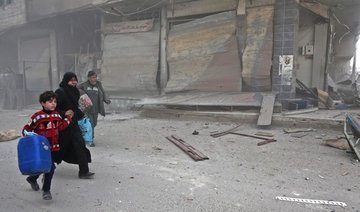
DOUMA, Syria: An aid convoy managed to deliver food to hunger-stricken Eastern Ghouta on Friday despite renewed bombardment by Syrian regime forces who have seized more than half of the besieged rebel enclave.
Nearly 950 civilians have been killed since Russia-backed government forces launched a blistering assault on the last opposition bastion near Damascus on February 18.
Fresh air strikes killed six civilians in the area of Jisreen, a war monitor said, even as the regime and businessmen held talks about the possible evacuation of residents from parts of the enclave.
The Doctors Without Borders charity called for desperately needed medical supplies to be allowed into the enclave, where exhausted doctors have been struggling to treat hundreds of wounded.
Air strikes hit the areas of Jisreen and Harasta after stopping briefly in the early morning, the Britain-based Syrian Observatory for Human Rights monitoring group said.
Earlier, 13 trucks loaded with 2,400 food parcels crossed into Eastern Ghouta, the International Committee of the Red Cross said, entering what UN chief Antonio Guterres has called “hell on earth.”
But renewed bombardment near the main town of Douma soon threatened the joint ICRC, Syrian Arab Red Crescent and United Nations convoy.
“Shelling in proximity of Douma, east Ghouta today, is putting the UN/ICRC/SARC convoy at risk, despite assurances of safety from parties including the Russian Federation,” the UN humanitarian coordinator in Syria, Ali Al-Zaatari, said.
The aid was delivered with helicopters hovering overhead and warplanes targeting areas outside Douma, a correspondent in the town said.
There were no medical supplies on board Friday’s convoy, which was carrying food that aid workers were unable to distribute on Monday.
The enclave’s 400,000 inhabitants have been living under government siege since 2013, with food and medicines in very short supply even before the latest assault.
The renewed artillery fire came as representatives of Damascus and businessmen pressed negotiations on a solution that would allow civilians or fighters to leave the enclave, the Observatory said.
Syrian state news agency SANA said dozens of civilians were expected to leave Eastern Ghouta on Friday.
In the town of Hammuriyeh, dozens of people took part in a protest calling for an end to the bloodshed, the Observatory said.
“Enough destruction and death! We want to save our children and all those who have not died,” said Abu Riyadh, a 47-year-old man in the town.
A negotiator from the town said a “civilian delegation” was “to negotiate with the regime toward a solution to end the fighting” in the area.
A tribal leader said more than 300 civilians from the areas of Kafr Batna, Saqba and Hammuriyeh wanted to leave.
He told journalists there had been discussions for “500 fighters to hand over their weapons to the army.”
Ambulances and green buses — usually used to evacuate people from areas retaken by the regime — waited near a key checkpoint out of the enclave, an AFP reporter there said, as national songs blared on loudspeakers.
The air and ground assault has left medical staff exhausted.
Doctors and nurses in the enclave have run out of several life-saving items, Doctors Without Borders (MSF) said Friday.
“The need for a massive medical re-supply, without life-saving items being removed, is increasingly urgent with each passing hour,” MSF said in a statement.
The Paris-based charity urged the warring parties to pause the bombardment to allow for the evacuation of critically ill or wounded patients.
More than a week ago, the United Nations said those already numbered more than 700.
The charity said 15 of the 20 medical facilities it supports in Eastern Ghouta have been hit by air strikes or shelling.
Regime forces have advanced rapidly through farmland in the enclave since last week, the Observatory says, taking control of more than half of the territory from the armed opposition.
On Monday, 46 trucks entered the area in the first aid provision since February 18 — but had to cut their deliveries short due to bombardment.
The United Nations said Syrian authorities removed some medical supplies from the trucks.
More than 340,000 people have been killed since Syria’s war started in 2011 with the brutal repression of anti-government protests.
UN High Commissioner for Refugees Filippo Grandi on Friday called the conflict a “colossal human tragedy.”
“The conditions faced by civilians inside Syria are worse than ever, with 69 percent languishing in extreme poverty,” he said.
UN-backed peace talks have failed to end the war, and a nationwide cease-fire called for by the UN Security Council last month has not been implemented.
In northern Syria, Turkey-led rebels have been pressing an assault on the Kurdish enclave of Afrin since January 20.
Turkish President Recep Tayyip Erdogan said on Friday that his forces and allied rebels could enter the center of Afrin town “at any moment,” a day after they seized another key town in the area.