Saudi Aramco, SABIC sign deal with Britain’s 'Wood Group' to develop world’s largest crude oil to chemicals project

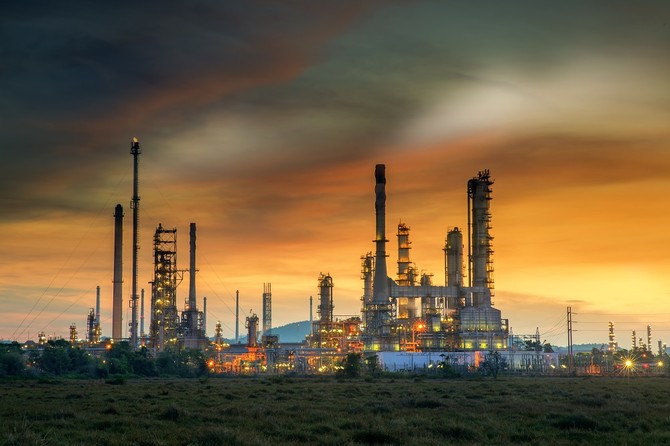
Wood Group will develop the $20 billion complex and provide front-end engineering design and project management services during the engineering, procurement and construction phase. (Shutterstock)
Updated 09 March 2018
Follow

Saudi Aramco, SABIC sign deal with Britain’s 'Wood Group' to develop world’s largest crude oil to chemicals project

DUBAI: Oil giant Aramco and petrochemicals manufacturer SABIC selected on Thursday British energy services provider Wood Group to develop the world’s largest fully integrated crude oil to chemicals (COTC) complex in Saudi Arabia.
Wood Group will develop the $20 billion complex and provide front-end engineering design and project management services during the engineering, procurement and construction phase.
The energy service provider will also support the development of the complex that is expected to process 400,000 barrels a day and around 9 million tons of chemicals and base oils annually.
The agreement coincided with the visit of Saudi Crown Prince Mohammed bin Salman to the United Kingdom. It also follows the signing of a Memorandum of Understanding in November 2017 between Saudi Aramco and SABIC to assist in bringing the mega-project to its next stage of development.
The scope of the contract primarily includes the finalization of the project, selection of technology providers, updating project economics and performing the front-end engineering design.
The project is expected to achieve a direct conversion rate from crude oil to chemicals of almost 50 percent.
“This offers the Kingdom solid opportunities to produce chemicals as a feedstock as part of Saudi Aramco’s efforts to maximize return on investments in hydrocarbon resources,” President and CEO of Saudi Aramco, Amin H. Nasser said.
“This is an important milestone in a partnership that we are proud of between Saudi Aramco and Sabic, a partnership that is in line with Saudi Aramco’s strategy for business integration, adding value and tackling global growth opportunities in chemicals,” he added.
It will be capable of maximizing chemical yield, recycling by-products, optimizing resources and driving efficiencies of scale, Nasser explained.
“Ours is a business relying on finite natural resources for our feedstock. We have an obligation to deploy those resources as efficiently and in the most sustainable manner possible,” Vice Chairman and CEO of SABIC Yousef Al-Benyan said.
The project will generate the world’s highest proven yield conversion rate of oil to chemicals in a competitive and sustainable way, according to Al-Benyan.
The contract is expected to continue through to the start of operations in 2025.
By 2030, the COTC complex is expected to be a significant contributor to Saudi Arabia’s GDP and play a key role in helping the continued economic diversification from crude exports to higher value industrial products.


Emerging markets driving global growth despite rising risks: Saudi finance minister 

Updated 41 sec ago
Follow

Emerging markets driving global growth despite rising risks: Saudi finance minister 

RIYADH: Emerging markets now account for a growing share of global output and are driving the bulk of world economic expansion, Saudi Arabia’s finance minister said, even as those economies grapple with rising debt and mounting geopolitical risks. 

Speaking at the opening of the annual AlUla Conference for Emerging Market Economies on Feb. 8, Mohammed Al-Jadaan said the role of emerging and developing nations in the global economy has more than doubled since 2000, underscoring a structural shift in growth away from advanced economies.

The meeting comes as policymakers in developing markets try to keep growth on track while controlling inflation, managing capital flows and repairing public finances after years of heavy borrowing. Saudi Arabia has positioned the forum as a platform to coordinate policy responses and strengthen the voice of emerging economies in global financial discussions. 

“This conference takes place at a moment of profound transition in the global economy. Emerging markets and developing economies now account for nearly 60 percent of the global gross domestic product in purchasing power terms and 70 percent of global growth,” Al-Jadaan said. 

He added: “Today, the 10 emerging economies and the G20 alone account for more than half of the world’s growth. Yet, emerging markets face a more complex and fragmented environment, elevated debt levels, slower trade growth and increasing exposure to geopolitical shocks.” 

According to Al-Jadaan, more than half of low-income nations face the risk of debt distress, while global trade growth has slowed to around half its pre-pandemic pace. 

Launched in 2025, the conference this year brings together economic decision-makers, finance ministers, central bank governors, leaders of international financial institutions, and a select group of experts and specialists from around the world. 

Al-Jadaan said credible fiscal frameworks and disciplined debt management are essential for long-term growth, pointing to Saudi Arabia’s own reform experience. 

“Macroeconomic stability is not the enemy of growth; it is actually the foundation. Credible fiscal framework, clear medium-term anchors, and disciplined debt management create the space for investment and reform, especially in volatile global conditions,” he said. 

The minister stressed that policy credibility depends on execution rather than plans, adding that structural reforms succeed only when institutions are able to deliver. 

The importance of multilateral cooperation is rising as the global system becomes more divided, he said, calling for stronger international financial safety nets for developing economies. 

“International cooperation matters more, not less, in a fragmented world. Strong multilateral institutions, effective surveillance and adequate global financial safety nets are essential, particularly for emerging and developing economies,” Al-Jadaan said. 

Kristalina Georgieva, managing director of the International Monetary Fund, said emerging markets are growing faster than advanced economies but remain vulnerable to future shocks. 

“Growth still lags pre-pandemic levels, and this is doubly concerning as we will surely experience more shocks, but face them with depleted fiscal buffers in many places, with high spending pressures practically everywhere, and rising debt levels in many countries,” she said. 


Georgieva outlined two policy priorities emerging economies should embrace to sustain growth. 

“First priority, unleash private sector-led growth by cutting red tape, deepening financial markets, strengthening institutions and improving governance,” she said.  

Georgieva added: “Second priority is stepping up integration. In a world of shifting alliances and trade partners, there are new opportunities for cooperation at the regional and cross-regional levels.”  

Lan Fo’an, China’s finance minister, said the world has entered a period of turbulence marked by unilateralism and geopolitical conflict. 

“A cold wave of deglobalization is sweeping across the globe, and the world once again stands at a crucial crossroads,” he said, adding that the global economy expanded 3.3 percent in 2025, below the pre-pandemic average of 3.7 percent. 

He called for reforms to global economic governance and greater attention to the needs of developing countries. 

“We should improve the global economic governance system through reforms. We should add dialogue over confrontation. We should practice multilateralism to ensure that our countries, regardless of their size or wealth, can participate, make decisions and benefit on an equal footing.” 

According to Fo’an, China has joined hands with the Global South to advance cooperation in food security, development financing and climate change.