Saudi Aramco signs preliminary gas deal with Shell

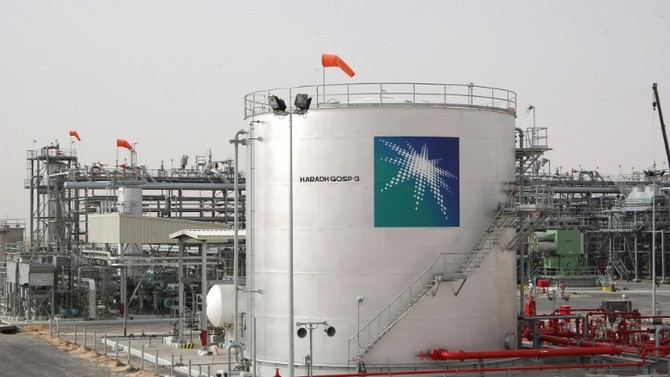
Saudi Aramco has signed a preliminary deal to pursue international gas opportunities with Royal Dutch Shell. (Reuters)
Updated 08 March 2018
Follow

Saudi Aramco signs preliminary gas deal with Shell

LONDON/DUBAI: State oil giant Saudi Aramco signed a preliminary deal to pursue international gas opportunities with Royal Dutch Shell on Thursday as part of top crude exporter Saudi Arabia’s diversification drive before the listing of Aramco.
The memorandum of understanding (MoU) signed in London between the two companies was during the official visit of Saudi Crown Prince Mohammed bin Salman to Britain, and would include gas upstream and liquefaction projects.
“It is a discussion that began some time ago and now we have signed a memorandum to work on gas projects from upstream to downstream across the world and in Saudi Arabia. Concrete projects would be announced in due course,” Shell Chief Executive Ben van Beurden told Reuters after the signing ceremony.
Last year, industry sources told Reuters Saudi Arabia and international oil companies had discussed gas venture opportunities inside the Kingdom and abroad.
Aramco is gearing up for a share listing later this year, aiming to get a valuation of up to $2 trillion in what could be the world’s biggest initial public offering (IPO).
The Kingdom has a long-term goal of increasing the use of gas for domestic power generation, thus reducing oil burning at home and freeing up more crude for export.
Expanding its gas portfolio inside the Kingdom as well as abroad could help increase Aramco’s valuation as it generates more revenue from exports than selling oil at lower domestic prices — Saudi Arabia is the world’s fifth-biggest oil consumer despite being only the 20th-biggest economy.
Saudi Energy Minister Khalid Al-Falih, who is also Aramco’s chairman, had said Aramco was interested in investing in international upstream ventures, particularly gas, and could invest in importing gas into the kingdom.
Diversifying gas assets abroad would help Aramco achieve a better valuation and is attractive for investors, industry sources has said. Riyadh also plans to raise domestic gas prices, a move seen as an incentive for foreign companies.
Aramco controls gas reserves in excess of 8 trillion cubic meters, according to BP’s annual energy review. The Saudi company has said it wants to explore for gas in the shallow waters of the Red Sea as well as onshore shale gas.


Arab food and beverage sector draws $22bn in foreign investment over 2 decades: Dhaman 

Updated 28 December 2025
Follow

Arab food and beverage sector draws $22bn in foreign investment over 2 decades: Dhaman 

JEDDAH: Foreign investors committed about $22 billion to the Arab region’s food and beverage sector over the past two decades, backing 516 projects that generated roughly 93,000 jobs, according to a new sectoral report. 

In its third food and beverage industry study for 2025, the Arab Investment and Export Credit Guarantee Corp., known as Dhaman, said the bulk of investment flowed to a handful of markets. Egypt, Saudi Arabia, the UAE, Morocco and Qatar attracted 421 projects — about 82 percent of the total — with capital expenditure exceeding $17 billion, or nearly four-fifths of overall investment. 

Projects in those five countries accounted for around 71,000 jobs, representing 76 percent of total employment created by foreign direct investment in the sector over the 2003–2024 period, the report said, according to figures carried by the Kuwait News Agency. 

“The US has been the region's top food and beverage investor over the past 22 years with 74 projects or 14 projects of the total, and Capex of approximately $4 billion or 18 percent of the total, creating more than 14,000 jobs,” KUNA reported. 

Investment was also concentrated among a small group of multinational players. The sector’s top 10 foreign investors accounted for roughly 15 percent of projects, 32 percent of capital expenditure and 29 percent of newly created jobs.  

Swiss food group Nestlé led in project count with 14 initiatives, while Ukrainian agribusiness firm NIBULON topped capital spending and job creation, investing $2 billion and generating around 6,000 jobs. 

At the inter-Arab investment level, the report noted that 12 Arab countries invested in 108 projects, accounting for about 21 percent of total FDI projects in the sector over the past 22 years. These initiatives, carried out by 65 companies, involved $6.5 billion in capital expenditure, representing 30 percent of total FDI, and generated nearly 28,000 jobs. 

The UAE led inter-Arab investments, accounting for 45 percent of total projects and 58 percent of total capital expenditure, the report added, according to KUNA. 

The report also noted that the UAE, Saudi Arabia, Egypt, and Qatar topped the Arab ranking as the most attractive countries for investment in the sector in 2024, followed by Oman, Bahrain, Algeria, Morocco, and Kuwait. 

Looking ahead, Dhaman expects consumer demand to continue rising. Food and non-alcoholic beverage sales across 16 Arab countries are projected to increase 8.6 percent to more than $430 billion by the end of 2025, equivalent to 4.2 percent of global sales, before exceeding $560 billion by 2029. 

Sales are expected to remain highly concentrated geographically, with Egypt, Saudi Arabia, Algeria, the UAE and Iraq accounting for about 77 percent of the regional total. By product category, meat and poultry are forecast to lead with sales of about $106 billion, followed by cereals, pasta and baked goods at roughly $63 billion. 

Average annual per capita spending on food and non-alcoholic beverages in the region is projected to rise 7.2 percent to more than $1,845 by the end of 2025, approaching the global average, and to reach about $2,255 by 2029. Household spending on these products is expected to represent 25.8 percent of total expenditure in 13 Arab countries, above the global average of 24.2 percent. 

Arab external trade in food and beverages grew more than 15 percent in 2024 to $195 billion, with exports rising 18 percent to $56 billion and imports increasing 14 percent to $139 billion. Brazil was the largest foreign supplier to the region, exporting $16.5 billion worth of products, while Saudi Arabia ranked as the top Arab exporter at $6.6 billion.