Kingdom aims to quadruple mining, renewables and logistics says Al-Falih

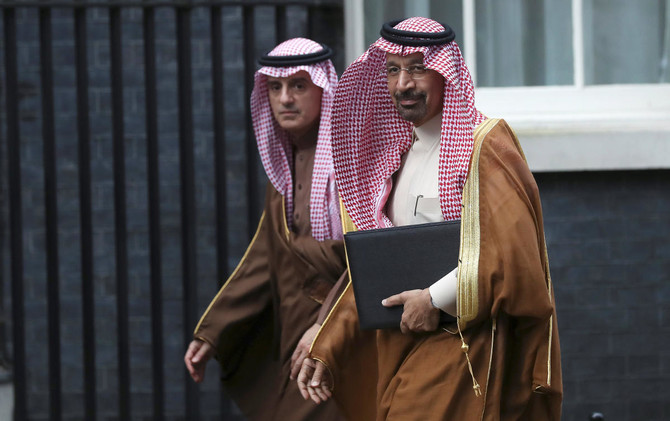
Saudi Arabia' oil minister Khalid Al-Falih and foreign minister Adel Al-Jubeir on their way to meet Britain's Prime Minister Theresa May in Downing Street. (Reuters)
Updated 08 March 2018
Follow

Kingdom aims to quadruple mining, renewables and logistics says Al-Falih

LONDON: Saudi Energy Minister Khalid Al-Falih has revealed the Kingdom aims to quadruple the size of its mining, renewables and logistics sectors.
He was speaking at the Saudi-UK CEO Forum in London to mark the state visit of Saudi Crown Prince Mohammed bin Salman to London.
“One of our programs is the development of the Kingdom’s industrial energy and logistics. These are right at the heart of creating investment opportunities. We have $1.3 trillion of mining endowment. We want to quadruple our mining statistics and supply chains. As we quadruple some of these sectors, the focus is on quality not quantity. This will require the best collaboration between us,” Al-Falih said.
“The chemicals sector, which has grown fantastically in the last few decades, now needs to grow in terms of technology content and value added projects.”
Earlier, Liam Fox, the UK trade secretary said Britain was committed to helping Saudi Arabia become a “global investment powerhouse.”
Fox said he hoped Saudi Arabia’s Public Investment Fund (PIF) would find Britain a key investment opportunity that could work for both countries, and that would boost London’s status as a world financial center.
Fox also said the first Saudi/UK education dialogue will take place, to “establish a government to government policy exchange.”
Peter Mandelson, former EU trade minister, said the key to understanding KSA investment opportunities for Britain was the realization that Saudi Arabia was a staging post between and East and West, and “a jumping off point to Africa,” said Mandelson, former minister in Tony Blair’s Labour government.


King Abdulaziz Airport among world’s busiest after record-breaking 2025

Updated 02 January 2026
Follow

King Abdulaziz Airport among world’s busiest after record-breaking 2025

RIYADH: King Abdulaziz International Airport has achieved a new historical milestone, reaching 53.4 million passengers in a single year.

This is the highest number ever recorded at a Saudi airport since the beginning of air travel in the Kingdom, placing it among the world’s mega airports in terms of passenger traffic, according to the Saudi Press Agency.

The airport handled a total of 310,000 flights and 60.4 million bags, representing a 12 percent increase compared to 2024. It also handled 9.57 million Zamzam water containers and 2,968 cargo flights. 

This achievement reflects the airport’s qualitative transformation and its position as a regional hub and national gateway connecting the Kingdom to the world. It also highlights its role in facilitating the movement of visitors and pilgrims, promoting tourism in line with the goals of Vision 2030, diversifying the economy, and providing a distinguished travel experience. 

For his part, CEO of Jeddah Airports Co. Mazen Johar, affirmed that reaching 53.4 million passengers confirms the airport’s high operational readiness and represents a pivotal milestone for moving to the next phase, in preparation for doubling this number, God willing, in the coming years. 

He pointed out that this national achievement would not have been possible without the grace of God Almighty, followed by the directives of the wise leadership and the continuous follow-up from the minister of transport and logistics, the president of the General Authority of Civil Aviation, and the CEO of Airports Holding Co. 

He explained that King Abdulaziz International Airport is strengthening its position as a major aviation hub in the region through expansions, increased capacity, and improved services, supporting the objectives of the aviation program and aligning with the goals of the Kingdom’s Vision 2030. 

The CEO of Jeddah Airports Co. expressed his gratitude to the partners in success from various government and private sectors for their fruitful cooperation through a collaborative work system that contributed to providing the best services.