KARACHI: Peering at the chess board from behind her spectacles, 14-year-old Pakistani schoolgirl Maleeha Ali deftly put her opponent’s king in checkmate, winning her third victory in a row.
With a score of 24-4, her team of blue-and-white uniformed teenagers from SMB Fatima Jinnah Government Girls School in Karachi, Pakistan’s biggest city, trounced a group of boys from a prestigious private school.
“You have to watch your opponent’s every move from every angle,” said Ali, sitting on a high stool.
With echoes of Uganda’s “Queen of Katwe,” the Pakistani teens have defied expectations about girls in their conservative nation by thrashing men nearly twice their age at chess.
“These girls always give us a tough time,” said Foad Abdullah, 15, from BVS Parsi High School who lost six of his eight games to the girls.
Like Phiona Mutesi – whose rise from a Ugandan slum to international chess championships inspired the 2016 Disney film – Pakistan’s chess queens have beaten the odds to succeed.
About 23 million children do not go to school in Pakistan, half of them girls who often marry before the age of 18, miss out on education because they have to work or cannot commute long distances because it is not safe.
The majority of children who go to school attend government institutions, which often have dilapidated facilities and poor attendance rates by teachers.
Chess Master
Karachi’s chess queens have a distinct advantage. They are being trained by Pakistan’s former international chess master Shahzad Mirza, a keen promoter of the game in schools across the country, better known for its love of cricket.
Most of the girls can outshine men in national tournaments, he told the Thomson Reuters Foundation.
“These girls have won the top five positions so many times, I’ve lost count,” he said with pride.
Chess is also a compulsory subject for girls in grades 4 to 8 in the school, which is in Karachi’s old city Garden area.
Their success has boosted their self-belief, according to their coach Hira Sher Mohammad, 23, a former student.
“When the girls win against boys, you should see how ecstatic they are,” she said.
“It is the consistent victory that has brought about a change – girls have become confident and parents have come around too,” she added.
“When these girls go to play matches outside the school premises, they have no problem getting permission from their parents.”
Strategic Thinkers
SMB Fatima Jinnah School has a second celebrity backer in the form of the Zindagi Trust, a charity run by Pakistani singer Shehzad Roy to improve the quality of education.
“Chess is not just a game,” he said. “It will help these girls ... when they have to make important decisions or handle tough situations in their lives.”
Chess can help to produce “strategic thinkers and problem solvers who will tackle complex issues affecting Pakistan or even the world,” said Roy, who has been honored by the government for his humanitarian work.
The school is one of about 600 in southern Sindh province – one of the poorest regions of Pakistan – that is part of the Adopt-A-School program, which aims to improve facilities in government schools.
One of the chess queens, 15-year-old Bushra Maqsood has been chosen to take part in the Seeds of Peace camp in the United States in June, which brings together teenagers from countries in conflict to encourage dialogue and understanding.
Although she has never left Pakistan or been on a plane and speaks only a smattering of English, she is not anxious.
“I think I will manage,” she said, beaming confidently.


Chess victories win Pakistan’s ‘Queens of Karachi’ confidence and freedom
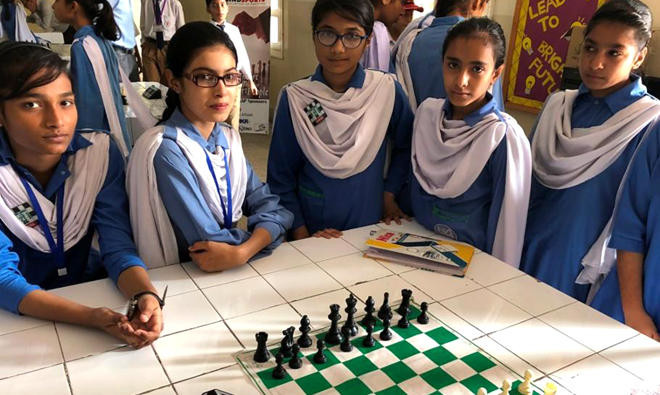
Chess victories win Pakistan’s ‘Queens of Karachi’ confidence and freedom

Pakistan to promote mineral sector at Saudi forum this month with 13 companies
- Delegation will take part in the Future Minerals Forum in Riyadh from Jan. 13-15
- Petroleum minister will lead Pakistan, participate in a 90-minute country session
ISLAMABAD: Around 13 Pakistani state-owned and private companies will attend the Future Minerals Forum (FMF) in Saudi Arabia from Jan. 13 to 15, an official statement said on Friday, as the country seeks to ramp up global engagement to develop its mineral resources.
The FMF is an international conference and investment platform for the mining sector, hosted by mineral-rich countries to attract global investors, companies and governments.
Petroleum Minister Ali Pervaiz Malik confirmed Pakistan’s participation in a meeting with the Saudi envoy, Nawaf bin Said Al-Malki.
Pakistan hosts one of the world’s largest copper-gold zones. The Reko Diq mine in southwestern Balochistan, with an estimated 5.9 billion tons of ore, is partly owned by Barrick Gold, which calls it one of the world’s largest underdeveloped copper-gold deposits. Its development is expected to boost Pakistan’s struggling economy.
“Upon an invitation of the Government of the Kingdom of Saudi Arabia, the Federal Minister informed the Ambassador that Pakistan will fully participate in the upcoming Future Minerals Forum (FMF), scheduled to be held in Riyadh later this month,” Pakistan’s Press Information Department (PID) said in an official statement.
The Pakistani minister will lead his country’s delegation at the FMF and take part in a 90-minute country showcase session titled “Unleashing Potential: Accelerating Pakistan’s Mineral Revolution” along with local and foreign investors.
Pakistan will also establish a dedicated pavilion to highlight the vast potential of its rich geological landscape to the global mineral community.
The Saudi envoy welcomed Pakistan’s decision to participate in the forum and discussed enhancing bilateral cooperation in the minerals and energy sectors during the meeting.
According to the statement, he highlighted the potential for cooperation between Saudi Arabia and Pakistan in the minerals and energy sectors, expressing confidence that the FMF would provide a platform to expand collaboration.
Pakistan’s mineral sector, despite its rich reserves of salt, copper, gold and coal, contributes only 3.2 percent to the country’s GDP and just 0.1 percent to global mineral exports.
However, many countries, including the United States, have shown interest in Pakistan’s underdeveloped mineral sector, particularly in copper, gold and other critical resources.
In October, Pakistan dispatched its first-ever shipment of rare earth and critical minerals to the United States, according to a Chicago-based US public relations firm’s report.


