PESHAWAR: Federally Administered Tribal Areas (FATA), will have their own treatment centers under the Pakistan Government’s National AIDS Control Program from next month.
Patients from tribal areas have been going to Peshawar for screening and treatment until now, according to health officials.
FATA Aids Control Program Manager Dr. Durkhanay Wali told Arab News that initially three treatment centers are being set up in FATA.
“We will select those places in FATA which have maximum catchment area,” she said.
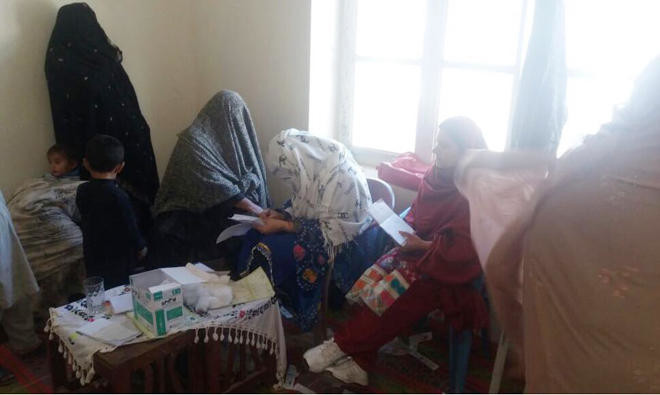
Wali added that the control program conducts annual screening camps in all tribal agencies and Frontier Regions (FRs).
“A screening camp in an agency is five-day long (exercise), while it is three days in an FR.”
There have been 547 registered HIV patients from FATA and the FRs from 2003 to date, according to Wali. The North Waziristan tribal region alone has 133 reported cases and would therefore have a dedicated treatment center of its own, she added.
The FATA AIDS Control Programme has registered 27 patients out of the 4,838 people screened since March 2017, across the seven tribal agencies and the FRs, she said.
Talking to Arab News, 52-year-old Johar Afridi at the AIDS treatment center in Peshawar said that he had been living with HIV for the past 23 years.
“The symptoms appeared in 1995 when I started suffering from fever and stomach disorders. However, I started HIV treatment in 2004 after I was diagnosed with it,” said Afridi, who comes from Khyber Agency.
He said he did not feel stigmatized at all and that, just like other diseases, HIV requires attention and treatment.
“I have spent half of my life with HIV and feel normal with the use of medication,” he said. The AIDS Control Program provides free medicines, which otherwise would cost him around Rs 13,000 ($118) a month, he said.
Akhtar Zaman, another HIV patient from Kakshal locality in Peshawar, said he had a fever for two months and was not getting well, which led him to take the test and discover that he was HIV positive.
“I don’t tell everyone about it. Only my in-laws and my immediate family know. I wish to keep it a secret because HIV is considered a taboo in our society,” he said.
AIDS is considered a stigma of shame in FATA but now there is much more awareness about the disease, which weakens the human immune system, said Dr. Niaz Ali, in charge of the Family Care Center for AIDS treatment at HMC.
“Patients cannot survive if they don’t take medication. However, if they take the medicines regularly, they can live a normal life,” he said.

FATA AIDS program to set up three treatment centers in tribal areas
Opposition protests over Imran Khan’s eye treatment as government offers specialist care
- Opposition alliance says protest in front of parliament to continue until Khan is admitted to Shifa Hospital
- Government says the ex-premier’s medical report will be compiled again amid judicial oversight of the case
ISLAMABAD: Pakistan’s opposition alliance staged a sit-in outside Parliament House on Friday demanding that jailed former prime minister Imran Khan be shifted to a private hospital for treatment of his worsening eye condition, as the government promised the best possible treatment and said the case was under judicial oversight.
Police locked the gates of parliament and cordoned off surrounding roads, preventing protesters from gathering in front of the building, witnesses and opposition leaders said. Security was also tightened around Khyber Pakhtunkhwa (KP) House, where officials and lawmakers from Khyber Pakhtunkhwa were stopped from approaching parliament.
The province is governed by Khan’s Pakistan Tehreek-e-Insaf (PTI) party which is in the opposition at the center.
“We have staged a sit-in for the earliest medical check-up of Imran Khan, which would take just ten minutes,” Mehmood Khan Achakzai, Leader of the Opposition in the National Assembly and head of the opposition Tehreek-e-Tahafuz-e-Ayeen-e-Pakistan alliance, told reporters at Parliament House.
“If it is conducted, we will end our protest,” he added.
In a post on X, the alliance said its leadership would continue the sit-in “until Imran Khan is admitted to Al-Shifa Hospital.”
A group of protesters, led by Khyber Pakhtunkhwa Chief Minister Sohail Afridi, also camped outside the KP House in the federal capital after an initial scuffle with police.
During the clash KP government spokesperson Shafi Jan was arrested but later released as more protesters gathered outside the facility.
Jan warned that if PTI activists were prevented from joining the main protest, they “will give a call for a countrywide strike.”
“We want to proceed toward Parliament to join the protest,” he added. “We want the Supreme Court’s verdict to be implemented that Imran Khan be shifted to Shifa Hospital, treated there and then brought back.”
The protest follows a rare prison visit earlier this month by Barrister Salman Safdar, appointed as amicus curiae by the Supreme Court to assess Khan’s health and living conditions at Rawalpindi’s Adiala jail. Safdar submitted a detailed report that was made public on Thursday.
The report said that in view of the seriousness of Khan’s ocular condition, “it is imperative that the seriousness of the condition be independently ascertained without delay.”
Safdar also recommended that the court consider involving Khan’s personal physicians or other specialists of his choice, warning that “any further delay poses a serious risk to the Petitioner’s well-being.”
According to a Feb. 6 medical report from the Pakistan Institute of Medical Sciences (PIMS) cited in Safdar’s filing, Khan was diagnosed with “right central retinal vein occlusion” after reporting reduced vision in his right eye. He underwent an intravitreal injection at PIMS and was discharged with follow-up advice.
In his interaction with Safdar, Khan said he had suffered “rapid and substantial loss of vision over the preceding three months” and claimed his complaints had not been addressed promptly in custody. He further said he had been left with “only 15 percent vision in his right eye.”
Safdar’s report noted that the 73-year-old former premier appeared “visibly perturbed and deeply distressed” over the loss of vision, though it also recorded that he expressed satisfaction with his safety, basic amenities and food provisions in prison.
Responding to the controversy, Parliamentary Affairs Minister Tariq Fazal Chaudhry rejected PTI’s claims that Khan had been suffering from an eye issue since October last year.
Speaking to reporters in Islamabad, he said Khan was visited by his sister on Dec. 2 but she did not mention the medical issue.
“Medical report will be compiled again, the chief justice of the Supreme Court is himself monitoring this case,” he said. “Wherever it will be requested, Imran Khan’s eye will be examined at.”
Chaudhry vowed there would be no negligence.
Information Minister Attaullah Tarar earlier rejected claims of mistreatment, saying the “narrative being propagated to international media” by Khan’s family had “fallen flat on its face,” and that prison records showed he enjoyed facilities “more than any other prisoner.”
Khan has been in custody since August 2023 in connection with multiple cases that he and his party describe as politically motivated. The government denies the allegation.
Concerns over his health resurfaced after authorities confirmed he had briefly been taken from prison to a hospital in Islamabad for an eye procedure. While the government said his condition was stable, Khan’s family and PTI leaders alleged they were not informed in advance and that he was being denied timely and independent medical access.


