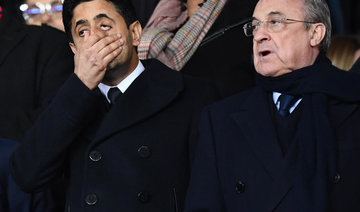
DOHA: Paris Saint-Germain’s latest bruising exit from the European football Champions League may have been particularly painful for two men watching among the almost 50,000-strong crowd at Parc des Princes.
High in the stands in the Paris stadium were Qatar’s Emir Sheikh Tamim bin Hamad Al-Thani and the former ruler, his father Sheikh Hamad bin Khalifa Al-Thani, who together have helped bankroll the French team’s obsession with landing club football’s biggest prize: The European Cup.
Tuesday’s limp defeat, even if by Real Madrid, seems scant return for the more than €1 billion ($1.2 billion) poured into PSG since Qatar Sports Investments (QSI) bought the French club in 2011.
This was meant to be the year the club — having signed Neymar and Kylian Mbappe for a combined €402 million — joined European football’s elite.
Instead, PSG has failed to realize its ambitions, crucially at a time when Qatar is at the center of a bitter political conflict with neighboring former allies in the Gulf.
Even more galling for Qatar and PSG is that one of the favorites this year is Abu Dhabi-owned Manchester City.
Those involved with PSG say there is no chance of Qatar turning its back on the club.
“The project is not stopping,” said a source close to the club.
“The investment has been huge and is continuing.”
Nasser Al-Khelaifi, who simultaneously serves as chairman of QSI and president of PSG — in addition to being a tennis buddy of the current emir — spoke immediately after the humbling defeat about taking time to reflect, despite being “upset.”
“Short-term, the club’s Neymar-powered, Gulf feud-busting tactics would appear to be at an end,” said Simon Chadwick, a professor of Sports Enterprise at Britain’s Salford University and a member of a Qatari government sport think tank.
“Longer term, however, one senses it will be a case of keep calm and carry on.”
Success “requires sustained investment in talent acquisition and development,” he adds, not just the occasional big name signing.
Patience, though, is not a highly regarded virtue in modern-day football, even though the experience of “nouveau-riche” clubs such as England’s Chelsea and Manchester City demonstrate it takes time for a team to establish itself among Europe’s traditional elite.
For those directly involved with the day-to-day running of PSG, reflection on the Real defeat is likely to take the form of what to do with coach Unai Emery and Neymar.
Paris-based French football specialist Jonathan Johnson says the latest failure will see “heads roll” and even speculates that Khelaifi may be for “the chopping block.”
For Qatar, what to do next with PSG seems to be a matter of broader considerations, including international politics, diplomacy and finance.
The emirate has exploited sport to pursue a soft power approach to improving its global image.
This effort has reached its height in football, through PSG and the country’s winning bid to host the 2022 World Cup.
“Overall, there’s no doubt that Qatar’s six-year involvement with PSG has been a soft power success,” says Christopher Davidson, a professor in Middle East politics at Durham University.
Financing the PSG European dream though is key.
One billion euros may sound a lot but is equal only to a fortnight’s spending on World Cup preparations for Qatar.
And despite its vast gas riches, the boycott by its regional rivals has hit Doha’s economy.
“The economic blockade drags on and no real end is in sight,” Davidson said.
“Cutting through the extensive propaganda produced by both sides, there’s no doubt that the Qatari economy is feeling the squeeze.”

PSG no closer to joining European elite despite $1 billion investment by Qatar
Al-Rajhi leads strong Saudi contingent for Dakar Rally 2026
- The event returns to the Kingdom for the 7th year in row from Jan. 3 to 17, featuring more than 800 competitors from 69 countries in 433 vehicles
- Though the local spotlight will be on defending champ Yazeed Al-Rajhi and established stars Dania Akeel and Yasser Seaidan, there is plenty of emerging Saudi talent to watch as well
JEDDAH: As the Dakar Rally returns for a seventh year to Saudi Arabia next week, what began in 2020 with a handful of local entrants from the host country among the international stars has evolved into a confident and sizable national presence at one of the toughest events in motor sports.
Saudis are set to play a central role as the competitors cruise through the country from Jan. 3 to 17, with no fewer than 25 drivers and co-drivers from the Kingdom taking part this year, including 10 graduates of the Saudi Next Gen program.
Much of the spotlight inevitably will fall on defending champion Yazeed Al-Rajhi, and established competitors such as Dania Akeel and Yasser Seaidan, but they are joined by an impressive roster of emerging talent.
Established Saudi stars
The Saudi contingent is led by Al-Rajhi, who returns for his 12th Dakar as the reigning champion after a landmark victory 12 months ago. Other successes at major international rally-raid events — including wins at the Abu Dhabi Desert Challenge, Rallye du Maroc and Desafio Ruta 40 — have firmly established his place among the elite in the “Ultimate” category.
“Winning the 2025 Dakar Rally was only the beginning,” Al-Rajhi said. “I am preparing for Dakar 2026 with full determination and focus. I will fight stage-by-stage. The car is ready, the team is ready and the ambition has no limits.”
In the “Challenger” category, Akeel continues to set the benchmark ahead of her fifth Dakar. She has earned a reputation for consistency, highlighted by an eighth-place T3 finish at Dakar 2022, and the FIA T3 Baja World Cup title in 2021.
Partnering once again with navigator Sebastien Delaunay, Akeel will compete in the Taurus by BBR Motorsport as she targets a podium finish.
Strength and depth across categories
Beyond the headline names, the Saudi presence at Dakar is underpinned by a selection of other experienced competitors. Yasir Seaidan is lining up for his ninth Dakar, after finishing third in the SSV category at the event in 2024 and securing the World Rally-Raid Championship SSV title the same year.
Saleh Al-Saif adds further depth to the SSV class, with six Dakar appearances under his belt, including a sixth-place finish in 2024, along with two Jordan Baja victories.
The Saudi representation extends to other categories. Tariq Al-Rammah will compete in the T5.2 Truck class for the fifth time, while Ibrahim Al-Muhanna will make his seventh Dakar appearance in the Classic Truck category, following a third-place Stock finish in 2024.
Ahmed Al-Jaber, Abdulhalim Al-Mogheera and Badr Al-Hamdan will represent the Kingdom in the motorcycle category.
The next generation
A defining feature of Dakar 2026 is likely to be the emergence of fresh talent from structured national pathways of development. Several graduates of the Saudi Next Gen program, for example, will make their Dakar debuts, reflecting the Kingdom’s growing focus on long-term development of talent.
Hamza Bakhashab lines up at the event after a standout season that included victories at the 2025 Saudi Baja – Hail and the Jordan Baja, a debut at WRC Rally Saudi Arabia 2025, and the Saudi Next Gen 2025 title.
Abdullah Al-Shegawi will also make his Dakar debut, as the second selection through the Saudi Next Gen program.
Khaled Al-Feraihi will make his Dakar debut in the Ultimate class, while Majed Al-Thunayan returns for a second appearance in the Stock category.
A growing motor sports ecosystem
From participation in the early years of the Dakar’s Kingdom era to recent championship successes, Saudi Arabia’s Dakar story has evolved into a sustained presence built on experience, ambition and long-term vision.
The 2026 event, the seventh Dakar Rally hosted by Saudi Arabia, will feature a prologue followed by 13 competitive stages across 14 race days, showcasing the diverse landscapes of the Kingdom.
The event will bring together more than 800 competitors of 69 nationalities in 433 vehicles. It is staged under the supervision of the Kingdom’s Ministry of Sport, and organized by the Saudi Automobile and Motorcycle Federation in partnership with the Saudi Motorsport Company.


