Saudi crown prince winds down trip to Egypt with mosque visit

1 / 8
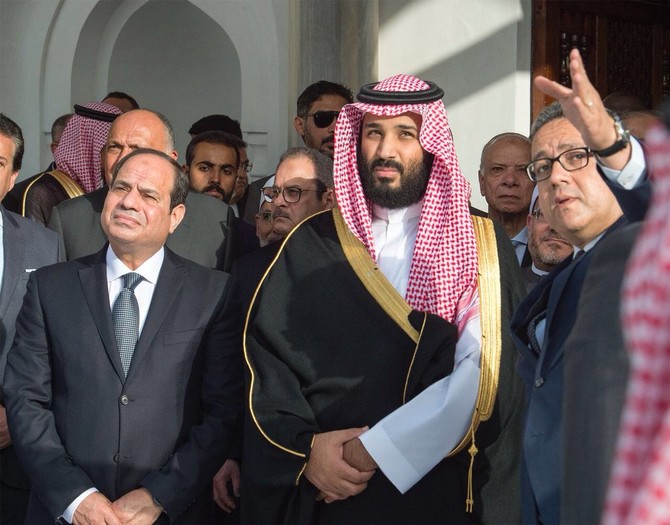
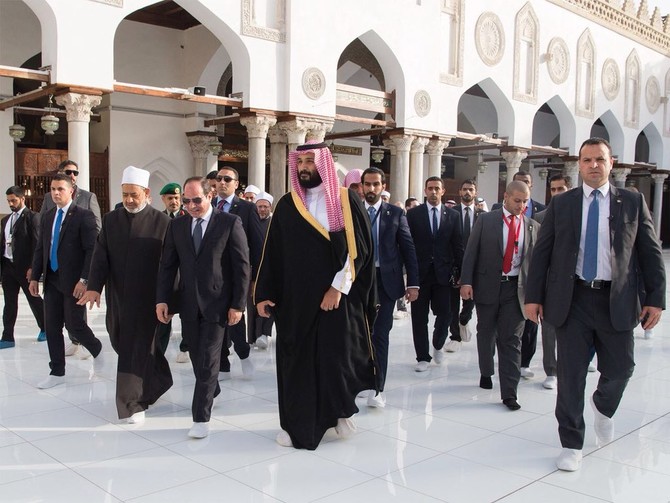
Saudi Crown Prince Mohammed bin Salman and Egypt’s president Abdel Fattah El-Sisi inspect the Al-Azhar Mosque after the first phase of restoration, funded by Saudi Arabia. (SPA)
2 / 8
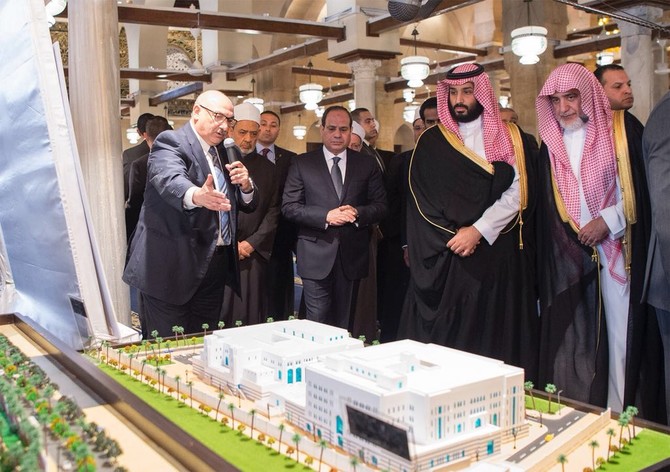
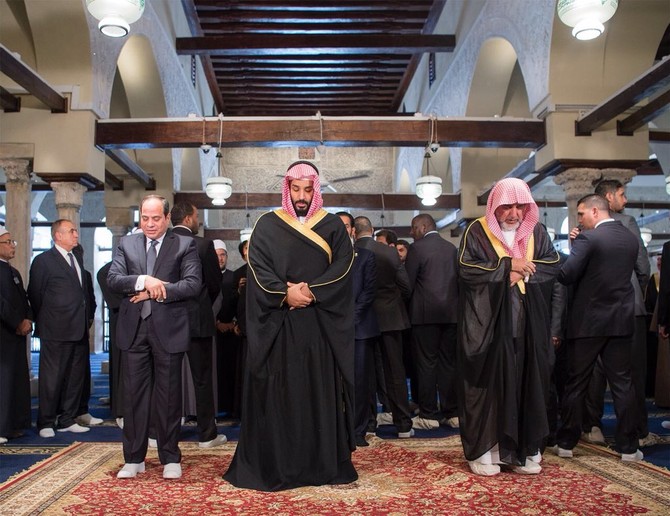
Saudi Crown Prince Mohammed bin Salman and Egypt’s president Abdel Fattah El-Sisi inspect the Al-Azhar Mosque after the first phase of restoration, funded by Saudi Arabia. (SPA)
3 / 8
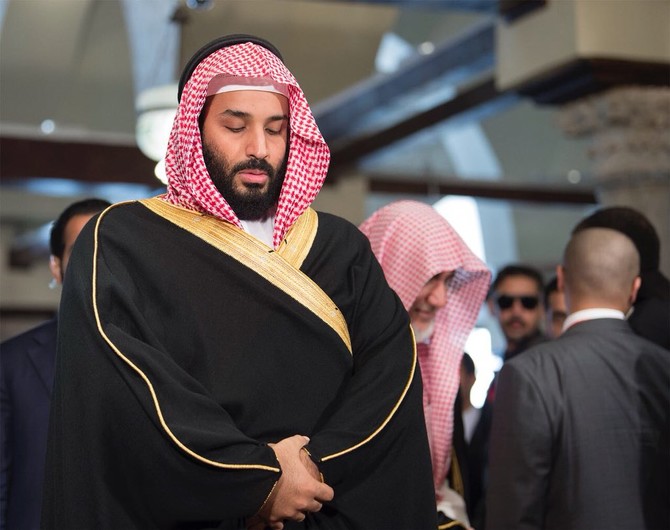
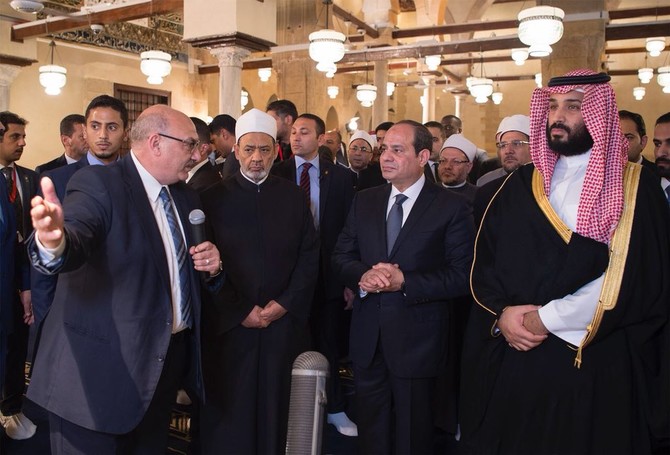
Saudi Crown Prince Mohammed bin Salman and Egypt’s president Abdel Fattah El-Sisi inspect the Al-Azhar Mosque after the first phase of restoration, funded by Saudi Arabia. (SPA)
4 / 8
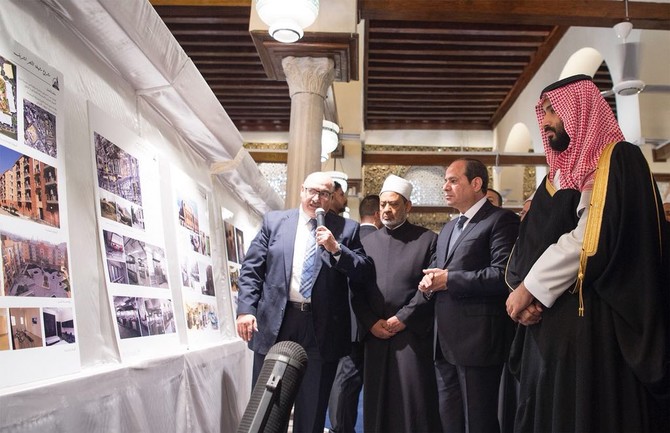
Saudi Crown Prince Mohammed bin Salman and Egypt’s president Abdel Fattah El-Sisi inspect the Al-Azhar Mosque after the first phase of restoration, funded by Saudi Arabia. (SPA)
5 / 8
Saudi Crown Prince Mohammed bin Salman and Egypt’s president Abdel Fattah El-Sisi inspect the Al-Azhar Mosque after the first phase of restoration, funded by Saudi Arabia. (SPA)
6 / 8
Saudi Crown Prince Mohammed bin Salman and Egypt’s president Abdel Fattah El-Sisi inspect the Al-Azhar Mosque after the first phase of restoration, funded by Saudi Arabia. (SPA)
7 / 8
Saudi Crown Prince Mohammed bin Salman and Egypt’s president Abdel Fattah El-Sisi inspect the Al-Azhar Mosque after the first phase of restoration, funded by Saudi Arabia. (SPA)
8 / 8
Saudi Crown Prince Mohammed bin Salman and Egypt’s president Abdel Fattah El-Sisi inspect the Al-Azhar Mosque after the first phase of restoration, funded by Saudi Arabia. (SPA)
Updated 08 March 2018
Follow

Saudi crown prince winds down trip to Egypt with mosque visit

CAIRO: Saudi Arabia’s crown prince wound up his three-day visit to Egypt on Tuesday with a symbolically significant visit to Al-Azhar.
Accompanied by Egyptian President Abdel-Fattah el-Sisi, Crown Prince Mohammed bin Salman was given a tour of the mosque at the heart of old Cairo to see the outcome of three years of restoration work financed by a Saudi grant. Also at hand was Al-Azhar’s Grand Imam, Sheikh Ahmed Al-Tayeb.
The mosque, built in the 10th century, is now part of a sprawling university teaching Islam as well as secular subjects and a nationwide network of schools. It is perceived to be a bastion of moderation whose teaching counters radicalism and violence.
Al-Tayeb thanked Prince Mohammed profusely for the kingdom’s help.
“This is our duty and every Saudi hopes that he can contribute, even in a simple way, to the renovation and improvement of Al-Azhar,” the Saudi heir apparent said in reply to Al-Tayeb.
The prince was given a warm welcome in Egypt, whose government views Saudi aid and investment as key to reviving the country’s battered economy. Posters featuring the prince alongside el-Sisi lined major roads in central Cairo. Pro-government television networks broadcast promotional videos about Saudi Arabia and the prince’s efforts to modernize the kingdom.
In what is perhaps a first for a Saudi heir apparent, Prince Mohammed and El-Sisi watched a play on Monday night at Cairo’s Opera House. In another first, he visited the spiritual leader of Egypt’s Coptic Orthodox church, Pope Tawadros II, at the Cathedral of St. Mark in central Cairo.
He and el-Sisi traveled through one of several tunnels being built under the Suez Canal linking mainland Egypt with the Sinai peninsula. They later boarded a boat from a red-carpeted dock as an army band played marching music. The two countries have plans to build a causeway across the Red Sea’s Gulf of Aqaba and to develop areas on both sides, including a multi-billion dollar city stretching across Saudi Arabia, Egypt and Jordan.
The prince left later Tuesday for London where he would be visiting before he travels on to Washington.


Experimental farm in Al-Lith looks into future of Saudi Arabian agriculture

Updated 02 February 2026
Follow

Experimental farm in Al-Lith looks into future of Saudi Arabian agriculture

  • Research initiative reflects strategic transformation

JEDDAH: An experimental farm in Saudi Arabia’s Al-Lith Governorate is one of the research initiatives reflecting the strategic transformation taking place in the Kingdom’s agricultural sector.

The farm uses highly efficient, sustainable production models that combine scientific research with commercial application, contributing to strengthening the country’s food security system and the sustainability of water resources.

Located in the Ghumaiqa Center on an area of about 10 hectares, the cutting-edge farm is a testing platform for modern agricultural technologies that tackle the challenge of water scarcity.

The farm includes developed open fields and modern greenhouses, supported by smart irrigation encompassing drip and sprinkler irrigation alongside surface and subsurface technologies.

All the systems operate via smart controls that enable the monitoring of water consumption and ensure improved efficiency, thereby achieving a balance between agricultural production and water conservation.

The farm also uses treated and diluted low-salinity seawater.

It aims to diversify agricultural water sources, reduce reliance on freshwater, and open new horizons for agriculture in coastal and semi-arid environments.

A view of the experimental farm in Al-Lith. (SPA)

The project represents a promising investment opportunity in the field of smart agriculture, enabling the development of commercially scalable production models, particularly for high-value vegetables and fruits, while reducing operational costs associated with water and energy, enhancing the economic feasibility of future agricultural projects.

In addition, the project contributes to transferring and localizing agricultural expertise, supporting local food supply chains, and creating an attractive environment for agricultural investment.

This aligns with Sustainable Development Goals and enhances the efficiency of the private sector in adopting innovative agricultural solutions.

Yahya bin Abdulrahman Al-Mahabi, the director of the Ministry of Environment, Water and Agriculture office in Al-Lith Governorate, told the Saudi Press Agency that the project represented the future of agriculture in the Kingdom.

He explained that the vision was based on investing in technology, enhancing the return on water per unit, and integrating scientific research with investment opportunities.

Al-Mahabi spoke of the experimental farm as a modern, scalable and replicable model applicable in several regions of the Kingdom, particularly in coastal environments.

Al-Mahabi highlighted the Ministry of Environment, Water and Agriculture’s commitment to supporting distinctive projects that contributed to achieving food security while developing rural areas and enhancing agricultural production efficiency, in line with the objectives of the Kingdom’s Vision 2030.