ROME: Rival populist leaders fought Monday for the right to govern Italy after their surge in a general election left the country in political limbo.
The anti-immigrant League party and the anti-establishment Five Star Movement (M5S) each claimed Sunday’s vote gave them a mandate to lead the nation of 60 million.
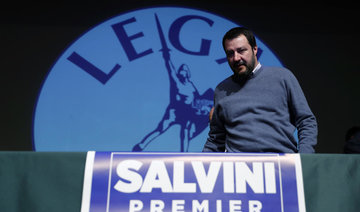
League leader Matteo Salvini said that he had “the right and the duty” to form a government after its surprise success at the heart of a right-wing coalition.
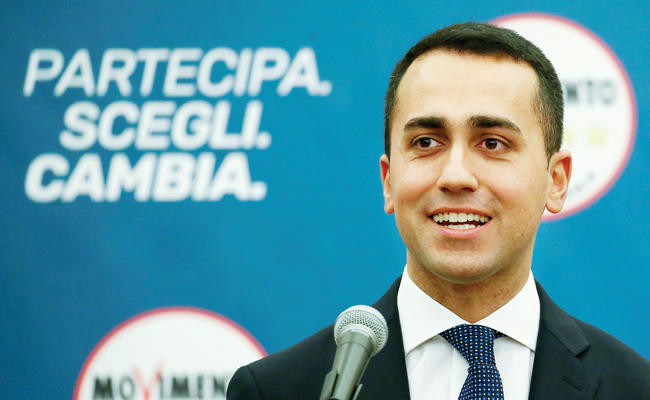
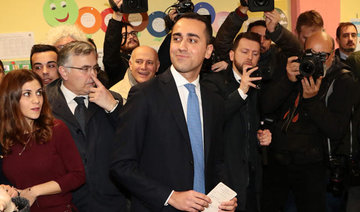
But M5S, which won the biggest share of the vote of any single party, claimed it was the winner. Its leader Luigi Di Maio said it had a “responsibility” to form a government.
With most ballots counted, the League was leading the dominant right-wing coalition, which won roughly 37 percent of the vote overall.
The League by itself was closing in on 18 percent, ahead of former Prime Minister Silvio Berlusconi’s Forza Italia (Go Italy) party, which collapsed to 14 percent.
Salvini’s party surged in the polls after promising to shut down Roma camps, deport hundreds of thousands of migrants and tackle what it called “danger” of Islam.
“Italians have chosen to take back control of the country from the insecurity and precariousness put in place by (center-left Democratic Party leader Matteo) Renzi,” Salvini told a press conference.
However much depends on M5S, which has drawn support from Italians fed up with traditional parties and a lack of economic opportunity.
It won 32 percent of the vote.
The M5S had previously refused to align itself with other parties, which it considered part of a “corrupt” system.
But Di Maio said his party now “feels the responsibility to form a government.”
To that end, he said he was “open to discussion with all political actors.”
“This election was a triumph for the Five Star Movement. We are the winners,” a joyous Di Maio told a news conference conference on Monday.
“More than half of voters in some regions have voted for the Movement,” he added.
According to polling company YouTrend, the M5S was set to gain 231 seats in the lower house Chamber of Deputies and 115 in the upper house Senate.
It could therefore form a majority with either one of the League, Forza Italia and the Democratic Party (PD).
Given its heated rivalry with the PD and Berlusconi, M5S’s most likely ally looked to be the euroskeptic League.
However Salvini swiftly ruled out the prospect of forming a coalition with the M5S.
“N. O. No, underlined three times,” Salvini told reporters.
Di Maio responded to Salvini by saying that “we represent the whole nation, from Val D’aosta to Sicily. The others can’t say that.”
The boost for far-right and populist parties has prompted comparisons to Britain’s vote to leave the European Union and the rise of US President Donald Trump.
Prominent British pro-Brexit figure Nigel Farage congratulated the Five Star Movement, his allies in the European Parliament, “for topping the poll” as by far Italy’s biggest single party.
Resentment at the hundreds of thousands of migrant arrivals in Italy in recent years fired up the campaign, along with frustration about social inequalities.
“These are historic results,” Giancarlo Giorgetti, deputy head of the League, told reporters in Milan.
Alessandro Di Battista, another senior Five Star leader, said: “Everyone is going to have to come and speak to us.”
PD leader Renzi looks doomed after his party dropped to 19 percent of the vote.
“The populists have won and the Democratic Party has lost,” PD lawmaker Andrea Marcucci admitted.
Berlusconi, a flamboyant three-time former prime minister, is on the ropes after his electoral flop.
The billionaire, who won his first election in 1994, has returned to the limelight at the age of 81 despite a career overshadowed by sex scandals and legal woes.
But he has turned out to be the big loser alongside Renzi.

Populists battle over right to govern Italy
Power outages hit Ukraine and Moldova as Kyiv struggles against the winter cold
- Outages had been caused by a technical malfunction affecting power lines linking Ukraine and Moldova
- Blackouts were reported in Kyiv, as well as Zhytomyr and Kharkiv regions
KYIV: Emergency power cuts swept across several Ukrainian cities as well as neighboring Moldova on Saturday, officials said, amid a commitment from the Kremlin to US President Donald Trump to pause strikes on Kyiv as Ukraine battles one of its bleakest winters in years.
Ukraine’s Energy Minister Denys Shmyhal said that the outages had been caused by a technical malfunction affecting power lines linking Ukraine and Moldova.
The failure “caused a cascading outage in Ukraine’s power grid,” triggering automatic protection systems, he said.
Blackouts were reported in Kyiv, as well as Zhytomyr and Kharkiv regions, in the center and northeast of the country respectively. The outage cut water supplies to the Ukrainian capital, officials said, while the city’s subway system was temporarily suspended because of low voltage on the network.
Moldova also experienced major power outages, including in the capital Chisinau, officials said.
“Due to the loss of power lines on the territory of Ukraine, the automatic protection system was triggered, which disconnected the electricity supply,” Moldova’s Energy Minister Dorin Junghietu said in a post on Facebook. “I encourage the population to stay calm until electricity is restored.”
Weaponizing winter
The large-scale outage followed weeks of Russian strikes against Ukraine’s already struggling energy grid, which have triggered long stretches of severe power shortages.
Moscow has sought to deny Ukrainian civilians heat, light and running water over the course of the war, in a strategy that Ukrainian officials describe as “weaponizing winter.”
While Russia has used similar tactics throughout the course of its almost four-year invasion of Ukraine, temperatures throughout this winter have fallen further than usual, bringing widespread hardship to civilians.
Forecasters say Ukraine will experience a brutally cold period stretching into next week. Temperatures in some areas will drop to minus 30 degrees Celsius (minus 22 Fahrenheit), Ukraine’s State Emergency Service said.
Trump said late Thursday that President Vladimir Putin had agreed to a temporary pause in targeting Kyiv and other Ukrainian towns amid the extreme weather.
“I personally asked President Putin not to fire on Kyiv and the cities and towns for a week during this ... extraordinary cold,” Trump said during a Cabinet meeting at the White House. Putin has “agreed to that,” he said, without elaborating on when the request to the Russian leader was made.
The White House didn’t immediately respond to a query seeking clarity about the scope and timing of any limited pause.
Kremlin spokesperson Dmitry Peskov confirmed Friday that Trump “made a personal request” to Putin to stop targeting Kyiv until Sunday “in order to create favorable conditions for negotiations.”
Talks are expected to take place between US, Russian and Ukrainian officials on Feb. 1 in Abu Dhabi. The teams previously met in late January in the first known time that officials from the Trump administration simultaneously met with negotiators from both Ukraine and Russia. However, it’s unclear many obstacles to peace remain. Disagreement over what happens to occupied Ukrainian territory, and Moscow’s demand for possession of territory it hasn’t captured, are a key issue holding up a peace deal, Zelensky said Thursday.
Russian presidential envoy Kirill Dmitriev said on social media Saturday that he was in Miami, where talks between Russian and US negotiators have previously taken place.
Russia struck Ukrainian energy assets in several regions on Thursday but there were no strikes on those facilities overnight, Ukraine’s President Volodymyr Zelensky said Friday.
In a post on social media, Zelensky also noted that Russia has turned its attention to targeting Ukrainian logistics networks, and that Russian drones and missiles hit residential areas of Ukraine overnight, as they have most nights during the war.
Trump has framed Putin’s acceptance of the pause in strikes as a concession. But Zelensky was skeptical as Russia’s invasion approaches its fourth anniversary on Feb. 24 with no sign that Moscow is willing to reach a peace settlement despite a US-led push to end the fighting.
“I do not believe that Russia wants to end the war. There is a great deal of evidence to the contrary,” Zelensky said Thursday.