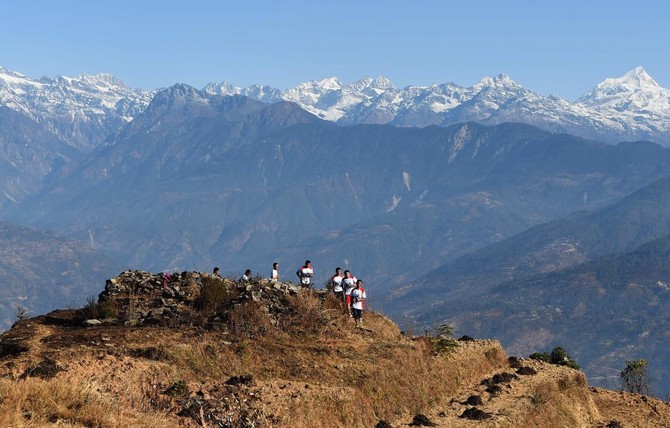
SINDHUKOT, Nepal: Swapping their maroon robes for running shoes, seven Buddhist monks take off at a sprint across the hills surrounding their remote village in the foothills of Nepal’s Himalayas.
They are aspiring ultra-marathon runners, hoping the sport will put their remote village on the map and provide the funds needed to rebuild homes destroyed by a massive earthquake nearly three years ago.
“We found out that we can get many opportunities through running and hope to do something from our monk team — make a name for our village and bring development here. That is why we are running,” says Man Bahadur Lama, 21, the fastest of the group.
The monks — most of them in their early twenties — follow a strict regime, praying in the morning before disappearing into the hills to run up to 40 kilometers (25 miles) each afternoon.
Life is tough in Sindhukot village, which lies just 80 kilometers from Katmandu but like many rural communities in impoverished Nepal feels totally cut off from the rest of the world. The nearest school is a two-hour walk and the only shops are in a neighboring village.
Many Buddhist families in Nepal send at least one son to join the local monastery, where they are usually fed, clothed and educated — relieving their parents of the financial burden.
Lama was sent away when he was just eight, but is currently living back at home as the village monastery was destroyed in the 2015 earthquake.
Fellow monk Mingma Lama is matter-of-fact about his new pursuit, which he says his monastic duties in the community have prepared him for.
“Every day we go up and down the hills. We often have to walk far... So running wasn’t too hard for us,” he said.
These Himalayan monks are not the first to take up running. The so-called ‘marathon monks’ of Mount Hiei in Japan are known for their superhuman feat of running 1,000 marathons in 1,000 days — but they are seeking enlightenment not prize money.
Mingma Gyalbo, a member of the monastery who also organizes races nearby, said the monks are talented but need more support to excel.
“They don’t have the technical know-how, like for their diet, or even proper shoes for running,” Gyalbo said.
Trail running and ultra marathons are gaining popularity in Nepal, where the Himalayan terrain lends itself to extreme tests of human endurance.
Nepal now hosts a handful of races each year, including the world’s highest marathon that starts at Mount Everest base camp at a breathless altitude of 5,364 meters (17,598 feet).
A few Nepali runners have made their mark internationally, like former child soldier Mira Rai who recently won the gruelling 52 kilometer Ben Nevis Ultra in Scotland and was named National Geographic Adventurer of the Year in 2017.
The Sindhukot monks’ first race was two years ago, a 30 kilometer trail run in a neighboring village. But they are yet to win any medals.
The fastest monk, Man Bahadur, came tenth in their first major marathon earlier this month, missing out on the top prize of 100,000 rupees ($964) — more than the average annual income in Nepal.
He said running in flat and hot Lumbini, Buddha’s birthplace in southern Nepal, was very different to their hilly home terrain.
“I was quite amazed when I first learned that these monks were running,” said race organizer Shekhar Pandey.
“They are very self-motivated and hardworking, they are training by themselves. They are very young and if they train well they have good potential.”
Chuldim Sampo, 24, said the monks were excited.
He explained: “We want to show people that even monks are capable of running.”


Nepal’s marathon monks trade robes for running shoes

Nepal’s marathon monks trade robes for running shoes

Essex man takes on charity endurance challenge for children in Gaza
- Mark Watson, 63, is undertaking a “virtual Sumud” journey from his Essex home town in Harlow to Gaza, covering 2,287 miles
LONDON: A man in England has launched a demanding charity challenge to raise funds for children affected by the war in Gaza.
Mark Watson, 63, is undertaking a “virtual sumud” journey from his Essex home town in Harlow to Gaza, covering 3,680 km running, walking, swimming, cycling and rowing.
He is raising money for Medical Aid for Palestinians, a UK-based humanitarian organization that provides healthcare to Palestinians in Gaza and the occupied territories.
“I have felt helpless day after day seeing images of countless children in Gaza with broken bodies and missing limbs and witnessing their unbearable suffering,” Watson said on his JustGiving page.
“I have been inspired by the courage of those who took part in the global sumud flotilla and all of the activists who have put their lives and freedom at risk supporting the Palestinian people and so I am raising funds for Medical Aid for Palestinians.
“My challenge is to complete a virtual sumud from Harlow, where I live, to Gaza. Running, walking, swimming, cycling and rowing I will cover the 2,287 miles as quickly as I can.
“I am an unfit, overweight 63-year-old, so I’m not going to break any records, but the Arabic word Sumud means steadfastness and perseverance, and I will give it my all.
Watson added: “I hope to be joined by people I love and admire along the way, so please support my fundraiser. Every donation, however small, will help save the lives of Palestinians.”
As of Jan. 3, his fundraising effort had reached 12 per cent of its £5,000 ($6,733) target.
The war in Gaza began after the Oct. 7, 2023, attack by Hamas on southern Israel, in which about 1,200 people were killed and more than 200 taken hostage, according to Israeli authorities.
Israel responded with a large-scale military campaign in Gaza, which local health authorities say has resulted in the deaths of more than 71,000 Palestinians, widespread destruction of civilian infrastructure and a severe humanitarian crisis.
International aid agencies have repeatedly said that children are among the most affected, facing injury, displacement, malnutrition and limited access to medical care.
Watson said he was inspired by activists and humanitarian efforts supporting Palestinians and hopes his challenge can make a small contribution to saving lives.


