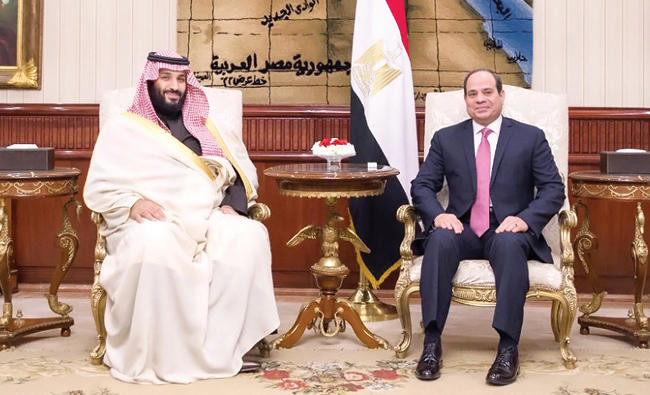
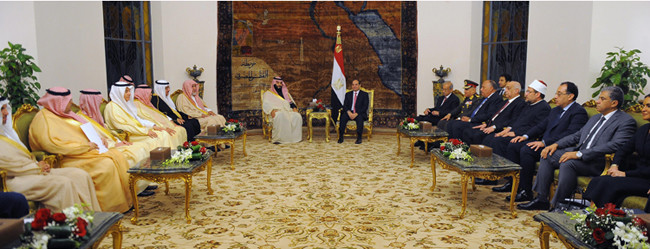
CAIRO: The visit by Crown Prince Mohammed bin Salman to Egypt comes as Saudi investment in the country continues to grow, boosted by easing trade restrictions, a weak Egyptian pound and plans for a bridge linking the two countries.
The Egyptian government is pushing to make foreign investment in the country easier to help the economy recover from the tumultuous period that followed the Arab Spring.
Saudi Minister of State Essam bin Saad bin Saeed said last week that the Kingdom is keen to enhance economic relations with Egypt and intends to pump money into new investments in the country.
According to the Egyptian state news agency MENA, Saudi investments in Egypt top those of other Arab countries.
At the Saudi-Egyptian Business Council last month in Cairo, Egyptian Minister of Trade and Industry Tariq Qabeel said the volume of trade exchange between the two countries in 2017 amounted to about $2.1 billion and that the volume of Saudi investments in Egypt exceeded $6 billion — about 11 percent of all foreign investments in Egypt.
President of the General Federation of Egyptian Chambers of Commerce Ahmed Al-Wakil, said the total Saudi investments in Egypt are worth up to $27 billion, which are spread across 2,900 projects in a huge variety of product and service sectors.
The Kingdom is also the second largest in terms of tourism — accounting for millions of dollars a year, according to Egyptian Ministry of Tourism figures.
The UAE and Kuwait have also been big investors in Egypt since Abdel Fattah El-Sisi became president.
The scale of Saudi Arabia’s investment is expected to increase after officials from Egypt and the Kingdom said they wanted to reduce the number of obstacles between the two countries by standardizing rules and making it easier to transport goods and services between the two.
Egypt has also become a more attractive prospect for investors since the central bank liberalized the exchange rate in November 2016 as part of a $12 billion International Monetary Fund reform program. The pound lost half of its value after the float.
The improved investment environment in Egypt means some major Saudi companies are considering establishing more projects in the Egyptian market.
A number of Saudi businessmen view some of the new cities being built in Egypt as strong investment opportunities.
The most important Saudi investments in Egypt are in the service sector, including energy, transport, logistics, health and education.
The Egyptian-Saudi Electricity Exchange Project, a scheme agreed in 2011 to connect the two countries’ power grids, is probably the most important investment to date.
Minister of Electricity and Renewable Energy, Dr. Mohammad Shaker, said in December that work is ongoing on the project but that the electrical connection lines between the two countries are expected to run in early 2021.
The King Salman Bridge project, which Egyptian sources said would be discussed during Prince Mohammed’s visit, will link Sharm El-Sheikh to the Tabuk region of northern Saudi Arabia.
Construction of the 50-kilometer bridge was announced during King Salman’s visit to Egypt in 2016. The bridge will help pilgrims, tourists and expatriate workers to travel easily between the countries and offer a significant improvement in trade between the two countries.
The bridge is also expected to boost energy links. Dr. Jamal Al-Kalioubi, a professor of petroleum and energy engineering, said the bridge would be one of the important ways to secure the oil and gas needs of neighboring Arab countries.
The visit is also expected to boost energy cooperation. The Egyptian government announced on Thursday that it had agreed with Saudi Aramco to supply 500,000 barrels per month of crude oil to the Egyptian refineries for six months from January to June. The Saudi National Oil Company had already provided oil to the Egyptian refineries in November and December 2017 on a trial basis.
During King Salman’s 2016 visit to Egypt, Riyadh agreed to supply Cairo with 700,000 tons of refined oil products per month for five years.
King Salman witnessed the signing of 21 agreements and investment memorandums of understanding between the two countries, most notably for the establishment of a free trade area in northern Sinai, which is the first important economic project linked to the construction of the bridge.


![]()
![]()
Saudi Arabia’s economic investments in Egypt run deep
Saudi Arabia’s economic investments in Egypt run deep


Latest updates


© 2026 SAUDI RESEARCH & PUBLISHING COMPANY, All Rights Reserved And subject to Terms of Use Agreement.