

New era of economic ties between Egypt and Saudi Arabia

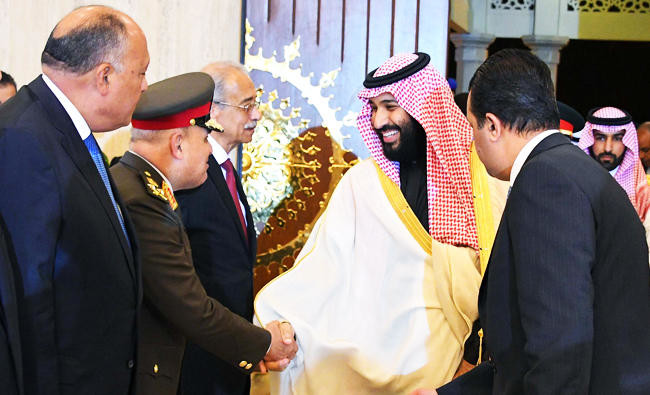
A handout photo released by the Egyptian Presidency on March 4, 2018 shows Saudi Arabia's Crown Prince Mohammed bin Salman (C) shaking hands with Egyptian officials upon his arrival in Cairo. (AFP)
Updated 05 March 2018
Follow

New era of economic ties between Egypt and Saudi Arabia

Recent investments and potential investments between Saudi Arabia and Egypt.

Oil
Egyptian Minister of Petroleum and Mineral Resources Tarek El Molla said Saudi Aramco agreed to supply Egyptian refineries with 500,000 barrels of crude oil per month for six months starting in January 2018.

Electricity
The electricity interconnection project between Egypt and Saudi Arabia aims to connect the power grids of the two countries to exchange a total capacity of 3,000 MW.
Egypt is contributing $600 million to the $1.6 million project, while other funders include the Kuwait Fund for Arab Economic Development, the Arab Fund for Economic and Social Development and the Islamic Development Bank.

Bridge between Egypt and Saudi
The Saudi-Egypt causeway or bridge will link the countries between Sinai and northern Saudi Arabia. The entire project is expected to cost about $3 billion and to pass through Tiran Island at the entrance of the Gulf of Aqaba.
The construction of the King Salman Bridge has been described as the largest project in the world by Egyptian Transport Minister Hashim Arafat.

Potential investments
The Egyptian-Saudi Investment Fund, with a capital of SR60 billion ($16 billion), aims to construct a power plant in Dairout worth $2.2 billion, a water treatment plant, residential projects in Sinai, 90 kilometers of development of coastal road, Taba’s tunnel project and a canal.


Saudi Post issues commemorative stamp to mark Al-Faw’s UNESCO recognition

Updated 8 sec ago
Follow

Saudi Post issues commemorative stamp to mark Al-Faw’s UNESCO recognition

RIYADH: Saudi Post has issued a SR3 ($0.79) commemorative stamp to celebrate the registration of Al-Faw Archaeological Area on the list of UNESCO World Heritage Sites, making it the eighth Saudi site on this prestigious list.

Located south of Riyadh at the junction of a vast plain and the Tuwaiq mountain range, Al-Faw is strategically positioned along ancient trade routes connecting the southern Arabian Peninsula to its center and east.

The area in Wadi Ad-Dawasir, at the intersection of the Empty Quarter desert and the Tuwaiq mountain range, is home to almost 12,000 archaeological remains and has a history of human habitation stretching back more than 6,000 years.

The site features a landscape shaped over millennia by human interaction with the environment and which was abandoned in the 5th century AD owing to depleted water sources.

The commemorative stamps issued honor significant national and international events, highlighting key chapters of Saudi history making them collectible for philatelists, researchers, and heritage enthusiasts, the Saudi Press Agency reported.

UNESCO, while recognizing the site last year, has said the site was a strategic point on the ancient trade routes of the Arabian Peninsula, but was abruptly abandoned around the fifth century.

Archaeological remains uncovered at the site range from prehistoric times to the late pre-Islamic era, testifying to successive occupations by three different populations.

Features include paleolithic and neolithic tools, tapered structures, cairns and circular constructions, the sacred mountain of Khashm Qaryah, rock carvings, funeral cairns, an ancient water management system, and remains of the city of Qaryat Al-Faw.

Other Saudi sites on the UNESCO Heritage List are Al-Hijr (2008), At-Turaif in Diriyah (2010), Historic Jeddah (2014), rock art in the Hail Region (2015), Al-Ahsa Oasis (2018), Hima Cultural Area (2021), and Uruq Bani Maarid protected area (2023).