ROME: Italians waited in long queues at polling booths on Sunday to vote in an election that could bring political gridlock after a campaign marked by anger over the listless economy, high unemployment and immigration.
Pollsters have predicted that former prime minister Silvio Berlusconi’s center-right party and his far-right allies will emerge as the largest bloc in parliament but fall short of a majority.
The anti-establishment 5-Star Movement looks set to be the biggest single party, feeding off discontent over entrenched corruption and growing poverty, while the ruling center-left bloc led by the Democratic Party (PD) is seen in third place.
“I think 5-Star will win ... but I’m also worried that there won’t be a winner. Both scenarios look catastrophic to me,” said Giuseppe Ottaviani, who voted in Amelia, central Italy.
Berlusconi and 5-Star leader Luigi Di Maio both had to wait in queues to cast their votes as new election procedures slowed the process at several polling stations.
At Berlusconi’s voting station in Milan, a Femen activist bared her chest in front of the former premier and shouted, “time’s up” before being hauled away.
“She passed so quickly I didn’t get a chance to see her,” said Berlusconi, who has a history of being caught up in sex scandals.
TURNOUT
Berlusconi also said he was concerned about the queues.
“There will be queues as well this evening. I am worried that there might be some situations in which some people will not be able to vote,” he said.
In Rome, many stood in line for more than an hour before voting. City hall invited the capital’s residents to show up well before polls close at 11 p.m. (2200 GMT) so they can be sure of voting.
At 7 p.m. preliminary figures showed voter turnout above 58 percent. That was higher than five years ago, when Italians voted over two days, and slightly higher than a 2016 referendum in which the final turnout exceeded 68 percent. In 2013, final turnout was above 75 percent.
During the morning, turnout was higher in the south compared with the 2016 referendum, which is a good sign for 5-Star, while a fall in the PD’s central Italian strongholds was a bad omen for the party, said pollster and data analysis group YouTrend.
Heavily indebted Italy is the third-largest economy in the 19-member euro zone and, though investors have been sanguine ahead of the ballot, prolonged political stalemate could reawaken the threat of market instability.
Exit polls are due out immediately after voting ends. The election is being held under a complex new electoral law that could mean the final result will not be clear until late on Monday.
Confusion over the new system led to 200,000 ballot papers having to be reprinted overnight in Palermo, where some polling stations delayed opening amid protests from voters. There were also reports of misprinted ballots at one polling booth in Rome.
The campaign has marked the return to frontline politics of 81-year-old Berlusconi, who was forced to quit as prime minister in 2011 at the height of a sovereign debt crisis and was widely written off after sex scandals, legal woes and ill health.
A 2013 conviction for tax fraud means he cannot hold public office and he has put forward Antonio Tajani, president of the European Parliament, as his candidate for prime minister.
POPULIST POWER
Tajani’s moderate profile is aimed at allaying fears in Europe about Berlusconi’s populist allies, notably the League, whose leader Matteo Salvini has promised to deport hundreds of thousands of migrants who have landed in Italy over the past four years.
Some pollsters say the League could overtake Berlusconi’s Forza Italia party on Sunday.
Populist parties have been on the rise across Europe since the 2008 financial crisis, and Italy’s mainstream parties have found it especially hard to contain voter anger, with the economy still 6 percent smaller than a decade ago and unemployment stuck at about 11 percent.
The 5-Star Movement, led by 31-year-old Di Maio, has been particularly successful at tapping into the disaffection in the underdeveloped south and has promised a monthly universal wage of up to 780 euros ($960) for the poor.
Although all party leaders have ruled out any post-election alliances with rivals, Italy has a long history of finding a way out of apparently intractable political stalemate.
But if, as expected, no one clinches clear victory on Sunday, it might take weeks before a government deal is reached.


![]()
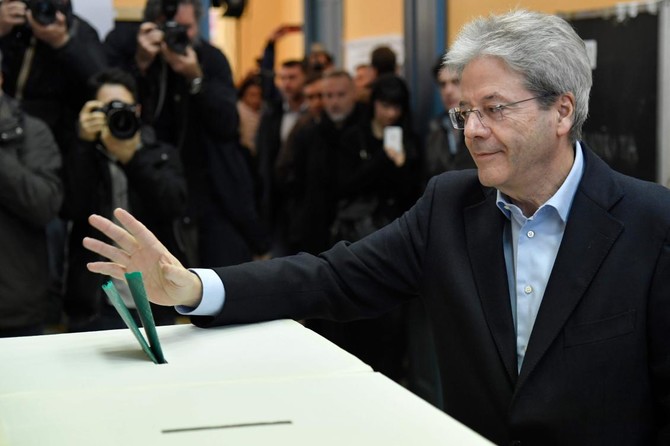
Italians queue to vote in election seen ending in political gridlock
Italians queue to vote in election seen ending in political gridlock

Latest updates




© 2026 SAUDI RESEARCH & PUBLISHING COMPANY, All Rights Reserved And subject to Terms of Use Agreement.