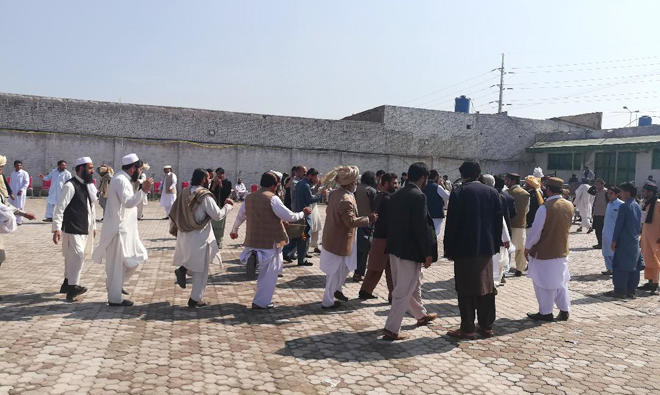
PESHAWAR: Pakistan has announced it will reopen a border crossing point in North Waziristan tribal agency on March 7 to promote trade with neighboring Afghanistan.
The Ghulam Khan check post on the Pak-Afghan border was closed in 2014 when the Pakistan Army launched a military operation against Taliban militants in the area.
Talking to Arab News, Mir Ali’s Assistant Political Officer, Taimur Afridi, said the border would be opened for imports on Fridays and Saturdays while local traders would be allowed to export goods to Afghanistan from Monday to Thursday.
“The border will be opened permanently, not just for a few days,” he said. “The idea is to facilitate tribal people and promote trade and commerce in the region.”
Afridi added that the decision to reopen the border was taken after peace was restored in the area.
About 15 vehicles – all dedicated to trade activities and none of them passenger carriers – are expected to cross the border every day apart from Sundays, he said.
“The Afghan drivers would be allowed to reach the National Logistics Cell (NLC) terminal in North Waziristan but they would not go beyond that point. Similar restrictions will be imposed on Pakistani drivers by the other side, and they would not be allowed to go deep into Afghanistan,” he added.
Local tribal elders and traders have welcomed the decision, saying this will create a positive economic effect and generate employment opportunities in the region.
Malik Khan Marjan, Chairman of the Federally Administered Tribal Areas (FATA) Grand Alliance, a representative body of seven tribal agencies, told Arab News that the Ghulam Khan border crossing with Afghanistan was an international route and its opening could give a great impetus to business and trade activities across the tribal belt.
“Much of the tribal population lost their homes during the Talibanization of this area and the ensuing military operations. They are moving from pillar to post to get compensation to rebuild these residences. The reopening of the North Waziristan border crossing with Afghanistan is a dire need in this context,” said Marjan.
He said that the move will “address the sense of deprivation among the tribal population to a certain degree.”
Marjan maintained that not only the people of North Waziristan but also residents of South Waziristan, Kurram Agency and other areas of the tribal belt would also benefit from the route.
Director of the Pakistan-Afghanistan Joint Chamber of Commerce and Industry, Ziaul Haq Sarhadi, agreed that the reopening of the border crossing point would help improve trade.
Talking to Arab News, he said the government should take more steps to create a conducive business environment in North Waziristan since it had already largely restored peace and stability in the area.
Sarhadi claimed the Pakistan-Afghanistan trade had come down from Rs5 billion ($45.2 million) to a little more than Rs1billion during the past four years.
“Poor relations between the two countries and poor trade policies have been affecting our business. Afghan authorities have imposed unnecessary taxes on Pakistani drivers. Even our own authorities are taxing Afghanistan-bound goods. All this increases the cost of doing business and negatively impacts the Pak-Afghan trade,” he said.
Pakistan’s existing border crossing points with Afghanistan include Torkham border in Khyber Agency, Kharlachi border in Kurram Agency, and Chaman border in Quetta, Balochistan.
“Pakistan and Afghanistan must do everything to open more trade points to strengthen physical connectivity and enhance commerce activities in the region,” said Sarhadi.
Pakistan and Afghanistan share around 2,500 kilometers of porous border that is largely unmanned on both sides.

Pakistan reopens North Waziristan border with Afghanistan
Karachi survivor recounts ‘doomsday’ mall inferno as records show warnings ignored
- Fire engulfed Karachi’s multi-story Gul Plaza on Jan. 17, killing at least 73 people
- Survivors say escape was hampered by locked doors, poor ventilation, crowded corridors
REUTERS, KARACHI: Muhammad Imran did not take the fire seriously at first, thinking it was another small spark at the Karachi mall that would be quickly extinguished by fellow shop owners.
But smoke seeped through ducts and blackened the air in seconds. The lights went out soon after and phone flashlights turned useless, people could no longer see their own hands, he said.
Imran, who has diabetes and has undergone heart surgery, managed only a few steps before nearly giving up.
“It felt like doomsday,” he said. “I felt my lungs collapsing. I could not breathe.”
The blaze would rage for nearly two days and reduce Gul Plaza, a multi-story complex of 1,200 family-run shops selling children’s clothes, toys, crockery and household goods, to ash.
At least 67 people were killed, with 15 still missing and feared dead, police official Asad Ali Raza said, in the January 17 blaze, the Pakistani port city’s largest in over a decade.
Imran’s escape from the inferno, along with more than a dozen others who spoke to Reuters, was hampered by locked doors, poor ventilation, and crowded corridors. When they eventually got out, the survivors watched Gul Plaza crumble as rescue efforts faced delays and poor resources.
Police said the fire appeared to have started at an artificial flower shop and may have been caused by children playing with matches. They added that all but three of the 16 exits were locked, which was routine practice after 10 p.m.
Documents reviewed by Reuters showed Gul Plaza, located on a major artery in Karachi’s historic city center and built in the early 1980s, had violated building regulatory standards for over a decade, with authorities warning the situation was dire in the last review two years ago.
Gul Plaza’s management did not respond to repeated requests for comment.
Records from the provincial Sindh Building Control Authority showed court cases filed over Gul Plaza’s lack of safety compliance in 1992, 2015 and 2021, as well as records of unauthorized construction.
The files reviewed by Reuters do not detail the outcomes of those cases, including whether fines were imposed or whether violations were fully remedied. SBCA did not respond to queries on enforcement action taken.
A Nov. 27, 2023, survey by the fire department, covering more than 40 commercial buildings in the area, cited inadequate firefighting equipment, blocked escape routes, faulty alarms, poor emergency lighting and a lack of fire safety training for occupants and staff.
A follow-up audit by the fire department in January 2024 placed Gul Plaza among buildings that failed to meet regulations, with inspectors marking key safety categories, including access to firefighting equipment, alarm systems and electrical wiring conditions, as “unsatisfactory.”
Separately, documents describing inspections by Karachi’s Urban Search and Rescue teams in late 2023 and early 2024 that were reviewed by Reuters also showed Gul Plaza was among several markets and commercial buildings flagged for deficiencies in one or more fire safety categories.
“Young boys aged 12, 13, 14, they were coughing and fainted. I was trying to encourage them. Those young boys had almost given up,” Imran said.
Others smashed doors and locks as they moved through the darkness, holding hands and forming human chains to avoid getting lost.
With no way down, they ran to the roof, where 70 people, including families and children, were trapped for nearly an hour, survivors said. The smoke was even worse there, funneled upward by the building’s design, making it impossible to see even the neighboring buildings.
Then the wind changed.
A sudden gust pushed the smoke aside, revealing Rimpa Plaza next door. Young men crossed first, found a broken ladder and began ferrying people across one by one, Imran said.
An ambulance from the Edhi Foundation charity was waiting on the other side.
Many survivors said the response by the fire brigade was delayed and inadequate. Imran and other shop owners said they had escaped from the building and watched Gul Plaza turn into a molten inferno as the first firefighters arrived.
“Light was gone and the doors were closed. Where could people go? The fire brigade came late,” Imran said.
The first emergency call came at 10:26 p.m. from a teenager, with two fire vehicles reaching the site within 10 minutes and classifying the blaze as a Grade 3 fire, “the highest category for an urban area,” said a provincial government spokesperson Sukhdev Assardas Hemnani.
A citywide emergency was declared by 10:45 pm, triggering the mobilization of resources from across Karachi, he said.
“As soon as the first call was received, two fire vehicles had reached the site within 9 minutes. At 10:45 we announced in fire brigade group that two fire vehicles were not sufficient classifying this is a Category 3 fire, “the highest category for an urban area,” he said.
Shopkeepers said the first engine soon ran out of water and left to refill but Hemnani said those allegations were inaccurate.
Firefighters used “water, foam, chemicals and sand,” he said, adding the blaze was difficult to control because the building contained more than 50 gas cylinders and flammable material such as perfumes, generator fuel and car batteries.
Many of the shops were stocked to the brim because of the holy month of Ramadan in February-March, Pakistan’s biggest shopping season.
The first fire truck was not delayed, Hemnani said, but later arrivals were slowed by heavy traffic on a busy Saturday night and a crowd of over 3,000 people that had gathered outside the mall.
The fire department did not respond to requests for comment.
Survivors said many of the missing were shop employees and traders who tried to help others escape — or went back inside looking for family members.
“We thought it was a small fire and will extinguish soon. But this is not understandable that it spread all over within 5, 10 minutes. This is not understandable how it engulfed all shops within 5 minutes,” said shop owner, Mohammad Amin, speaking at the site.
Several shopkeepers said the losses have scarred the market’s tightly knit community.
“All of this keeps replaying in front of my eyes. Those children, those shopkeepers who died, May Allah forgive them and raise their place in heaven. I cannot sleep. I still feel the bitter taste of toxic smoke in my mouth,” said Imran.