Turkish troops push deeper into northern Syria

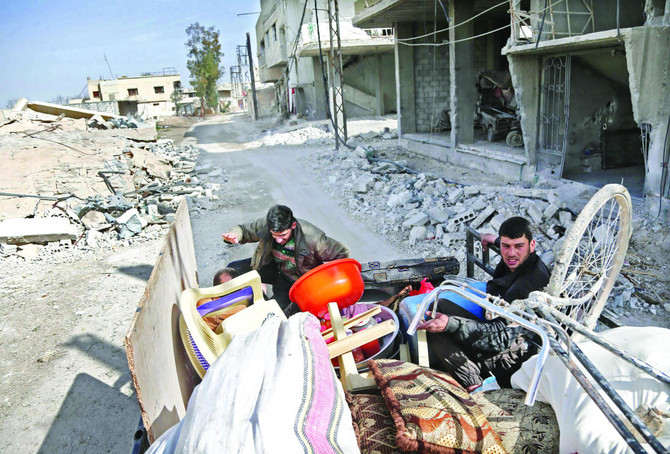
Eastern Ghouta’s 400,000 residents have lived under regime siege since 2013, facing severe food and medicine shortages even before the latest offensive. (AFP)
Updated 04 March 2018
Follow

Turkish troops push deeper into northern Syria

BEIRUT: Turkey’s Prime Minister Binali Yildirim said on Saturday Turkish troops have captured a strategic village in the Kurdish-held enclave in northwestern Syria, tightening its grip on Kurdish militia in the sixth week of its offensive on the area.
Yildirim said Turkish soldiers cleared Rajo in Afrin district of “terrorists” and have pushed them back from the border with Turkey.
The premier, speaking at a rally in the central province of Konya, said the Kurdish Afrin district has been “surrounded” by the military, special police and paramilitary forces, as well as allied Syrian opposition fighters.
“Afrin has been surrounded. We have cleared all areas near our borders of terror nests,” he said. He said Turkey would not cease its campaign against “terror.”
The Syrian Observatory for Human Rights, which monitors the Syria conflict, said fierce clashes were still ongoing in Rajo, in Afrin’s northwest.
If confirmed, Rajo would be the largest center in Afrin to be captured since the Turkish offensive began on Jan.20. Turkish borders run along Afrin’s western and northern borders. To the east lies a Syrian territory controlled by Turkey-backed Syrian opposition fighters. In the south, Syrian government forces control territory.
Turkish troops and allied Syrian fighters have been attacking Afrin from the north, west and east, and have formed a crescent around the district.
Turkey said it wants to oust the Syrian Kurdish People’s Protection Units, or YPG, from Afrin. It considers the group a terrorist organization, an extension of a Kurdish insurgency within its own borders. Turkey said 41 of its soldiers have been killed since the operation began.
The offensive has heightened tensions between Turkey and its NATO ally, the United States, which backs the YPG fighting against Daesh militants in eastern Syria. The US has no troop presence in Afrin, but has said it fears the Turkish offensive could distract from the fight against Daesh in the east.
Complicating matters further, fighters loyal to Syria’s government entered Afrin late last month to support the Syrian Kurdish militia, raising the spectre of a possible confrontation between Turkish and pro-government Syrian troops.
Meanwhile, near Damascus, the Syrian government continued to lay siege to the besieged enclave of Eastern Ghouta yesterday. The military news service run by the Iranian-backed militant group Hezbollah, named three other areas it said the Syrian Army had captured at the eastern and southeastern rim of the rebel enclave.
With no sign of decisive Western pressure to halt the assault, Eastern Ghouta appears on course to eventually fall to the much more heavily armed government side, which has recaptured many other areas using the same military tactics.


Ceasefire with Kurdish-led force extended for another 15 days, Syrian army says

Updated 25 January 2026
Follow

Ceasefire with Kurdish-led force extended for another 15 days, Syrian army says

  • The defense ministry said the extension was in support of an operation by US forces to transfer accused Daesh militants to Iraq
  • The Kurdish-led Syrian Democratic Forces confirmed the ceasefire extension

RAQQA, Syria: Hours after the expiration of a four-day truce between the Syrian government and Kurdish-led fighters Saturday, Syria’s defense ministry announced the ceasefire had been extended by another 15 days.
The defense ministry said in a statement that the extension was in support of an operation by US forces to transfer accused Daesh militants who had been held in prisons in northeastern Syria to detention centers in Iraq.
The Kurdish-led Syrian Democratic Forces confirmed the ceasefire extension.
“Our forces affirm their commitment to the agreement and their dedication to respecting it, which contributes to de-escalation, the protection of civilians, and the creation of the necessary conditions for stability,” the group said in a statement.
Over the past three weeks, there have been intense clashes between government forces and the SDF, in which the SDF lost large parts of the area they once controlled.
Earlier in the day, the Kurdish-led force called on the international community to prevent any escalation.
The end of the truce came as government forces have been sending reinforcements to Syria’s northeast.
Syria’s interim government signed an agreement last March with the SDF for it to hand over territory and to eventually merge its fighters with government forces. In early January, a new round of talks failed to make progress over the merger, leading to renewed fighting between the two sides.
A new version of the accord was signed last weekend, and a four-day ceasefire was declared Tuesday. Part of the new deal is that SDF members will have to merge into the army and police forces as individuals.
The SDF said in a statement Saturday that military buildups and logistical movements by government forces have been observed, “clearly indicating an intent to escalate and push the region toward a new confrontation.” The SDF said it will continue to abide by the truce.
On Saturday, state TV said authorities on Saturday released 126 boys under the age of 18 who were held at the Al-Aqtan prison near the northern city of Raqqa that was taken by government forces Friday. The teenagers were taken to the city of Raqqa where they were handed over to their families, the TV station said.
The prison is also home to some of the 9,000 members of the Daesh group who are held in northeastern Syria. Most of them remain held in jails run by the SDF. Government forces have so far taken control of two prisons while the rest are still run by the SDF.
Earlier this week, the US military said that some 7,000 Daesh detainees will be transferred to detention centers in neighboring Iraq.
On Wednesday, the US military said that 150 prisoners have been taken to Iraq.