More than 100 killed since Philippine police returned to Duterte’s drug war

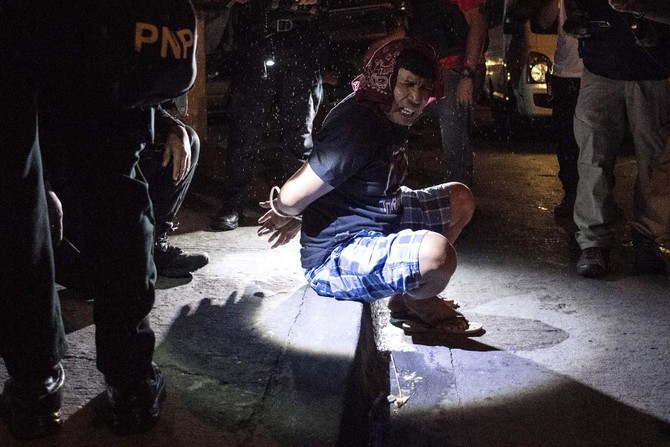
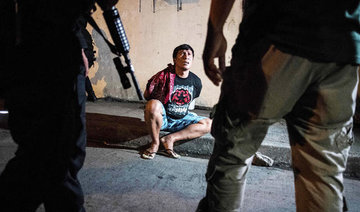
Philippine Drug Enforcement Agency (PDEA) agents and police arrest an alleged drug dealer during a drug raid in Maharlika Village, Taguig, south of Manila on February 28, 2018. (AFP)
Updated 03 March 2018
Follow

More than 100 killed since Philippine police returned to Duterte’s drug war

MANILA: More than 100 drug suspects have been killed since Philippine President Rodrigo Duterte ordered the police to rejoin his “war on drugs,” an official said Saturday.
Duterte was elected in 2016 on a promise to eradicate drugs, and launched an unprecedented campaign in which — rights activists allege — as many as 12,000 people have been killed.
Chief Superintendent John Bulalacao confirmed that 102 drug suspects were killed by police between December 5 — when Duterte ordered the force to rejoin the drug war — and March 1.
In October last year, the president had announced that the Philippine Drug Enforcement Agency would replace the police in counter-narcotics operations following mounting public opposition, including rare street protests.
But Duterte, 72, also repeatedly said the anti-drug agency, with only around 2,000 officers, would not be able to effectively conduct the crackdown.
He eventually ordered the police back into the anti-drug campaign without any major reform of the force.
Bulalacao could not give comparative figures for the death toll before December 5, but according to figures released separately by the government, 4,021 “drug personalities” were killed between June 2016 — when Duterte took office — and February 8 this year.
Activists allege that around 12,000 people have been killed in the drug war, many of them by shadowy vigilantes, and warn that the fiery president may be carrying out a crime against humanity.
In early February, the prosecutor at the International Criminal Court said she had opened a “preliminary examination” into the alleged abuses.
In recent weeks, the Philippine government has said it is willing to let a UN Special Rapporteur into the country to look into the accusations.
But the foreign secretary has called for fairness in the investigation, and Duterte has told police and the military to not cooperate with the rapporteur.
“If they ask you about wrongdoing, do not answer. And if they ask you why, tell them: we have a commander in chief,” Duterte told police and soldiers on Thursday.
Asked about this remark, Bulalacao said that if international investigators approach the police, “we shall refer this matter to the higher authorities.”


Uganda partially restores internet after president wins 7th term

Supporters of President Yoweri Museveni celebrate his winning the polls. (AFP)
Updated 9 sec ago
Follow

Uganda partially restores internet after president wins 7th term

  • “The internet shutdown implemented two days before the elections limited access to information, freedom ‌of association, curtailed economic activities ... it also created suspicion and mistrust on the ‍electoral process,” the team said in ‍their report

KAMPALA: Ugandan authorities have partially restored internet services late after 81-year-old President Yoweri Museveni won a seventh term to extend his rule into a fifth decade with a landslide ​victory rejected by 
the opposition.
Users reported being able to reconnect to the internet and some internet service providers sent out a message to customers saying the regulator had ordered them to restore services excluding social media.
“We have restored internet so that businesses that rely on internet can resume work,” David Birungi, spokesperson for Airtel Uganda, one of the country’s biggest telecom companies said. He added that the state communications regulator had ordered that social media remain shut down.
The state-run Uganda Communications Commission said it had cut off internet to ‌curb “misinformation, disinformation, ‌electoral fraud and related risks.” The opposition, however, criticized the move saying ‌it was ​to ‌cement control over the electoral process and guarantee a win for the incumbent.
The electoral body in the East African country on Saturday declared Museveni the winner of Thursday’s poll with 71.6 percent of the vote, while his rival pop star-turned-politician Bobi Wine was credited with 24 percent 
of the vote.
A joint report from an election observer team from the African Union and other regional blocs criticized the involvement of the military in the election and the authorities’ decision to cut 
off internet.
“The internet shutdown implemented two days before the elections limited access to information, freedom ‌of association, curtailed economic activities ... it also created suspicion and mistrust on the ‍electoral process,” the team said in ‍their report.

In power since 1986 and currently Africa’s third longest-ruling head of state, ‍Museveni’s latest win means he will have been in power for nearly half a century when his new term ends in 2031.

He is widely thought to be preparing his son, Muhoozi Kainerugaba, to take over from him. Kainerugaba is currently head of the military and has expressed presidential ambitions.
Wine, who was taking on ​Museveni for a second time, has rejected the results of the latest vote and alleged mass fraud during the election.
Scattered opposition protests broke out late on Saturday after results were announced, according to a witness and police.
In Magere, a suburb in Kampala’s north where Wine lives, a group of youths burned tires and erected barricades in the road prompting police to respond with tear gas.
Police spokesperson Racheal Kawala said the protests had been quashed and that arrests were made but said the number of those detained would be released later.
Wine’s whereabouts were unknown early on Sunday after he said in a post on X he had escaped a raid by the military on his home. People close to him said he remained at an undisclosed location in Uganda. Wine was briefly held under house arrest following the previous election in 2021.
Wine has said hundreds of his supporters were detained during the months leading up ‌to the vote and that others have been tortured.
Government officials have denied those allegations and say those who have been detained have violated the law and will be put through due process.