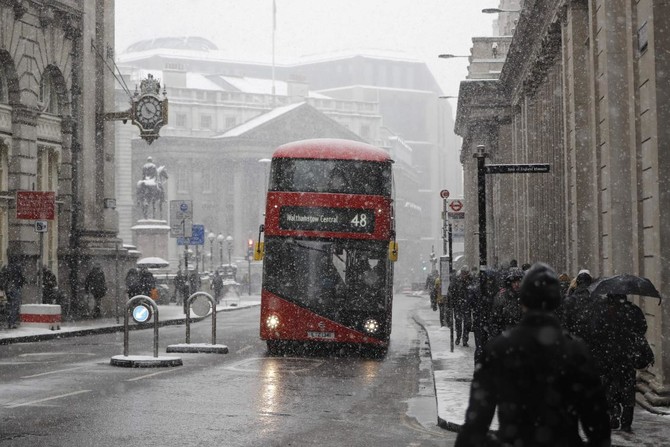
LONDON: As unusually cold weather gripped Europe, Britain’s military was sent out Friday to central and western England to get hospital employees to work and help police rescue people from snowbound vehicles.
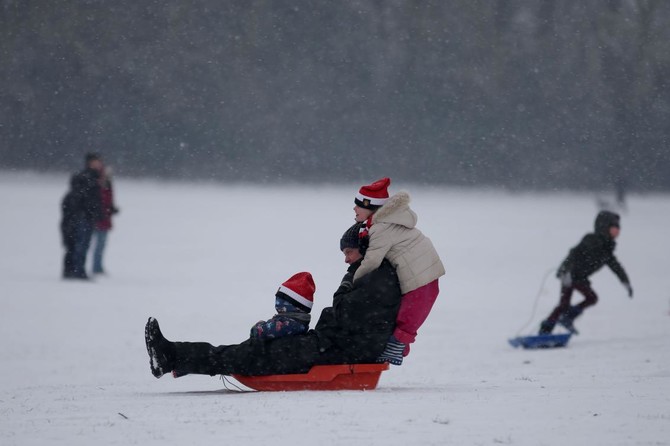
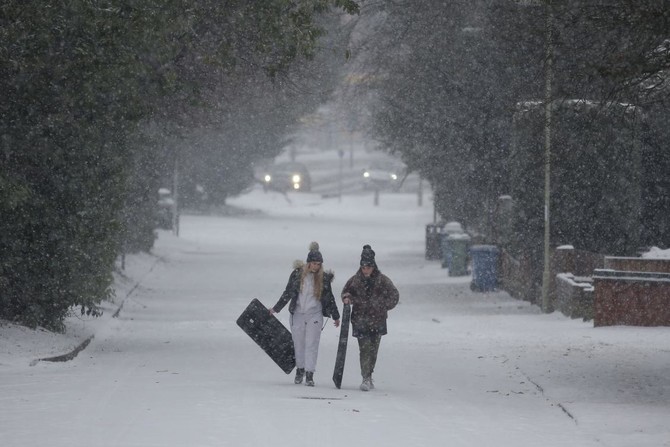
Nicknamed “The Beast from the East,” the cold front caused travel chaos, with hundreds of flights canceled in the United Kingdom, Ireland and Switzerland. Trains broke down. Motorists found themselves stuck on highways and trapped in frosty conditions for hours.
“This is particularly unusual weather,” British Transport Secretary Chris Grayling said. “It’s something that happens very rarely in this country.”
Up to a meter (three feet) of snow was reported in eastern Ireland, and travelers were stranded south and west of the capital, Dublin.
The big chill also froze canals in the Dutch capital, Amsterdam. Ice on the historic Prinsengracht canal was thick enough for residents to lace up their skates and glide across its frozen surface. Tourists without skates slid across the ice, taking selfies.
“It’s just cool. You can go fast and you see the world from a slightly different perspective,” said skater Noldus Reijnders.
Heathrow Airport tweeted Friday that it was working with airlines to consolidate the flight schedule “to provide more certainty around departing flights,” amid the extreme winter conditions across the UK and Europe. More than 350 flights were canceled. Gatwick, London City, Edinburgh and Glasgow airports also reported cancelations.
Other European airports closed down entirely. Authorities at Geneva’s airport suspended air traffic for a second straight day amid heavy snowfall. By early afternoon, flights had resumed.
Around 340 flights were canceled at Ireland’s Dublin Airport, which posted images of swirling snow together with the hashtag “BeastFromTheEast.” It doesn’t plan to open until Saturday.
The army sent 20 troops and 10 four-wheel drive vehicles to Shropshire, the county south of Liverpool, and the Royal Marines sent resources to Devon and Cornwall on the southwest coast after police asked for help.
One train traveling from London’s Waterloo Station to Weymouth ground to a halt outside New Milton, stranding motorists for hours. By mid-afternoon, South Western Railway and Southeastern had urged customers not to travel.
Some commuters reported that rail doors refused to open as the push-button mechanisms froze in the cold. Thousands of homes are without electricity as temperatures remain below freezing with bitter winds.
One police force in Scotland tweeted a picture of a patrol car beside a snowdrift almost as high as the vehicle itself to show drivers why they should stay home. “PLEASE AVOID THIS AREA,” the post said.
In central England, volunteers brought hot drinks and blankets to stranded drivers as they waited for help. Eleanor Kelly, 19, said those stranded in the Milnrow suburb of Rochdale included a father with a baby and toddler in his car.
“We’ve been trying to get to as many people as we can,” she said.
Commuter Philip Brown endured more than 15 hours on a train traveling from London Waterloo to Bournemouth, Dorset. The average time for the journey is about two hours.
“I didn’t have any food or water. There were no buffet facilities on board. The train lost power and we lost heating and lights,” said Brown, 49. “I couldn’t tell you how cold it was, but it was cold enough to prevent you from sleeping ... People were wrapping jumpers round their legs trying to keep warm.”
But in Amsterdam, nobody was complaining about the cold. Residents on skates glided past tourists who slithered across the ice for pictures. One woman took her dog for a walk along the frozen canal.
Still, despite measures taken by authorities to help the ice develop, there were still some holes and parts of the canal weren’t frozen at all. Reijnders was wearing a special red ice pick around his neck just in case.
“If you sink through the ice — and there are still a few dangerous places — you can pull yourself out,” he said.


![]()
![]()
![]()
![]()
![]()
Europe weather: UK army sent out; Dutch ice skate on canals


Europe weather: UK army sent out; Dutch ice skate on canals
Latest updates





© 2026 SAUDI RESEARCH & PUBLISHING COMPANY, All Rights Reserved And subject to Terms of Use Agreement.