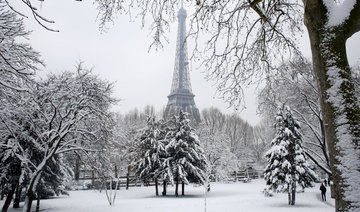
Two killed as snow, sub-zero temperatures paralyze Europe

1 / 4
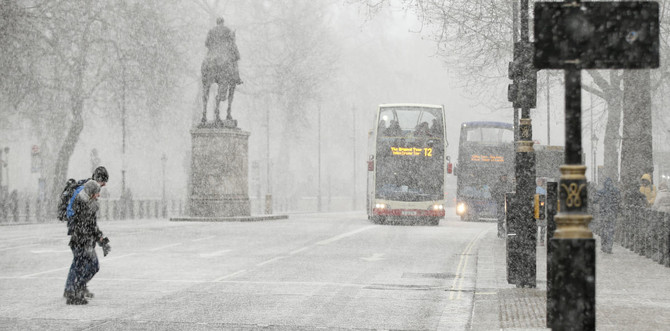
Pedestrians cross Whitehall as snow falls in London. (AP)
2 / 4
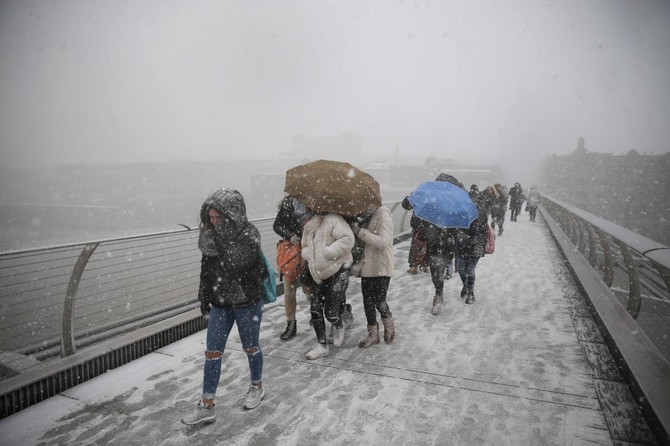
Pedestrians cross the millennium bridge as heavy snowfall hits London. (AFP)
3 / 4
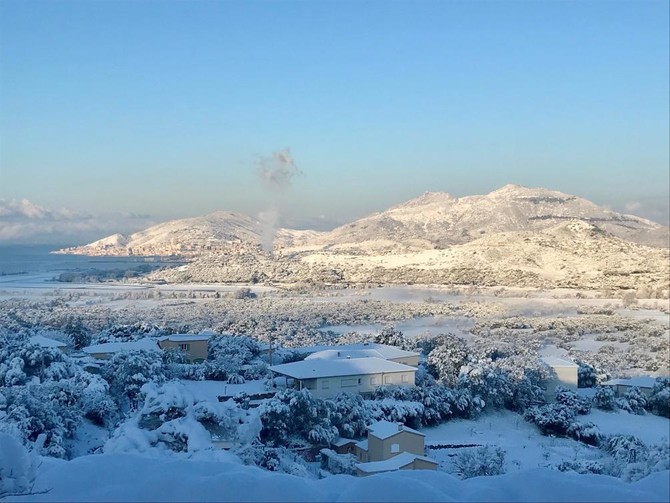
A man fits snow chains to his car in the village of Brenchley in southeast England. (AFP)
4 / 4
The Ajaccio basin covered with snow on the French Mediteranean island of Corsica. (AFP)
Updated 27 February 2018
Follow

Two killed as snow, sub-zero temperatures paralyze Europe

BUCHAREST: Two people were found dead in Romania as snow and sub-zero temperatures across much of Europe saw flights canceled, road and rail transport disrupted and schools closed on Tuesday.
A Siberian weather system forecasters have called the “beast from the east” brought the coldest temperatures for years to many regions. The freeze was expected to continue for much of the week.
In southern Romania, an 83-year-old woman from Adancata was found collapsed in the snow and died on the way to hospital, the Institute for Emergency Situations (ISU) said. A 65-year-old man was found dead late on Monday in the eastern county of Suceava, an official told state news agency Agerpres.
Parts of a motorway linking the capital Bucharest to Constanta and dozens of other roads were closed. More than 80 trains and 15 flights were canceled, Romanian police said, and Romania’s Black Sea ports were closed.
Record snowfall of 182 cm (72 inches) paralyzed the northern Croatian town of Delnice and rescue services took several hours to evacuate residents in the nearby village of Mrzle Vodice. Temperatures hit a low of -20 degrees Celsius in Zavizan on the Velebit mountain.
Schools were closed in Bucharest and ten Romanian counties as well as across western and central Croatia.
The roofs of dozens of houses collapsed under the weight of snow in the Unsko-Sanski canton in northwestern Bosnia.
State-run RTCG TV reported that Montenegro’s main Golubovci airport was closed for several hours overnight.
In Britain, parts of the east saw up to 10 cm of snow and the weather service said temperatures could fall toward -10 degrees Celsius in some rural areas.
Some schools closed on Tuesday and train services and some flights were canceled. In London, snow covered some parts of Westminster and a blizzard briefly swept through the Canary Wharf financial district.
A rare snowstorm in Rome on Monday prompted Italian authorities to call in the army to help clear the streets.
As the storm moved south on Tuesday, Naples saw the most snow since 1956. It blanketed the beach and covered fishing boats in small city ports such as Santa Lucia and Mergellina.
With a snow-covered Mount Vesuvius providing the backdrop, the snow paralyzed traffic and train services. Schools were closed in Naples and much of southern Italy.


US Justice Department official eyes cases against Cuba leaders as Trump floats ‘friendly takeover’

Updated 07 March 2026
Follow

US Justice Department official eyes cases against Cuba leaders as Trump floats ‘friendly takeover’

  • “Working group” formed to build cases against people connected to the Cuban government
  • Trump’s has increasingly displayed aggressive stance against Cuba’s communist leadership

MIAMI: The top Justice Department prosecutor in Miami is considering criminal investigations of Cuban government officials, according to people familiar with the matter. The inquiry comes as President Donald Trump has raised the possibility of a “friendly takeover” of the communist-run island.
Jason Reding Quiñones, the US attorney for the Southern District of Florida, has created a “working group” that includes federal prosecutors and officials from the Drug Enforcement Administration and other agencies to try to build cases against people connected to the Cuban government and its Communist Party, according to one of the people. They spoke on the condition of anonymity because they were not authorized to publicly discuss the effort.
It was not immediately clear which Cuban officials the office is targeting or what criminal charges prosecutors may be looking to bring.
The Justice Department said in a statement Friday that “federal prosecutors from across the country work every day to pursue justice, which includes efforts to combat transnational crime.”
The effort is taking place against the backdrop of Trump’s increasingly aggressive stance against Cuba’s communist leadership.
Emboldened by the US capture of Cuba’s close ally, Venezuelan President Nicolás Maduro, Trump last month said his administration was in high-level talks with officials in Havana to pursue “a friendly takeover” of the country. He repeated those claims this week, saying his attention would turn back to Cuba once the war with Iran winds down.
“They want to make a deal so bad,” Trump said of Cuba’s leadership.
While Cuba has faded from Washington’s radar as a major national security threat in recent decades, it remains a priority in the US Attorney’s office in Miami, whose political, economic and cultural life is dominated by Cuban-American exiles.
The FBI field office has a dedicated Cuba group that in 2024 was instrumental in the arrest of former US Ambassador Victor Manuel Rocha on charges of serving as a secret agent of Cuba stretching back to the 1970s.
In recent weeks, several Miami Republicans, in addition to Florida Sen. Rick Scott, have called on the Trump administration to reopen its criminal investigation into the 1996 shootdown of four planes operated by anti-communist exiles.
In a letter to Trump on Feb. 13, lawmakers including Reps. Maria Elvira Salazar and Carlos Gimenez highlighted decades-old news reports indicating that former President Raúl Castro — the head of Cuba’s military at the time — gave the order to shoot down the unarmed Cessna aircraft.
“We believe unequivocally that Raúl Castro is responsible for this heinous crime,” lawmakers wrote. “It is time for him to be brought to justice.”
While no indictment against Castro has been announced, Florida’s attorney general said this week that he would open a state-level investigation into the crime.
The Trump administration has also accused Cuba of not cooperating with American counterterrorism efforts, adding it alongside North Korea and Iran to a select few nations the US considers state sponsors of terrorism.
The designation stems from Cuba’s harboring of US fugitives and its refusal to extradite several Colombian rebel leaders while they were engaged in peace talks with the South American nation.