BEIRUT/ISTANBUL: Turkish warplanes attacked pro-Syrian government forces overnight, killing at least 17 people in a village in the north of the Afrin region in northwestern Syria, the British-based Syrian Observatory for Human Rights said on Friday.
The dead included three members of the Syrian Kurdish YPG force, while the rest came from militias that support President Bashar Assad and entered Afrin last week to help repel a Turkish offensive, the Observatory said.
The Turkish military declined to comment on the Observatory report, but the Turkish state-run Anadolu news agency reported on Friday that Turkish attack helicopters had killed nine YPG fighters in the west of Afrin.
Another Turkish news agency, Dogan, reported that Turkish and allied forces had started an operation on Friday morning to take control of the town of Rajo in Afrin.
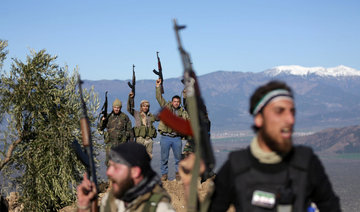
Turkey and allied Syrian rebel groups began their operation against the YPG in Afrin in January, aiming to drive out the Kurdish militia, which Ankara sees as a terrorist group linked to an insurgency inside Turkey’s borders.
Despite making slow progress at first, the offensive has gained control over all Afrin’s border areas adjoining Turkey. Late on Thursday, the Turkish military said eight Turkish soldiers had been killed and 13 injured in clashes in Afrin.
Last month, after the YPG asked the Syrian government to send its army to repel the offensive, pro-Syrian government militias crossed into Afrin and deployed along the frontlines with Turkey.
However, the move did not deter the Turkish offensive and has not so far heralded any wider escalation involving the Syrian government and the forces that support it.

Syrian Observatory: Turkish jets attack pro-government forces in Afrin
Rubio plans to update Netanyahu on US-Iran talks in Israel next week, officials say
- Trump is weighing whether to take military action against Tehran as the administration surges military resources to the region
- Dozens of US fighter jets, including F-35s, F-22s and F-16s, have left bases in the US and Europe in recent days to head to the Middle East
WASHINGTON: Secretary of State Marco Rubio plans to travel to Israel next week to update Israeli Prime Minister Benjamin Netanyahu on the US-Iran nuclear talks, two Trump administration officials said.
Rubio is expected to meet with Netanyahu on Feb. 28, according to the officials, who spoke Wednesday on condition of anonymity to detail travel plans that have not yet been announced.
The US and Iran recently have held two rounds of indirect talks over the Islamic Republic’s nuclear program.
Iran has agreed to draw up a written proposal to address US concerns that were raised during this week’s Geneva talks, according to another senior US official who was not authorized to comment publicly and spoke on the condition of anonymity.
That official said top national security officials gathered Wednesday in the White House Situation Room to discuss Iran, and were briefed that the “full forces” needed to carry out potential military action are expected to be in place by mid-March. The official did not provide a timeline for when Iran is expected to deliver its written response.
Officials from both the US and Iran had publicly offered some muted optimism about progress this week, with Iranian Foreign Minister Abbas Araghchi even saying that “a new window has opened” for reaching an agreement.
“In some ways, it went well,” US Vice President JD Vance said about the talks in an interview Tuesday with Fox News Channel. “But in other ways, it was very clear that the president has set some red lines that the Iranians are not yet willing to actually acknowledge and work through.”
Netanyahu visited the White House last week to urge President Donald Trump to ensure that any deal about Iran’s nuclear program also include steps to neutralize Iran’s ballistic missile program and end its funding for proxy groups such as Hamas and Hezbollah.
Trump is weighing whether to take military action against Tehran as the administration surges military resources to the region, raising concerns that any attack could spiral into a larger conflict in the Middle East.
On Friday, Trump told reporters that a change in power in Iran “seems like that would be the best thing that could happen.” He added, “For 47 years, they’ve been talking and talking and talking.”
The Trump administration has dispatched the USS Gerald R. Ford, the world’s largest aircraft carrier, from the Caribbean Sea to the Mideast to join a second carrier as well as other warships and military assets that the US has built up in the region.
Dozens of US fighter jets, including F-35s, F-22s and F-16s, have left bases in the US and Europe in recent days to head to the Middle East, according to the Military Air Tracking Alliance, a team of about 30 open-source analysts that routinely analyzes military and government flight activity.
The team says it’s also tracked more than 85 fuel tankers and over 170 cargo planes heading into the region.
Steffan Watkins, a researcher based in Canada and a member of the MATA, said he also has spotted support aircraft like six of the military’s early-warning E-3 aircraft head to a base in Saudi Arabia.
Those aircraft are key for coordinating operations with a large number of aircraft. He says they were pulled from bases in Japan, Germany and Hawaii.