Toyota venture to spend $2.8bn on self-driving technology

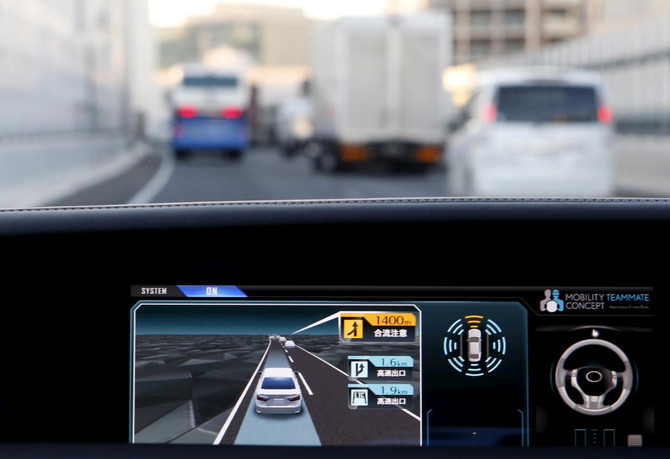
A Toyota staffer drives its self-driving technology ‘Mobility Teammate Concept’ prototype car hands-free on the Metropolitan Expressway in Tokyo. The Japanese automaker is boosting its investment in automated-driving software development. (Reuters)
Updated 02 March 2018
Follow

Toyota venture to spend $2.8bn on self-driving technology

TOKYO: Toyota Motor Corp. said a new venture would be investing more than $2.8 billion to develop automated-driving software — the latest salvo in an increasingly frenetic battle in a sector hit by a slew of disruptive technologies.
The Tokyo-based venture, which will bring together some 1,000 employees including new hires, will be 90 percent held by Toyota with group suppliers Denso Corp. and Aisin Seiki Co. each taking 5 percent.
“This company’s mission is to accelerate software development in a more effective and disruptive way, by augmenting the Toyota Group’s capability through the hiring of world-class software engineers,” James Kuffner, who will lead the venture, said in a statement.
The establishment of the new venture, Toyota Research Institute-Advanced Development, comes as firms such as Alphabet Inc’s Waymo and Tesla Inc. give traditional automakers a run for their money in building self-driving and electric cars.
English is set to be the main business language of the new venture, the statement said.
Toyota is also investing $1 billion in artificial intelligence and other technologies through its US-based Toyota Research Institute, and has struck up technology partnerships with Microsoft Corp. and Uber Technologies.
Last month, Toyota Research Institute’s venture capital unit said it was co-leading an $11.5-million seed investment in May Mobility, an Ann Arbor-based startup that is developing self-driving shuttles for college campuses, central business districts and similar low-speed applications.


Saudi Arabia’s foreign reserves rise to a 6-year high of $475bn

Updated 22 February 2026
Follow

Saudi Arabia’s foreign reserves rise to a 6-year high of $475bn

RIYADH: Saudi Arabia’s foreign reserves climbed 3 percent month on month in January to SR1.78 trillion, up SR58.7 billion ($15.6 billion) from December and marking a six-year high.

On an annual basis, the Saudi Central Bank’s net foreign assets rose by 10 percent, equivalent to SR155.8 billion, according to data from the Saudi Central Bank, Argaam reported.

The reserve assets, a crucial indicator of economic stability and external financial strength, comprise several key components.

According to the central bank, also known as SAMA, the Kingdom’s reserves include foreign securities, foreign currency, and bank deposits, as well as its reserve position at the International Monetary Fund, Special Drawing Rights, and monetary gold.

The rise in reserves underscores the strength and liquidity of the Kingdom’s financial position and aligns with Saudi Arabia’s goal of strengthening its financial safety net as it advances economic diversification under Vision 2030.

The value of foreign currency reserves, which represent approximately 95 percent of the total holdings, increased by about 10 percent during January 2026 compared to the same month in 2025, reaching SR1.68 trillion.

The value of the reserve at the IMF increased by 9 percent to reach SR13.1 billion.

Meanwhile, SDRs rose by 5 percent during the period to reach SR80.5 billion.

The Kingdom’s gold reserves remained stable at SR1.62 billion, the same level it has maintained since January 2008.

Saudi Arabia’s foreign reserve assets saw a monthly rise of 5 percent in November, climbing to SR1.74 trillion, according to the Kingdom’s central bank.

Overall, the continued advancement in reserve assets highlights the strength of Saudi Arabia’s fiscal and monetary buffers. These resources support the national currency, help maintain financial system stability, and enhance the country’s ability to navigate global economic volatility.

The sustained accumulation of foreign reserves is a critical pillar of the Kingdom’s economic stability. It directly reinforces investor confidence in the riyal’s peg to the US dollar, a foundational monetary policy, by providing SAMA with ample resources to defend the currency if needed.

Furthermore, this financial buffer enhances the nation’s sovereign credit profile, lowers national borrowing costs, and provides essential fiscal space to navigate global economic volatility while continuing to fund its ambitious Vision 2030 transformation agenda.