Damascus must be 'held accountable' for Eastern Ghouta attacks: Merkel, Trump

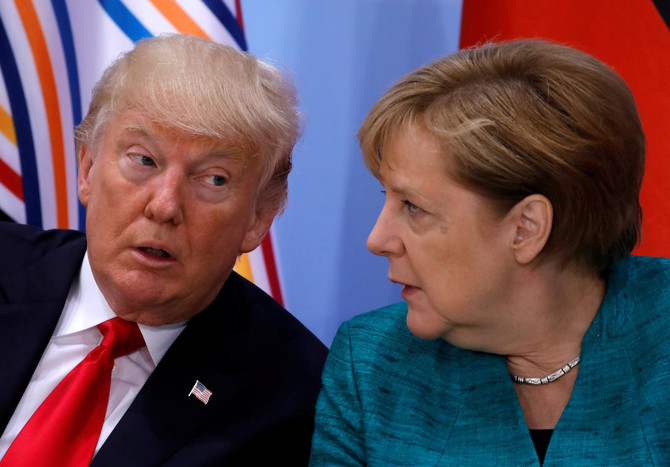
In this file photo, US President Donald Trump and German Chancellor Angela Merkel attend the Women’s Entrepreneurship Finance event during the G20 leaders summit in Hamburg, Germany. (Reuters)
Updated 02 March 2018
Follow

Damascus must be 'held accountable' for Eastern Ghouta attacks: Merkel, Trump

BERLIN: US President Donald Trump and German Chancellor Angela Merkel in a phone call agreed that the Syrian regime must be held accountable for the Eastern Ghouta violence, Berlin said Friday.
Both also "urge Russia to end its involvement in the bombing of Eastern Ghouta and to persuade the Assad regime to stop its offensive operations against civilian areas", a chancellery statement said.
President Bashar Al-Assad's regime "must be held accountable" for the attacks on Eastern Ghouta and the humanitarian crisis in the rebel-held enclave, they agreed in the conversation Thursday.
"This applies both to the Assad regime's deployment of chemical weapons and for its attacks against civilians and the blockade of humanitarian support."
"Both agreed that the Syrian regime and its Russian and Iranian allies are urged to promptly and fully implement" a UN Security Council resolution that calls "for a prompt ceasefire in Syria", said the statement.


US forces withdraw from Syria’s Al-Tanf base: Syrian military sources

Updated 7 sec ago
Follow

US forces withdraw from Syria’s Al-Tanf base: Syrian military sources

  • The Americans had been moving equipment out of Al-Tanf base for the past 15 days, one source told AFP
  • Following the withdrawal from Al-Tanf, US troops are mainly now based at the Qasrak base in Hasakah

DAMASCUS: US forces have withdrawn to Jordan from Syria’s Al-Tanf base, where they had been deployed as part of the international coalition against the Daesh group, two Syrian military sources told AFP on Wednesday.
One source said “the American forces withdrew entirely from Al-Tanf base today” and decamped to another in Jordan, adding Syrian forces were being deployed to replace them.
A second source confirmed the withdrawal, adding the Americans had been moving equipment out for the past 15 days.
The second source said the US troops would “continue to coordinate with the base in Al-Tanf from Jordan.”
During the Syrian civil war and the fight against Daesh group, US forces were deployed in the country’s Kurdish-controlled northeast and at Al-Tanf, near the borders with Jordan and Iraq.
The Kurdish-led Syrian Democratic Forces (SDF) had been a major partner of the anti-Daesh coalition, and were instrumental in the group’s territorial defeat in Syria in 2019.
However, after the fall of longtime ruler Bashar Assad over a year ago, the United States has drawn closer to the new government in Damascus, recently declaring that the need for its alliance with the Kurds had largely passed.
Syria agreed to join the anti-Daesh coalition when President Ahmed Al-Sharaa visited the White House in November.
As Al-Sharaa’s authorities seek to extend their control over all of Syria, the Kurds have come under pressure to integrate their forces and de facto autonomous administration into the state, striking an agreement to do so last month after losing territory to advancing government troops.
Since then, the US has been conducting an operation to transfer around 7,000 suspected jihadists from Syria — where many were being held in detention facilities by Kurdish fighters — to neighboring Iraq.
Following the withdrawal from Al-Tanf and the government’s advances in the northeast, US troops are mainly now based at the Qasrak base in Hasakah.
Despite Daesh’s territorial defeat, the group remains active.
It was blamed for a December attack in Palmyra in which a lone gunman opened fire on American personnel, killing two US soldiers and a US civilian.
Washington later conducted retaliatory strikes on Daesh targets in Syria.