WAFIDEEN CHECKPOINT, Syria: Syrian and Russian forces kept up military pressure on opposition-held Eastern Ghouta on Thursday as their controversial unilateral truce failed to yield a humanitarian breakthrough.
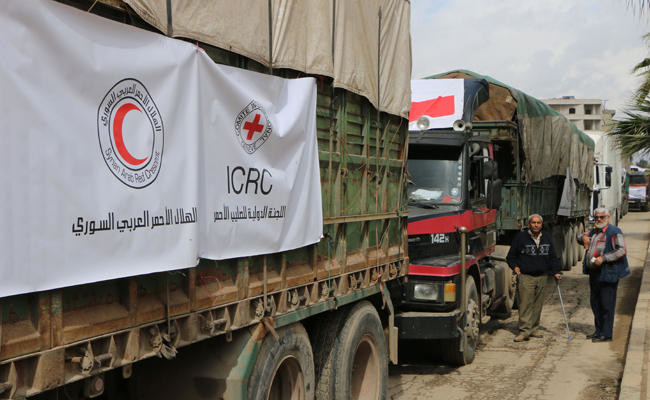
More than 40 trucks loaded with aid were unable to reach the 400,000 people living in the battered enclave, prompting fresh calls for a UN cease-fire to be implemented.
A five-hour daily “pause” announced by Moscow on Monday has led to a reduction in the bombardment that killed hundreds in only a few days and sparked global outrage last month.
But a corridor offered by Russia for civilians to flee remained ostensibly empty for a third day running, with distrust running high on both sides.
Jan Egeland, the head of the UN’s humanitarian taskforce for Syria, said he hoped aid convoys “may now be able to go to Eastern Ghouta in the next few days.”
He told reporters in Geneva that he had received word during a taskforce meeting on Thursday “that we may have the first facilitation letter, permit from the government, to go to (the main Eastern Ghouta town of) Douma in a very long time.”
But he also stressed that “five hours is not enough.”
Syrian aircraft carried out strikes on Thursday before the 9:00 am start of the daily “truce,” killing nine civilians, according to the Syrian Observatory for Human Rights, a Britain-based war monitor.
Ground battles were also taking place in Al-Shaifuniyah which lies in the enclave’s northeastern region and has been extensively destroyed in recent days.
A spokesman for the Syrian Civil Defense volunteer rescuers, known as the “White Helmets,” said access to the area had been very difficult.
“There is hardly any life there. It is completely destroyed and there are people under the rubble,” said Siraj Mahmud.
Air strikes have eased compared with last week when the joint Syrian and Russian aerial campaign against Eastern Ghouta killed up to 100 civilians a day.
But the death toll for the assault launched on February 18 continued to mount even after Russia’s “humanitarian pause” kicked in, as rescuers found bodies they had been unable to access.
In the town of Hazeh, rescuers working with rudimentary equipment were painstakingly hoisting buckets of gravel from a basement where they feared up to 21 had been buried alive by a strike on Feb. 20.
So far they have only retrieved six bodies.
“I left my daughter in the basement with her husband and his family,” said 60-year-old Abu Mohammed.
“I came back the next morning. I found the building collapsed and until now I haven’t found my daughter nor her husband’s family.”
According to the UN, three quarters of all private housing in Eastern Ghouta has been damaged and hundreds of civilians need life-saving medical evacuations.
The Russian daily “pause” falls far short of a 30-day cease-fire voted for by the UN Security Council on Saturday and yet to be implemented.
UN agencies and aid organizations have argued that the five-hour window was too short for aid deliveries.
“When will your resolution be implemented?” top UN relief official Mark Lowcock asked Security Council members on Wednesday.
Russia and its allies in Syrian President Bashar Assad’s regime have blamed the humanitarian deadlock on the armed groups controlling Eastern Ghouta.
Syrian military sources accused anti-regime forces in Eastern Ghouta of deliberately shelling the designated safe passage to prevent civilians from leaving and keep them as human shields.
A spokesman for Russian military observers monitoring the cease-fire initiative told Interfax news agency that many civilians were trying to leave.
The number of Ghouta residents asking for “assistance and help in getting evacuated from territory controlled by the fighters has increased exponentially over the past 24 hours,” Major General Vladimir Zolotukin said.
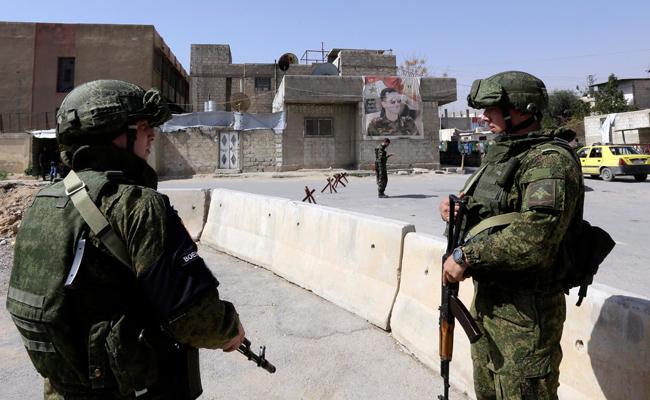
AFP reporters at the Wafideen checkpoint, through which civilians were asked to evacuate the enclave, said no movement was reported, however.
The only civilians believed to have fled the enclave since the “pause” took effect are an elderly Pakistani couple who had remained in Ghouta throughout the seven-year conflict but decided to leave when the violence increased.
Mohammed Fadhl Akram, 73, moved to Syria in 1974.
He and his wife, who left on Wednesday and were given shelter at the Pakistani embassy in Damascus, leave two sons, three daughters and 12 grandchildren behind.
“I hope God protects them,” said Akram, who wore a warm hat and sported a trimmed white beard, when he spoke to an AFP reporter in the main eastern Ghouta town of Douma this week.
“I don’t want anything else,” he said.


Syria regime strikes Eastern Ghouta as aid trucks wait
Syria regime strikes Eastern Ghouta as aid trucks wait

Israel says it has launched ‘broad wave’ of strikes on Iran, as Tehran widens its response across the region
- US military says 17 Iranian navy ships destroyed, struck nearly 2,000 targets in Iran thus far
- US and Israeli attacks have killed 787 people in Iran: Iranian Red Crescent
JERUSALEM/DUBAI/TEHRAN: Israel early Wednesday launched new attacks on Iran as the US military said it has hit nearly 2,000 targets inside the Islamic republic, which tried to impose a cost by expanding a missile and drone barrage across the region.
With global energy prices on the rise, President Donald Trump said the US Navy was ready to escort oil tankers through the Strait of Hormuz, the vital chokepoint into the Gulf that Iran has threatened to seal off.
Israel’s military said it launched a “broad wave of strikes” after midnight across Iran, which in the hours before had launched three separate missile barrages at Israel, causing mild injuries to a woman in Tel Aviv.
The US military has destroyed 17 Iranian ships, including a submarine, and struck nearly 2,000 targets in Iran, the commander of the US Central Command said on Tuesday.
“Today, there is not a single Iranian ship underway in the Arabian Gulf, Strait of Hormuz, or Gulf of Oman,” US Central Command’s Brad Cooper said in a video posted to X.
Cooper said the US military has “severely degraded Iran’s air defenses” and taken out hundreds of ballistic missiles, launchers and drones.
The video showed missiles and jets launching from US ships, and targets exploding on the ground.
Cooper noted that Iran has launched over 500 ballistic missiles and more than 2,000 drones in retaliation.
But he said the US is “hunting” Iran’s last remaining mobile ballistic missile launchers to eliminate their “lingering launch capability.”
Cooper said the operation has involved more than 50,000 troops, 200 fighter jets, two aircraft carriers and bombers, and “more capability is on the way.”
“We’ve just begun,” Cooper said, adding that the US military is targeting “all the things that can shoot at us.”
“These forces bring a massive amount of firepower, representing the largest buildup by the US in the Middle East in a generation,” he said in the video message, describing the first day’s barrage as bigger than the so-called “shock and awe” against Saddam Hussein’s Iraq in 2003.
Iran‘s response
The US and Israeli attacks have killed 787 people in Iran, according to the Iranian Red Crescent, a toll that could not be independently confirmed.
Iran vowed to inflict a heavy price in retaliation. Drones struck adjacent the US consulate in Dubai, starting a fire but inflicting no casualties, and against the US military base at Al-Udeid in Qatar.
The attacks came a day after strikes on the US embassies in Riyadh and Kuwait City and on a US air base in Bahrain.
“We are saying to the enemy that if it decides to hit our main centers, we will hit all economic centers in the region,” Islamic Revolutionary Guard General Ebrahim Jabbari said.
Iranian attacks have killed at least nine people and wounded dozens in the Gulf region, according to various reports quoting local authorities.

Among the latest death was an 11-year-old girl who was killed after shrapnel fell in a residential area in Kuwait City, health authorities said Wednesday.
The Kuwait army said in a statement the shrapnel fell over a house and left casualties while forces were intercepting “several hostile aerial targets” over the country.
The Health Ministry said in a separate statement that the child died of her wounds at the hospital.
The child’s mother and three other relatives were injured and being treated at the hospital, it said.
Vessel hit in Gulf of Oman
A vessel was hit by a projectile early Wednesday in the Gulf of Oman off the United Arab Emirates, an agency of the UK military said.
There were no reported casualties.
The United Kingdom Maritime Trade Operations Center said the vessel was struck 8 miles east of Fujairah, one of the UAE’s seven emirates.
The attack damaged the vessel’s steel plating.
No fire or water intake was reported, it said.

Iran hits US embassies
The US State Department said Tuesday it’s preparing military and charter flights for Americans who want to leave the Middle East. Several other countries also arranged evacuation flights for their citizens.
An attack from two drones on the US Embassy in Riyadh caused a “limited fire,” according to the Saudi Arabian Defense Ministry, and the embassy urged Americans to avoid the compound.
An Iranian drone struck a parking lot outside the US consulate in Dubai, sparking a small fire, Secretary of State Marco Rubio said in Washington. He said all personnel were accounted for.
The United Arab Emirates said it has intercepted the vast majority of more than 1,000 Iranian missile and drone attacks against it.
US embassies in Saudi Arabia, Kuwait and Lebanon said they were closed to the public.
The US State Department ordered the evacuation of non-emergency personnel and family in Kuwait, Bahrain, Iraq, Qatar, Jordan and the United Arab Emirates. And US citizens were urged to leave more than a dozen Middle Eastern countries, though many were stranded because of airspace closures.
The US military has confirmed six deaths of American service members.
Four of the American soldiers killed were identified as Capt. Cody A. Khork, 35, of Winter Haven, Florida; Sgt. 1st Class Noah L. Tietjens, 42, of Bellevue, Nebraska; Sgt. 1st Class Nicole M. Amor, 39, of White Bear Lake, Minnesota; and Sgt, Declan J. Coady, 20, of West Des Moines, lowa, who received a posthumous promotion in rank. They were assigned to the Iowa-based 103rd Sustainment Command.
Ghost town
In Tehran, residents who have not fled remained shut away in their homes for fear of the US-Israeli bombardment.
The Iranian capital is normally home to around 10 million people, but in recent days “there are so few people that you’d think no one ever lived here,” said Samireh, a 33-year-old nurse.
Authorities had previously urged people to leave the city, and police officers, armed security forces and armored vehicles have been stationed at main junctions, carrying out random checks on vehicles.
In the more upmarket north of Tehran, the meowing of cats and chirping of birds replaced the usual din of traffic jams.
Iranian authorities said a strike on a school in the city of Minab on the first day of the war killed more than 150 people.
Drone downed near Baghdad airport
In Baghdad, a drone was shot down on Wednesday near Baghdad’s international airport, a day after a similar attack on the facility, two security sources told AFP.
“A drone was downed near Baghdad airport, with no casualties or material damage reported,” an Iraqi security source said. Another security source in Baghdad confirmed the incident.
The airport includes a military base that hosts a US diplomatic facility and previously housed US-led coalition troops.


