Cryptocurrencies are failing as money, Bank of England chief says

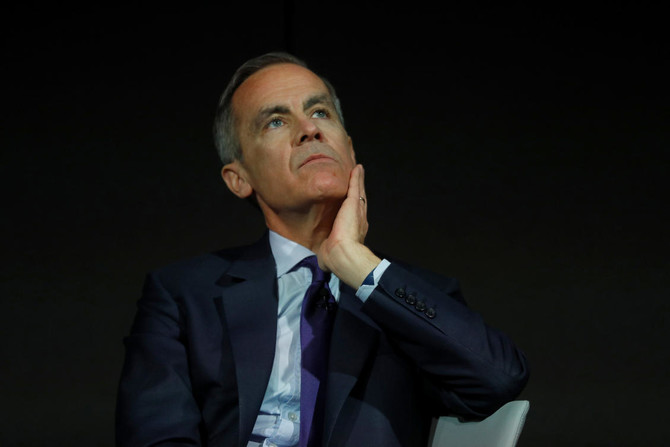
Bank of England Governor Mark Carney said on Friday that ‘cryptocurrencies act as money, at best, only for some people and to a limited extent.’ (Reuters)
Updated 02 March 2018
Follow

Cryptocurrencies are failing as money, Bank of England chief says

LONDON: Cryptocurrencies are failing as a form of money and have shown classic signs of being a financial bubble, requiring regulators to protect consumers and stop their use for illegal activities, Bank of England Governor Mark Carney said on Friday.
Carney did not call for a ban on cryptocurrencies such as bitcoin but said they needed to be regulated in a similar way to other parts of the financial system, and stressed they could not effectively replace traditional currencies.
“Cryptocurrencies act as money, at best, only for some people and to a limited extent, and even then, only in parallel with the traditional currencies of the users. The short answer is they are failing,” Carney said in a speech.
Carney, who heads the Financial Stability Board, a global financial rule-making body, expressed doubts about cryptocurrencies earlier this year and his speech for a Scottish student economics conference expanded on these.
“At present, crypto-assets raise a host of issues around consumer and investor protection, market integrity, money laundering, terrorism financing, tax evasion, and the circumvention of capital controls and international sanctions,” he said.
For now, they posed little financial stability risk to Britain as whole, due mostly to major banks’ limited involvement with them. But for individual investors, they were a major risk.
“Many cryptocurrencies have exhibited the classic hallmarks of bubbles including new paradigm justifications, broadening retail enthusiasm and extrapolative price expectations reliant in part on finding the greater fool,” he said.
Bitcoin prices have fallen sharply since December 2017.
However, the distributed-ledger technology underlying cryptocurrencies did have potential for improving cash settlement in the banking system and other asset transactions, he added.


Acwa signs key terms to develop 5GW of renewable energy capacity in Turkiye

Updated 23 February 2026
Follow

Acwa signs key terms to develop 5GW of renewable energy capacity in Turkiye

JEDDAH: Saudi utility giant Acwa has signed key investment agreements with Turkiye’s Ministry of Energy and Natural Resources to develop up to 5 gigawatts of renewable energy capacity, starting with 2GW of solar power across two plants in Sivas and Taseli.

Under the investment agreement, Acwa will develop, finance, and construct, as well as commission and operate both facilities, according to a press release.

The program builds on the company’s first investment in Turkiye, the 927-megawatt Kirikkale Independent Power Plant, valued at $930 million, which offsets approximately 1.8 million tonnes of carbon dioxide annually, the statement added.

A separate power purchase agreement has been concluded with Elektrik Uretim Anonim Sirketi for the sale of electricity generated by each facility.

Turkiye aims to boost solar and wind capacity to 120GW by 2035, supported by around $80 billion in investment, while recent projects have already helped prevent 12.5 million tonnes of CO2 emissions and reduced reliance on imported natural gas.

Turkiye’s energy sector has undergone a rapid transformation in recent years, with renewable power emerging as a central pillar of its strategy.

Raad Al-Saady, vice chairman and managing director of ACWA, said: “The signing of the IA (implementation agreement) and PPA key terms marks a pivotal moment in Acwa’s partnership with Turkiye, reflecting the country’s strong potential as a clean energy leader and manufacturing powerhouse.”

He added: “Building on our long-standing presence, including the 927MW Kirikkale Power Plant commissioned in 2017, this step elevates our partnership to a new level,” Al-Saady said.

In its statement, Acwa said the 5GW renewable energy program will deliver electricity at fixed prices, enhancing predictability for grid planning and supporting long-term industrial investment.

By replacing imported fossil fuels with domestically generated clean energy, the initiative is expected to reduce Turkiye’s exposure to global energy market volatility, strengthening energy security and lowering long-term power costs.

The company added that the economic impact will extend beyond the anticipated investment of up to $5 billion in foreign direct investment, with thousands of jobs expected during the construction phase and hundreds of high-skilled roles created during operations.

The energy firm concluded that its existing progress in Turkiye reflects a strong appreciation for Turkish engineering, construction, and manufacturing capacity, adding that localization has been a strategic priority, and it has already achieved 100 percent local employment at its developments in the country.