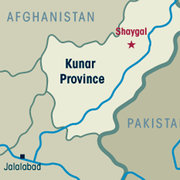
KUNAR, Afghanistan: Hajji Amanullah had been walking through the night, hoping to use the cover of darkness to shake off the Americans hunting him down, when he again heard the familiar low-pitched hum of the drone that seemed to watch his every move. It was early on the morning of June 24, 2017, near the end of Ramadan, and for the past few days the unmanned aerial vehicle had been doggedly following the insurgent commander as he traversed the boulder-strewn peaks and valleys that form the district of Shaygal, in eastern Afghanistan.
Almost 180 coalition troops had been killed in the surrounding province of Kunar since the war began in 2001 and Amanullah was the architect of much of the bloodshed. As a senior figure in the Islamist group Hizb-e Islami (the Islamic Party), he had clashed with the Americans dozens of times. Only now did he realize that this was their moment of revenge.
He had been using a torch to light a path through the rugged terrain and just as he recognized his mistake and paused to switch it off, a loud tearing sound split the sky. The first missile hit the ground in front of him, throwing him to the floor. The second landed closer, sending dirt, rocks and branches into the air. Stunned, and with his left wrist and left ear bleeding, he recited his last rites, convinced another missile was on its way. But to his amazement there were no more explosions. After several minutes villagers arrived on the scene and took him to a cluster of nearby houses. There, he began to recuperate and plot his next move.
Recounting the details of the drone strike in an exclusive interview with Arab News recently, Amanullah blamed himself for being too casual with his own security and underestimating the Americans’ firepower.
“If your enemy is a fox, you should think of it as a lion,” he said, repeating an old proverb.
Amanullah’s previously untold story offers a fascinating, and sobering, glimpse into the insurgent side of the war in Afghanistan, as US policymakers continue their search for a decisive breakthrough that will turn around the conflict. It is a tale of missed opportunities and shifting alliances; the horrors of combat and the perils of making peace with an intractable enemy. Ultimately, it is also the story of the changing face of radicalism in this country — a land that nurtured Al-Qaeda and that is now becoming an increasingly important sanctuary for Daesh.
Aged 50 and sporting a long white beard, Amanullah comes from the La Hussein valley in Shaygal, a picturesque area of persimmon and walnut trees. He belongs to the Shinwari tribe, one of eastern Afghanistan’s most prominent Pashtun groups, and was born into a typically large family, with eight brothers and three sisters. He was just 12-years-old when he joined Hizb-e Islami in its guerrilla war against local Marxists in the late 1970s.
Hizb, as it is commonly known by Afghans, was influenced by the ideas of the Egyptian Muslim Brotherhood and led by a charismatic and ruthless former engineering student, Gulbuddin Hekmatyar, who Aman revered. Together, they vowed to wage armed jihad until the country was governed by a radical interpretation of Islamic law. The party went on to become the most powerful Mujahedeen faction in the 1979-1989 war against Soviet occupation, when it received the largest share of covert US arms supplies funnelled to the resistance through Pakistan’s ISI intelligence agency. At the same time, Hekmatyar mentored militants from across Asia and the Middle East, training them to launch insurrections in their home countries after the Soviet withdrawal.
But when the Russians left Afghanistan and victory seemed within reach, Hizb was outflanked by rival Mujahedeen parties and Kabul descended into a savage civil war that killed tens of thousands of people, ultimately giving rise to the Taliban. Hekmatyar, one of the conflict’s main protagonists, fled to Iran before returning to Afghanistan in 2002 to launch a jihad against the America-led occupation.
For many of Hekmatyar’s supporters this new guerrilla campaign was a step too far and, exhausted by years of conflict, they laid down their arms to join the democratic process in Kabul, forming their own factions of Hizb. Amanullah was one of the few who stood by Hekmatyar and the insurgent wing of the party, known in US-military parlance as HIG. Before he had a chance to fire a shot in anger, however, American forces arrested him in the eastern province of Nangarhar while he was trying to visit a friend in jail. The experience only hardened his resolve. Released after five months, he returned to Shaygal and resumed his insurgency.
By his own account, Amanullah first confronted US soldiers in battle in late 2002, digging up a rocket-propelled grenade launcher he had hidden in a cemetery and ambushing a military convoy. Already well known in local rebel circles, his reputation grew in the years that followed as he led dozens of raids against the Americans. He rose through Hizb’s ranks, eventually becoming head of its military committee — the section of the party tasked with organizing guerrilla operations across the country. His growing influence was most keenly felt in Kunar, where American troops stationed in remote outposts struggled to withstand frequent assaults from radical fighters largely drawn from a local population hostile to outsiders.
As the war dragged on, Hizb conducted several high-profile attacks in Kabul, including one by a female suicide bomber in September 2012 that killed at least 12 people — eight of them South African employees of a chartered aviation company. But Hekmatyar’s faction remained militarily weak compared with the Taliban and, after years of behind the scenes talks, it signed a peace agreement with the Afghan government in September 2016, less than two months before Donald Trump’s election as US president. It seemed like one of the most significant political breakthroughs Afghanistan had experienced in years.
Even then, however, there were warning signs that the deal would give rise to a new wave of radicalism. A small band of Daesh fighters had already spent several months living under Amanullah’s protection in Shaygal, impressing him with their adherence to a violent and austere way of life that they claimed mirrored the conduct of Islam’s earliest apostles. He sheltered them in accordance with Pashtun honor codes but opted to keep a prudent distance from their daily operations while he waited to see how their jihad progressed.
The more time that passed, the more troubled he became by the contrasting approaches between the extremist old guard he grew up with and the younger, stricter, fighters emerging in their wake. While Daesh seemed to resemble the earlier incarnation of Hizb that he joined in the late 1970s — executing alleged spies in the pockets of territory under its control and demanding everyone adhere to its interpretation of Islam — the men he had spent a lifetime serving alongside appeared to have given up on their goal of turning Afghanistan into a radical Islamist state that would inspire uprisings across the Muslim world.
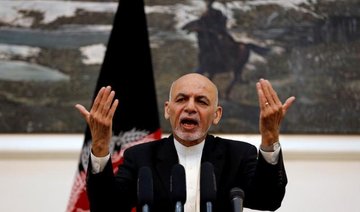
The last straw for Amanullah came in April 2017, when Hekmatyar used his first public speeches in the country for 20 years to rebuke sections of the insurgency and call for an end to the war. As far as the commander was concerned, his leader was tacitly condoning the American occupation. To add to his consternation, Hekmatyar — a man once famous for his support for Al-Qaeda and his strident denunciations of US foreign policy — then came to Kabul and took up residency in a house owned by the Afghan president, Ashraf Ghani.
“God is a witness that from the start of the peace talks until the end, the process was un-Islamic and illegal,” Amanullah told Arab News. “If you look at history Muslims never send an offer of peace to infidels and apostates; it is always the infidels who send us the offer of peace. They are the forces of Satan and they will be defeated by the forces of God — they cannot resist us.”
Disgusted, he announced that he was forming his own faction of Hizb and took hundreds of fighters with him. He insisted to us that this move was initially meant as a symbolic show of dissent, rather than an act of war against his former colleagues. He claimed he only intended to speak out against the peace deal and had no plans to reignite his insurgency until the drone strike caused him to reconsider his options and edge even closer to Daesh.
Amanullah survived the attack, which occurred in La Hussein, with relatively minor injuries, but two of his most trusted fighters were killed: Amran, a 25-year-old father of five, and Redi Gul, a 30-year-old father of seven. In the hours that followed the commander’s men began to spread the rumor that he had also died, hoping the announcement would be picked up by mainstream and social media, throwing the Americans off his scent. The deception worked.
In the ensuing days leaflets started appearing in and around Kunar, warning of more retribution to follow. “Hajji Amanullah is dead!” they proclaimed in Pashto, over a picture of him with his face crossed out. “We are coming after you. Understand this: your leaders are also not safe because the coalition forces are coming after you.”
It was a boast that may yet come back to haunt the American and Afghan governments. We first met Amanullah in June 2016, before he formed his own faction of Hizb. Back then, he was happy walking in daylight and served under Hekmatyar’s chief lieutenant, Kashmir Khan, a prominent local commander who would die of natural causes later that year. Even in those days Daesh fighters enjoyed the protection of Hizb in Shaygal but their numbers were small. By the time of our most recent meeting late last year, the situation was markedly different. Security was tighter and the tension greater.
With drones clearly audible in the sky over the district, Amanullah’s militants forbade photography and kept phone conversations to a minimum. It took us several attempts to rendezvous with him at a safe house in rugged terrain in a remote corner of the district.
He arrived for the interview just after 10:45pm, accompanied by five bodyguards. He wore a shalwar kameez, a flat Afghan pakhool hat, military belt and hiking boots, and walked with the aid of a long stick. He was polite and genial, demonstrating the hospitality Pashtuns customarily show to guests. Throughout the area in which we met there was talk of the growing strength of Daesh. In places under Amanullah’s jurisdiction the group’s fighters roamed freely alongside members of the Taliban. He claimed they had all learnt from the way he and his men governed with an iron fist.
“I tell people here that the rules and laws of Daesh were the rules of Hizb. First they were adopted by the Taliban, now they are adopted by Daesh,” he said.
As someone who prides himself on keeping his word and protecting the honor of his fighters, Amanullah’s split with Hizb’s leadership has proved more traumatic than the drone strike that nearly killed him. He still regards himself as a member of the party but feels senior figures within the movement have betrayed its core principles, leaving him with no choice other than to take matters into his own hands and establish a splinter group.
At a gathering of 3,000 mainstream Hizb members in Kabul last November, Hekmatyar attempted to address the grievances of colleagues like Amanullah who are angry with the peace agreement. He acknowledged that the government had yet to fulfil key aspects of its side of the deal, including the large-scale release of party prisoners and the provision of land for the families of thousands of Hizb members currently living as refugees in Pakistan. But he claimed that by working openly in the country Hizb now had “an effective and decisive role” in Afghan politics. Dissidents should “be patient and have hope in the future,” he said.
Privately, some senior party officials are less magnanimous toward their former brothers-in-arms who continue to advocate violent resistance. Speaking to us last autumn, one high-ranking figure in Hekmatyar’s inner-circle accused Amanullah of acting out of self-interest, claiming the rogue commander was being funded by unspecified foreign donors to cause divisions within the party’s ranks.
We found no evidence to support this claim. The living conditions of Amanullah and his men were far harsher than their contemporaries in Kabul, and they expressed no interest in compromise or political power. What mattered to them was sticking to their radical beliefs, however unpalatable those ideas may be to millions of their fellow Afghans.
In Shaygal itself, the highly conservative community views Amanullah’s strict leadership as upholding Islamic values. Smoking and music are outlawed in villages under his control and it is forbidden for men to shave. Opium cultivation is banned and residents are only allowed to fish using nets or rods, not by throwing grenades into the local river — a practice that has become all too common in war-ravaged Afghanistan.
He predicted that Hizb’s influence would wane under Hekmatyar’s continued guidance and left open the possibility that he would formally merge his break-away faction of the movement with Daesh. Even if he is killed there seems little doubt that his followers will continue the jihad he started more than 30 years ago.
“All over the country the Mujahedeen of Hizb are ready to stay with us and continue as Mujahedeen until we achieve our holy aim,” he said.
When the interview was over he gathered a handful of his men and led them in prayer. He then melted back into the night.
* For this article Chris Sands reported from Kabul and Fazelminallah Qazizai reported from Kunar.