LONDON: Iran has strengthened its hand in Syria through proxy militias, which could cause further chaos and be difficult to dislodge when the war ends, according to observers.
Sinan Hatahet, senior associate fellow at Al-Sharq Forum and Omran for Strategic Studies, told a discussion panel at a Syria conference in London on Thursday that there would be ‘“new dynamics kicking in’’ when the fighting comes to an end with “a myriad of small conflicts that will emerge throughout the country.’’
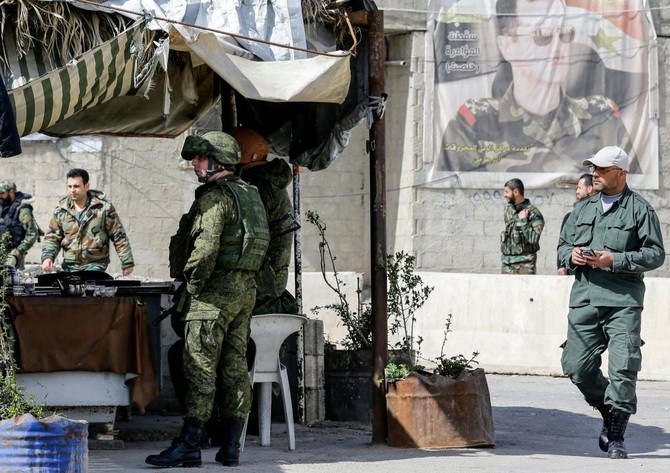
Syrian President Bashar Assad’s attempts to plug major gaps in the Syrian army’s manpower by recruiting Iranian and Russian-sponsored fighters have led to a surplus of foreign fighters on the ground, creating “huge doubt” over the government’s capacity to control these groups in future, Hatahet said.
A discussion on regime-held areas at the Demystifying the Syrian Conflict conference at Chatham House highlighted the influence of militias in areas where the situation is “hugely complex,’’ Hatahet said.
Senior US officials believe that up to 80 percent of the Syrian army is made up of foreign fighters, many of whom are loyal to international forces, including Hezbollah and other Shiite militias with ties to the Islamic Revolutionary Guards and Iraqi Popular Mobilization Units (PMU), according to the Middle East Institute.
In an article published on the institute’s website, Charles Lister and Dominic Nelson said: “Militias loyal to Iran in Syria, in tandem with the Iran-backed elements of the PMU in Iraq, have successfully secured the strategically significant Iranian goal of a land route from Tehran through Baghdad and Damascus to Beirut and the Mediterranean.
“Given the gains these militias have reaped for Iran, it is virtually impossible to see why they would surrender to Russian and Syrian central control in the name of future peace.”
Estimates from 2016 suggest that the number of troops under direct Syrian government influence is between 20,000 and 25,000 compared with between 150,000 and 200,000 militia fighting for the regime.
Assad has tried to redress the imbalance by stepping up conscription and offering former defectors case settlements to return, but this has failed to shift the balance on the ground.
Higher salaries financed by Iran, more freedom and less accountability have also made the militias more attractive than the army for some young men.
In this context, it is unlikely militia members will be kept in check by offers to join the army after the conflict, leading some to question who they will answer to in the aftermath.
Wael Sawah, Editor-in-Chief of The Syrian Observer, an independent news website, said the “Syrian regime is in a state of self-defense’’ as it tries to play off competing Russian and Iranian interests.
While the regime lacks a clear reconstruction plan, paying back Russian and Iranian forces for their military and political support will be high on the agenda when it comes to rebuilding Syria, he said.
This presents a further destabilizing influence on Syria as Russia and Iran compete for control over the country’s resources, including phosphate and gas, while jostling for influence in the government to enact their different visions for reconstruction.
Chairing the Chatham House discussion, Lina Sinjab, Middle East correspondent for the BBC, highlighted the “impression among many that the Iranians are trying to change the demography in Syria.’’
Iran is consolidating its position in the suburbs surrounding Damascus “to create a belt around the area so they can control it better,” Hatahet said.


![]()
Iran-backed ‘rogue militias a future threat in Syria’
Iran-backed ‘rogue militias a future threat in Syria’
Latest updates


© 2026 SAUDI RESEARCH & PUBLISHING COMPANY, All Rights Reserved And subject to Terms of Use Agreement.