Ghani’s Taliban offer an act of desperation

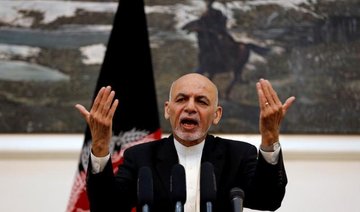
Afghan President Ashraf Ghani. (AFP)
Updated 01 March 2018
Follow

Ghani’s Taliban offer an act of desperation

LONDON: The Afghan president’s offer to make peace with the Taliban is unlikely to have any immediate impact on the militants or the direction of a war in which civilians are being increasingly targeted in complex, well-coordinated attacks.
Ashraf Ghani’s call for a cease-fire and his proposal to recognize the insurgent group as a political party may ultimately say more about his own beleaguered position and the intractability of a conflict now in its 17th year than it does about his ability to come up with a new strategy that has a realistic chance of success.
He knows the Taliban have always refused to acknowledge his administration, and the government of his predecessor, Hamid Karzai, as legitimate brokers in any peace negotiations. He must also surely suspect that this stance will not change now that the militants are openly active in 70 percent of the country, according to a recent BBC study.
For years the militants have said they are willing to talk — but only with American officials. The US toppled its regime in 2001 and continues to station 14,000 troops in Afghanistan. As far as the Taliban leadership is concerned, the last two Afghan presidents have been little more than Washington’s puppets.
Ghani’s speech at the opening of an international summit in Kabul yesterday will have played well with many of the dignitaries from the 23 nations in attendance. But Afghans have seen similar gatherings come and go in the past, and the sense of weariness and anger coursing through the country is more acute now than at any time since the American-led invasion.
In February, the UN reported that more than 10,453 civilians were killed or injured in Afghanistan during 2017, with 42 percent of casualties caused by the Taliban. While the total number represented a decrease on the previous year, 22 percent of the casualties were caused by suicide bombings and other complex insurgent attacks, compared with 17 percent in 2016.
Already this year there have been several high-profile attacks in Kabul, including one on Jan. 27 in which at least 95 people died when a suicide bomber driving an ambulance blew himself up in a heavily fortified part of the capital. The Taliban claimed responsibility, and its fighters seem intent on exploiting the government’s weakness by ramping up the violence in the weeks and months ahead.
Ghani’s offer to recognize the group as a legitimate political force is long overdue — a similar gesture by the US and Afghan governments at the start of the war may have helped save thousands of lives.
The timing of the president’s offer, amid the current wave of bloodshed, hints at his desperation.
The Taliban draw most of their strength from ethnic Pashtuns in the south and east of the country, and pockets of the north. While Ghani is himself a Pashtun, he has minimal support in what should be his natural heartland.
Further complicating any potential peace deal is the growing discord emanating from elements of the old Tajik-dominated Northern Alliance, which fought the Taliban regime in the 1990s and was the chief beneficiary of its demise.
Several powerful figures from this coalition of warlords and militia commanders feel sidelined by Ghani and are holding to their view that the Taliban are simply a proxy army for Pakistan. Rumours that these rogue officials are plotting a coup, or conspiring to foment violent unrest against the government, refuse to go away.
At the same time, Daesh has emerged as a small, but potent, force in Afghanistan. The terror group is unable to hold large areas of territory, but has the capacity to carry out devastating suicide bombings in urban centers and stands ready to embrace any disaffected Taliban fighters who would oppose signing a peace treaty when their group is in the ascendancy.


San Francisco parents scramble as teachers strike leaves 50,000 students out of school

Updated 3 sec ago
Follow

San Francisco parents scramble as teachers strike leaves 50,000 students out of school

  • On Tuesday, the San Francisco Unified School District’s 120 schools remained closed for a second day
  • About 6,000 teachers are striking over wages, health benefits, and resources for special needs students
SAN FRANCISCO: Connor Haught has been juggling virtual work meetings and arts and crafts projects for his two daughters as his family tries to navigate a teachers strike in San Francisco with no end date in sight.
Haught’s job in the construction industry allows him to work from home but, like many parents in the city, he and his wife were scrambling to plan activities for their children amid the uncertainty of a strike that has left nearly 50,000 students out of the classroom.
“The big concern for parents is really the timeline of it all and trying to prepare for how long this could go on,” Haught said.
The San Francisco Unified School District’s 120 schools were set to remain closed for a third day Wednesday, after about 6,000 public schoolteachers went on strike over higher wages, health benefits, and more resources for students with special needs.
Some parents are taking advantage of after-school programs offering full-day programming during the strike, while others are relying on relatives and each other for help with child care.
Haught said he and his wife, who works evenings at a restaurant, planned to have their 8- and 9-year-old daughters at home the first week of the strike. They hope to organize play dates and local excursions with other families. They have not yet figured out what they will do if the strike goes on a second week.
“We didn’t try to jump on all the camps and things right away because they can be pricey, and we may be a little more fortunate with our schedule than some of the other people that are being impacted,” Haught said.
The United Educators of San Francisco and the district have been negotiating for nearly a year, with teachers demanding fully funded family health care, salary raises and the filling of vacant positions impacting special education and services.
Teachers on the picket lines said they know the strike is hard on students but that they walked out to offer children stability in the future.
“This is for the betterment of our students. We believe our students deserve to learn safely in schools and that means having fully staffed schools. That means retaining teachers by offering them competitive wage packages and health care and it means to fully fund all of the programs we know the student need the most,” said Lily Perales, a history teacher at Mission High School.
Superintendent Maria Su said Tuesday there was some progress in the negotiations Monday, including support for homeless families, AI training for teachers and establishing best practices for the use of AI tools.
But the two sides have yet to agree on a wage increase and family health benefits. The union initially asked for a 9 percent raise over two years, which they said could help offset the cost of living in San Francisco, one of the most expensive cities in the country. The district, which faces a $100 million deficit and is under state oversight because of a long-standing financial crisis, rejected the idea. Officials countered with a 6 percent wage increase paid over three years.
On Tuesday, Sonia Sanabria took her 5-year-old daughter and 11-year-old nephew to a church in the Mission District neighborhood that offered free lunch to children out of school.
Sanabria, who works as a cook at a restaurant, said she stayed home from work to take care of the children.
“If the strike continues, I’ll have to ask my job for a leave of absence, but it will affect me because if I don’t work, I don’t earn,” Sanabria said.
She said her elderly mother helps with school drop off and pick up but leaving the children with her all day is not an option. Sanabria said she has given them reading and writing assignments and worked with them on math problems. Sanabria said she is making plans for the children day-by-day and expressed support for the striking teachers.
“They are asking for better wages and better health insurance, and I think they deserve that because they teach our children, they take care of them and are helping them to have a better future,” she said, adding, “I just hope they reach agreement soon.”