JEDDAH: Ahaad Alamoudi is a rising star in the world of Saudi art. Her latest work, Those Who Do Not Know of Falcons Grill Them, is on show now in Jeddah as part of Refusing to Be Still, the fifth edition of 21,39, an annual exhibition at the forefront of the country’s contemporary art scene.
Jeddah-based Alamoudi was born in 1991 to a family of artists.
“My mother is an artist, so I grew up surrounded by art and I realized very early on that I wanted to create art,” she said. “I did my bachelor’s degree in visual communication at Dar Al-Hekma University, here in Jeddah. Then I got my master’s in fine arts from the Royal College of Art in London.”
During her studies, her art began to evolve as she realized she needed to develop a focus in her work.
“In the beginning I just started by constantly producing work but I didn’t see it having any defined links,” said Alamoudi. “If there was a topic that I wanted to address, I would produce an artwork about it. That made me feel like my work wasn’t representing something specific because I use different mediums and talk about different topics. I felt like I didn’t have a defined position as an artist and I needed to grow.
“What was interesting for me is that I was able to refine my practice during my fine art master’s program. I was able to see more clearly the links within my body of work – and now I see my work as a form of anthropology, studying the ethnography and culture of my country and society. My work also helped me identify with my national identity on a more profound level.”
This evolution led her to the current focus of Alamoudi’s work, exploring the links between the ancient and modern.
“I use ethnographic methodologies to study the outlets of internet integration in Saudi Arabia,” she said. “A new global thought is emerging on the internet and is impacting on a culture that is deeply rooted in traditions and customs.
“My main focus is the manifestation of Saudi pop culture on social media, and the generated images that emerge from that space. Funny or dramatic viral videos and songs are not in any way truths about culture but people today have such strong connections to the symbolism within them – and that’s what my work studies.
“I gather and examine mass-media products generated by the Kingdom. These are personal videos that have been altered and stripped of their own form. Through their continued use as viral videos they become artifacts that define current Saudi culture.”
Alamoudi’s work on show at the 21,39 exhibition is a 7-minute presentation incorporating video, sound, sand and organic material. It explores the progression, evolution and speed of change that are part of the process of realizing a new vision for the country and the changing social landscape. She uses images of falcons as a symbolic reference to the co-existence of traditional and modern attitudes.
“Those Who Do Not Know of Falcons Grill Them is a commentary on the constant progressive changes that are occurring around me,” she said. “It’s about the formation and reformation of my country and society.
“I view change as a positive thing but a part of me wants to slow it down and see how communities are affected.”
While she has clearly put a lot of thought and meaning into her work, Alamoudi is reluctant to spell it all out to viewers, instead preferring that they form individual interpretations and find their own meaning.
“To me, the work is more of an emotional experience, so I let it be,” she said. “I let them experience it guided by their own experiences. Whether they love it or hate it, it triggers an emotion in them and that’s what art is for.”
Alamoudi this year started teaching in the Visual Communication faculty at Dar Al-Hekma, the same university from which she graduated.
“I went from being a student in the Visual Communication department to becoming a part of the faculty and it’s a really strange and amazing experience,” she said. “But I still see them as my teachers.
“The most important thing I teach to my students about art is that they have the space to share their ideas and thoughts and that there’s nothing wrong with that.”
Alamoudi would like to see more investment in art education in Saudi Arabia, but points out that this if not the only way for artists to grow and develop.
“I think there’s a necessity and a responsibility on communities and governments to invest in art education,” she said. “That being said, I don’t think that a formal education in art is a prerequisite to becoming an artist – but it does inform the way we reflect on our cultural identity.”
In another sign of her growing reputation, Alamoudi’s work will be on show at the 12th edition of the highly regarded Art Dubai event next month.
“This year will be the first time I get to participate with my artwork in Art Dubai and I’m really proud of that,” she said.
Ultimately, she believes there should be one priority above all when creating art.
“Having fun with the work,” she says. “If I’m not having fun creating then there’s nothing in it for me. I use a lot of comedy in my work as a form of addressing serious topics.”
* 21,39’s Refusing to Be Still exhibition continues until May 5, 2018. Visit www.21-39.com for venues and more details. Art Dubai takes place from March 21 to 24, 2018. Visit www.artdubai.ae.


![]()
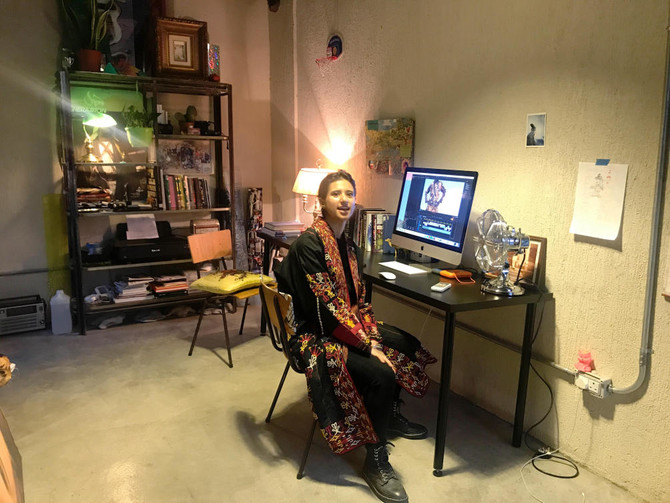
Ancient and modern attitudes collide in the work of Saudi artist Ahaad Alamoudi
Ancient and modern attitudes collide in the work of Saudi artist Ahaad Alamoudi
Latest updates


© 2026 SAUDI RESEARCH & PUBLISHING COMPANY, All Rights Reserved And subject to Terms of Use Agreement.