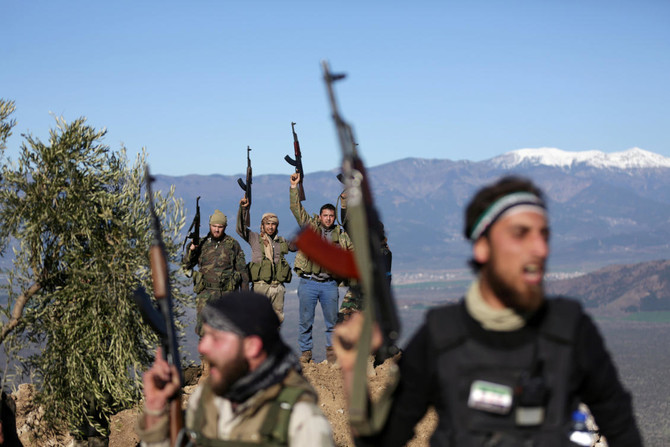
ANKARA: The Kurdish Hawks Brigade, dubbed the “red berets”, will reportedly join Turkey’s Operation Olive Branch in Syria’s Kurdish-held northwestern province of Afrin, where it will take part in fighting in Afrin city center.
The brigade was formed by the Hamza Division, which is affiliated to the Free Syrian Army (FSA). The brigade includes 400 Kurdish fighters from Syria’s Azaz region, and 200 Arabs.
“God willing, we will liberate our people in Afrin from PKK (Kurdistan Workers’ Party) oppression,” said Kurdish Commander Hassan Abdullah Kulli, Turkish state-run agency Anadolu reported.
In a similar move, about 180 state-funded Kurdish village guards recently joined Turkey’s operation.
Kurdish village guards are used by the Turkish state in operations against Kurdish militants in the country’s southeast.
Turkey has been conducting Operation Olive Branch for more than five weeks against the Kurdish People’s Protection Units (YPG), which Ankara sees as a terrorist group affiliated with the PKK, which is waging an insurgency against the state.
Turkey says the Afrin operation is not covered by Sunday’s UN Security Council resolution that demands a 30-day truce across Syria to allow aid access and medical evacuations.
“Although the Kurdish Hawks Brigade is a special unit that would have a better understanding of the local culture, language and geography, it’s hard to estimate how many of them are really from this region and know its topography,” Salih Bicakci, a Middle East expert from Kadir Has University in Istanbul, told Arab News.
“But their military training will probably help the FSA gain the upper hand in the looming urban warfare.”
However, Bicakci said the YPG also gained considerable urban warfare experience during the four-month siege of the northern Syrian town of Kobani, which was captured from Daesh.
Aaron Stein, senior resident fellow at the Atlantic Council in Washington, told Arab News that after taking Afrin, “Ankara will then have to administer and rebuild damaged areas, as is the case in Euphrates Shield territory. Afrin is small, but the population will be hostile.”
Last March, Turkey ended its seven-month Operation Euphrates Shield in northern Syria against Daesh and the YPG.
Dr. Magdalena Kirchner, Mercator-IPC fellow at the Istanbul Policy Center, told Arab News: “Keeping a seat at the Astana table with the other guarantor countries Russia and Iran, and having a role as a guarantor power in Syria, requires Turkey to resist pressure from the Syrian regime, which aims to create a new narrative that Kurds are only safe under its rule.”
Using local village guards in Afrin is less costly and risky than deploying Turkish troops, she added.
“They’re familiar with the area and could accelerate, through better communication, the PKK’s withdrawal from the city,” she said.
But the political gains for Ankara will be less than it expects due to the small number of Kurds fighting on its side, Kirchner added.


![]()
Kurdish brigade to fight for Turkey in Syria’s Afrin
Kurdish brigade to fight for Turkey in Syria’s Afrin
Latest updates




Recommended


© 2026 SAUDI RESEARCH & PUBLISHING COMPANY, All Rights Reserved And subject to Terms of Use Agreement.