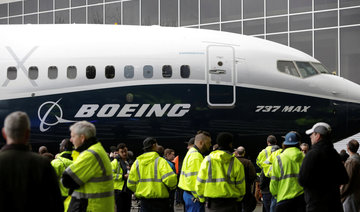
BRASILIA: Boeing will have a 51 percent stake in a joint company currently being negotiated with Brazilian aircraft maker Embraer, O Globo newspaper columnist Lauro Jardim reported on Sunday.
Boeing has agreed to a Brazilian government demand that the US company have no more than a 51 percent controlling share, Jardim said, without citing sources.
Embraer said it would not comment on the matter. Boeing did not respond to a request for comment.
Boeing has sought Brazilian government approval of the partnership with Embraer that would create a new company focused on commercial aviation, excluding Embraer’s defense unit, Reuters reported three weeks ago.
The Valor Economico newspaper later reported that Boeing’s proposal would give it an 80 percent to 90 percent stake in a new commercial jet business with Embraer.
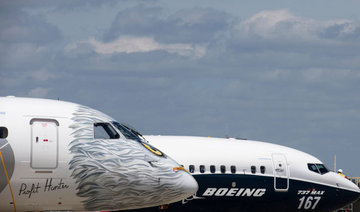
Embraer is the world’s third largest planemaker and the leader in the 70-seat to 130-seat regional jet market.
With the proposed tie-up Boeing would be the market leader in the smaller passenger jet market, creating stiffer competition for the CSeries aircraft program designed by Canada’s Bombardier Inc. and backed by European rival Airbus SE.
Boeing’s initial plan to buy Embraer was rejected by the Brazilian government because it did not want a foreign company to control its defense unit for strategic security reasons.
The government maintains a so-called golden share in Embraer, a former state enterprise, that gives it veto power over strategic decisions, including Boeing’s push for a tie-up.
On Thursday Brazilian Defense Minister Raul Jungmann told reporters that Boeing had understood Brazil’s refusal to give up control of Embraer. He said negotiations on the creation of a third company were advancing well.

Boeing to have 51% stake in venture with Embraer, Brazilian newspaper says
Saudi Arabia aims to raise foreign ownership cap in listed companies this year
RIYADH: The Saudi Capital Market Authority has announced that a review of the rules restricting foreign ownership in local stocks is underway, as the Kingdom seeks to further open up to international investors.
Board member Abdulaziz Abdulmohsen Bin Hassan confirmed that “the foreign ownership limits are under review,” referring to the current caps that prevent foreign investors from holding majority stakes in local companies.
He added: “We are committed to completing this and hope to do so this year.”
Review of Cap continues
The remarks, made at the Capital Markets Forum Select in New York on Feb. 2, indicate that the regulator is moving forward with plans to raise the ownership cap from 49 percent this year, following months of uncertainty surrounding the issue.
Bin Hassan did not elaborate on the next steps, but the CMA stated that the review will examine whether the foreign ownership limits should be eliminated entirely or adopted in a phased approach.
A long-awaited decision could boost foreign investment flows
A change to the rules is one of the most anticipated developments in the Saudi financial market in 2026. Wall Street firms, including Goldman Sachs and JPMorgan, have stated that the complete removal of the cap could lead to new inflows of around $10 billion into the Riyadh stock exchange.
“Foreign capital is extremely important for Saudi Arabia, and it’s very important to highlight where we were four or five years ago,” Nayef Al-Athel, group chief of sales and marketing officer at Tadawul Group, told Bloomberg in an interview.
“We were a local market driven by individual investments, where about 80 percent of the investor base and liquidity came from individual investors. We made significant efforts to institutionalize the Saudi market, and today we are at a 50/50 split between institutions and individuals, with a large portion of institutional funds coming from foreign investors,” he added.
For his part, Yazeed Al-Dumeiji, CEO of Wamedh, the technology and innovation arm of the Tadawul, said in an interview on the sidelines of the forum that “the vast majority of our clients are from the US and Europe, and we are beginning to see growth from Asian investors, specifically from Singapore, Hong Kong, China, and Japan.”
Saudi Arabia’s anticipated move to liberalize its stock market comes as part of a package of recent reforms, including allowing all foreigners to trade directly in local stocks, and aims to attract more foreign direct investment to the Kingdom. This is part of Crown Prince Mohammed bin Salman’s efforts to build stronger financial markets, supporting his vision to diversify the economy away from oil with an investment volume approaching $2 trillion.
The Saudi stock market index, TASI, rose 8.5 percent in January, marking its best monthly performance since 2022, partly fueled by optimism surrounding these changes. The index also climbed 1.4 percent on Feb. 2.
Speaking at the Capital Markets Forum Select New York 2026, Tadawul CEO Mohammed Al-Rumaih explained that foreign ownership is expected to increase and reach $100 billion by 2030, according to Al-Eqtisadiah.
He also noted that the Saudi market capitalization now exceeds $2.5 trillion.
“The Saudi capital market is resilient and undergoing a radical transformation,” he said.
The CEO added: “We see many opportunities in our future collaboration with Nasdaq.”