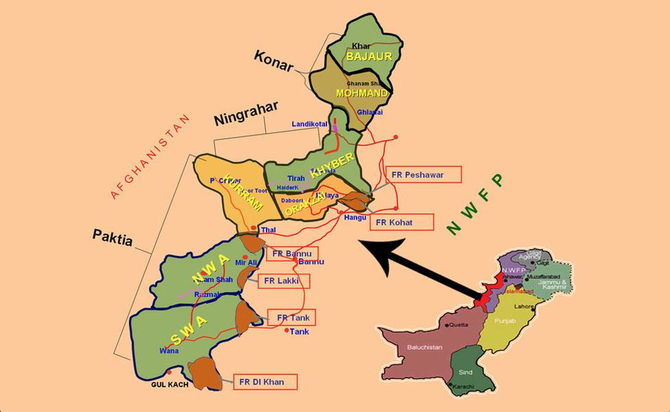
PESHAWAR: Pakistan’s northwestern tribal belt was once the focus of international attention. The area constituted one of the largest ungoverned spaces in the region and was used by various transnational militant networks as a sanctuary.
As the world began to call it the global “ground zero for terror”, Pakistan launched a string of military operations to reclaim the craggy mountainous terrain abutting Afghanistan and re-establish its writ over that territory.
Even so the Federally Administered Tribal Areas (FATA) continue to be a major challenge to the country. The British used the region as a buffer zone to avoid a direct confrontation with Russia, and the Pakistani authorities did not revisit this colonial policy. For decades, there was no attempt to mainstream the region by changing its anomalous legal and administrative systems introduced to control, not govern, the tribal zone. As a result, FATA remained quite underdeveloped and its people did not have the same citizenship rights as other Pakistanis.
However, the country’s recent experience with violent extremism in the area has compelled policymakers to take a fresh look at the situation, and it has turned out to be a daunting challenge.
In a report in August 2016, the Fata Reforms Committee, established to look into the issue, recommended that FATA should merge with the province of Khyber Pakhtunkhwa (KP). Explaining the rationale behind its recommendation, the committee said that the seven tribal agencies in the area were not deeply integrated with one another, and their residents mostly interacted with people in the adjacent settled districts of Khyber Pakhtunkhwa (KP).
According to the 2017 census, FATA has 558,379 households and a population of just over five million whereas the 1998 census declared that the population was 3.1 million. Many analysts remain skeptical toward the recent census results, suggesting much of the tribal population has either migrated to other parts of the country or been displaced by militancy and subsequent military operations.
Malik Khan Marjan, Chief Patron of the FATA Grand Alliance, told Arab News: “The FATA population has been downplayed in the recent census to give it a small share in the national resources.”
An author and research scholar, Dr. Khadim Hussain, said that ungoverned spaces such as FATA have created a massive industry for war, kidnapping, drug trafficking, car lifting, hired assassins, and private militias who established their training camps over there in the past.
“Mainstreaming FATA will change that, and if the region is mainstreamed and a local government is installed there, the fund meant for FATA development will also be overseen and audited. At present, no one knows where the FATA funds are being spent,” he added.
While Dr. Hussain agreed that FATA should be merged with KP, Marjan opposed the idea and said that the tribal belt should be turned into a separate province. He pointed out that FATA Medical College was being set up in Kohat, a settled area, instead of the tribal region.
“Merger with KP cannot remove our sense of deprivation,” he said. “We have been subjected to such politics of dispossession for a very long time. The only way to bring it to an end is to turn FATA into a province.”
A politico-religious party, Jamiat Ulema-e-Islam-Fazl (JUI-F), has also been railing against the FATA-KP merger. The party’s provincial spokesperson, Hajji Abdul Jalil Jan, told Arab News: “Until now, FATA has been seeking donations from the federal government. If the merger takes place, the region will seek alms from a weak province like KP.
“If FATA is turned into a separate province it will get its own resources like the other provinces. A provincial status is therefore better for its people.”
However, Pakistan Tehreek-e-Insaf, the party ruling the KP province, has launched a campaign to merge FATA with KP.
Talking to Arab News, the province’s chief minister, Pervez Khattak, mentioned the cultural affinities among the residents of KP and FATA. “They both speak Pashto,” he pointed out, “and their culture is also the same. Hence, it makes sense to merge the two.”
Responding to a question, he said: “There is no threat of an Afghan claim on FATA even if we merge it with KP. We are fencing the border with Afghanistan and much of the work has already been done.”
The chief minister added that if FATA was merged with KP, it would receive 100 billion rupees ($903 million) a year for 10 years, bringing it on par with other developed areas of the country. He also disputed the claim that the merger of the two entities would take a long time.
“Once an administrator is appointed to supervise the process,” he added, “it could be carried out within a month.”


![]()
FATA reforms: future of tribal region hangs in the balance
FATA reforms: future of tribal region hangs in the balance
Latest updates




Recommended


© 2026 SAUDI RESEARCH & PUBLISHING COMPANY, All Rights Reserved And subject to Terms of Use Agreement.