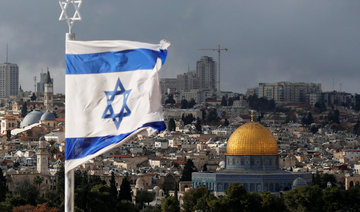
ANKARA: Turkey on Saturday described as “extremely worrying” the US move to open its embassy in Jerusalem in May to coincide with the 70th anniversary of the founding of Israel.
Friday’s announcement by Washington to move the embassy from Tel Aviv to the disputed city follows US President Donald Trump’s recognition of Jerusalem as Israel’s capital in December.
“This decision shows the US administration’s insistence on damaging the grounds for peace by trampling over international law, resolutions of UN Security Council on Jerusalem,” the Turkish Foreign Ministry said in a statement.
“Turkey will continue its effort to protect the legitimate rights of the Palestinian public ... against this extremely worrying decision by the US,” the ministry added.
Ankara said the decision showed the US does not hear, “and worse still, does not care about the voice of the international community’s conscience.”
Turkish President Recep Tayyip Erdogan led condemnation of the ruling in December and called an Organization of Islamic Cooperation (OIC) summit of the leaders of Muslim nations in Istanbul shortly after Trump’s announcement last year.
The leaders urged the world to recognize East Jerusalem as the Palestinian capital.
East Jerusalem was annexed by Israel after it seized control of the area in the 1967 war, but the move has never been recognized by the international community.
Jerusalem is a city considered holy by Christians, Jews and Muslims and is perhaps the most sensitive issue in the Israeli-Palestinian conflict.
The Palestinian leadership on Friday said the US move, a year earlier than originally expected, was “a provocation to Arabs.”
The founding of Israel on May 14, 1948 is mourned by Palestinians as the Nakba, or “catastrophe” when an estimated 750,000 Palestinians either fled or were expelled from their homes in the war surrounding Israel’s creation.
Relations between Turkey and the US have already been strained over multiple issues including Ankara’s latest offensive in Syria against a US-backed Kurdish militia.
Although Erdogan has frequently criticized Israel’s policies, the two sides increased cooperation following the end of a rift in 2016 caused by Israel’s storming in 2010 of a Gaza-bound ship that left 10 Turkish activists dead.


Turkey: US decision to open embassy in Jerusalem damaging peace


Turkey: US decision to open embassy in Jerusalem damaging peace

Fledgling radio station aims to be ‘voice of the people’ in Gaza
- The electricity crisis is one of the most serious and difficult problems in the Gaza Strip, says Shereen Khalifa Broadcaster
DEIR EL-BALAH: From a small studio in the central city of Deir El-Balah, Sylvia Hassan’s voice echoes across the Gaza Strip, broadcast on one of the Palestinian territory’s first radio stations to hit the airwaves after two years of war.
Hassan, a radio host on fledgling station “Here Gaza,” delivers her broadcast from a well-lit room, as members of the technical team check levels and mix backing tracks on a sound deck. “This radio station was a dream we worked to achieve for many long months and sometimes without sleep,” Hassan said.
“It was a challenge for us, and a story of resilience.”
Hassan said the station would focus on social issues and the humanitarian situation in Gaza, which remains grave in the territory despite a US-brokered ceasefire between Israel and Hamas since October.
“The radio station’s goal is to be the voice of the people in the Gaza Strip and to express their problems and suffering, especially after the war,” said Shereen Khalifa, part of the broadcasting team.
“There are many issues that people need to voice.” Most of Gaza’s population of more than 2 million people were displaced at least once during the gruelling war.
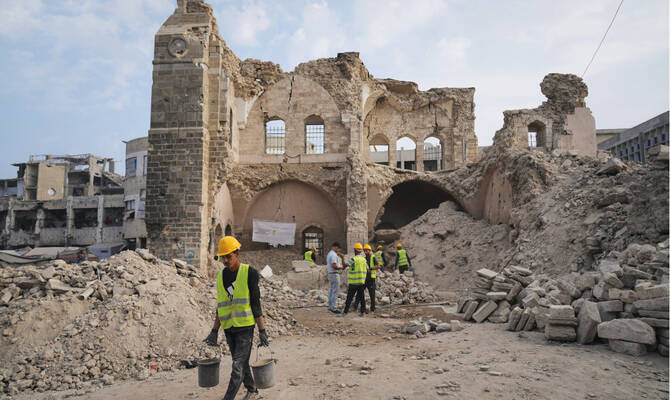
Many still live in tents with little or no sanitation.
The war also decimated Gaza’s telecommunications and electricity infrastructure, compounding the challenges in reviving the territory’s local media landscape. “The electricity problem is one of the most serious and difficult problems in the Gaza Strip,” said Khalifa.
“We have solar power, but sometimes it doesn’t work well, so we have to rely on an external generator,” she added.
The station’s launch is funded by the EU and overseen by Filastiniyat, an organization that supports Palestinian women journalists, and the media center at the An-Najah National University in Nablus, in the occupied West Bank.
The station plans to broadcast for two hours per day from Gaza and for longer from Nablus. It is available on FM and online.
Khalifa said that stable internet access had been one of the biggest obstacles in setting up the station, but that it was now broadcasting uninterrupted audio.
The Gaza Strip, a tiny territory surrounded by Israel, Egypt, and the Mediterranean Sea, has been under Israeli blockade even before the attack on Oct. 7, 2023, which sparked the war. Despite the ceasefire, Israel continues to strictly control the entry of all goods and people to the territory.
“Under the siege, it is natural that modern equipment necessary for radio broadcasting cannot enter, so we have made the most of what is available,” she said.



