Hillside crashes onto Indonesian farmers; 5 dead, 18 missing

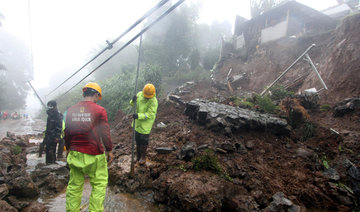
People take photos of a landslide in Brebes, Indonesia February 22, 2018, in this image obtained from social media. (Aji Santoso/via REUTERS)
Updated 23 February 2018
Follow

Hillside crashes onto Indonesian farmers; 5 dead, 18 missing

BREBES, Indonesia: Farmers were working in their rice paddies on the Indonesian island of Java, when the soggy hillside above them collapsed under the weight of torrential rains, killing five people and leaving rescuers digging for 18 missing.
Survivors described a sudden roar as Thursday’s landslide was unleashed, sweeping trees and everything else in its path toward the terraced rice fields below.
“The hill above us looked like it was spinning down,” said Watirah, a 53-year-old farmer from Pasir Panjang village, who with other villagers from the affected hamlet in Central Java’s Brebes district tried to outrun the sliding earth.
“I tried to keep going, tried to stand up and screamed loudly for help before I fell again,” said Watirah, who goes by a single name. “I felt my body was so weak I couldn’t stand up, but three people came to save me,” she said. Her husband, Minarto, who was working in a nearby field, also narrowly survived.
Hundreds of rescuers including soldiers and villagers were using their bare hands and farm tools to search for victims buried beneath tons of mud and soil. The search and rescue team was having difficulty finding victims because of the unstable muddy conditions and width of the landslide.
“Heavy equipment cannot be used,” said National Disaster Mitigation Agency spokesman Sutopo Purwo Nugroho.
Sutopo said 14 people were hospitalized with injuries. He said 18 others are missing based on reports from residents.
Local disaster official Eko Andalas said the landslide, which started in surrounding hills that are part of a forestry plantation, was triggered by torrential rains.
Disaster officials urged people to stay away from the area because of the risk of further landslides.
Seasonal rains cause widespread flooding and landslides across much of Indonesia, an archipelago of more than 17,000 islands. Millions of people live in mountainous regions and on flood plains.


Italian PM pledges to deepen cooperation with African states

Updated 14 February 2026
Follow

Italian PM pledges to deepen cooperation with African states

  • The plan, launched in 2024, aims to promote investment-led cooperation rather than traditional aid

ADDIS ABABA: Italy pledged to deepen cooperation with African countries at its second Italy-Africa summit, the first held on African soil, to review projects launched in critical sectors such as energy and infrastructure during Italy’s first phase of the Mattei Plan for Africa.

The plan, launched in 2024, aims to promote investment-led cooperation rather than traditional aid.

Italy’s Prime Minister Giorgia Meloni addressed dozens of African heads of state and governments in Ethiopia’s capital, Addis Ababa, and reiterated that a successful partnership would depend on Italy’s “ability to draw from African wisdom” and ensure lessons are learned.

“We want to build things together,” she told African heads of state.  “We want to be more consistent with the needs of the countries involved.”

Ethiopian Prime Minister Abiy Ahmed said Italy had provided Africa with a gateway to Europe through these partnerships.

“This is a moment to move from dialogue to action,” he said. 

“By combining Africa’s energetic and creative population with Europe’s experience, technology, and capital, we can build solutions that deliver prosperity to our continents and beyond.”

After the Italy-Africa summit concluded, African leaders remained in Addis Ababa for the annual African Union Summit.

Kenyan writer and political analyst Nanjala Nyabola said tangible results from such summits depend on preparations made by countries.

African governments often focus on “optics instead of actually making summits a meaningful engagement,” she said.

Instead of waiting for a list of demands, countries should “present the conclusions of an extended period of mapping the national needs” and engage in dialogue to determine how those needs can be met.

Since it was launched two years ago, the Mattei Plan has directly involved 14 African nations and has launched or advanced around 100 projects in crucial sectors, including energy and climate transition, agriculture and food security, physical and digital infrastructure, healthcare, water, culture and education, training, and the development of artificial intelligence, according to the Italian government.