CAIRO: Nada Mohammed has been married for nearly two years and has two children. But there is no official record of her marriage, or of her children’s birth.
This is because Nada was married at just 15, three years under the age of legal marriage in her home country, Egypt. Going to school is compulsory in the country between the ages of six and 15.
Nada had not finished school and now never will. She is still only 16.
“My parents believe it is more important for me to be married and settled in my husband’s house than for me to have an education,” says Nada, who is from a small village near the city of Tanta, 120 km north of Cairo. As a girl, she had no right to object, she adds.
Her husband is 18 and works in construction. Before marrying Nada, he was made to sign a document declaring he owes her father a large sum of money. This is to deter him from deserting Nada, giving her some level or security, or money for her and her family if he does leave.
It was deemed necessary to do this as with no official marriage record when a bride is under age, there can be no comeback if her husband walks out before she is 18, or if he tries to blackmail her family by threatening to expose them for giving him false information about her age.
Further, as Nada’s marriage cannot be registered until she is 18, the birth of her one-year-old child and newborn cannot be registered either. Even when she is legally able to register her marriage, it could be difficult to register her children as it would expose her under-age marriage. And so her relatives have bribed registry officials to falsify Nada’s age on documents.
“Relatives and friends have intervened to help my family register my children in the civil registry until I am 18 years old and the marriage is documented,” she said.
Despite child marriage being illegal in Egypt, unfortunately it is still not uncommon. The Egyptian constitution states: “Any person under the age of 18 is considered a child.”
The law on under-age marriage is clear: “A marriage contract may not be registered for a person who has not attained the age of 18.”
Egypt is a signatory to the African Union’s Charter on the Rights and Welfare of the Child, which outlaws marriage to anyone under 18.
But even though it contravenes domestic and international law, marrying a minor is not a criminal offense in Egypt and so it continues to happen on a large scale.
According to a 2017 census by the Central Agency for Public Mobilization and Statistics, 118,904 girls in Egypt were under 18 when they wed and 18,127 — 15 percent — were under 16.
The Ministry of Health says that 500,000 children are born every year to underage mothers.
In 2006, the International Population Council in Egypt interviewed girls and women who married young. It was found that 62 percent of the girls who married young did so because their parents had forced them to get married.
There is no sign of a change in the number of child marriages since then, and the driving factors now and then are the same: Poverty — marrying off a daughter means one less mouth to feed — and the fear of losing social status. A girl who loses her virginity before her wedding shames her whole family. The fear is that the longer a girl remains unwed, the higher the chance that she will have her purity compromised.
According to Dr. Iqbal Samalouti, formerly dean of the High Academy for Social Services, a branch of the Higher Education Ministry, 36 percent of the marriages in impoverished rural Egypt involved under 16s, and 16 to 20 percent of all babies born in the Arab world were born to adolescent mothers.
Since marrying a minor is not a recognized crime punishable by law, it is treated as fraud.
Legal experts say the bride’s father and the person officiating at such weddings should be fined and the marriage annulled.
They also demand that the law should clearly state that minors in the marriage are not at fault.
Mohamed Hamed Al-Gamal, a former judge, wants the offense of forcing or facilitating child marriage should carry a jail sentence of seven years to life as a deterrent.
“The marriage of minors is a big problem for the girl and for society as it leads to an increase in the number of births and the consequent crises in society,” he said.
In an official editorial, lawyer Amr Abdel Salam, deputy head of Al-Haq International Human Rights Organization, said the police should be proactive in pursuing offenders.
“A crime has been committed and that is a matter of national security,” he said.
In a speech last October, following the publication of the annual census, President Abdel Fattah El-Sisi admitted he was shocked by the figures on the numbers of girls married at age 12.
“At this young age, we are putting too much responsibility on their shoulders,” said the president.
“How can a girl get married at 12? There are widows and divorcees who are 12 years old. We are cruel to our children.”
Nada, still a child in the eyes of the law, was allowed no say in her own marriage. But that does not mean she has no opinion on it.
“Early marriage before the legal age is not in the interest of any girl,” she says. “My advice is that girls should wait until they reach legal age so that they can take responsibility for the family and their children.”


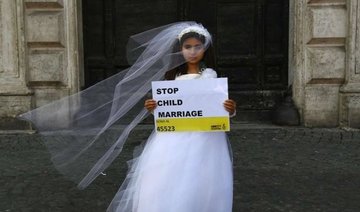
Despite child marriage being illegal in Egypt, it is still all too common

Despite child marriage being illegal in Egypt, it is still all too common



New poll shows only 6% of Arabs accept recognizing Israel
- Reasons ‘mainly linked to its colonial, racist, and expansionist nature’
- More than 40,000 people in 15 Arab countries surveyed on wide range of issues
CHICAGO: Eighty-seven percent of citizens in the Arab world oppose recognition of Israel while only 6 percent accept it, according to a new survey by the Arab Center Washington DC.
The 2025 Arab Opinion Index, conducted nine times since 2011, surveyed more than 40,000 people in 15 Arab countries on a wide range of issues including politics, economy and identity.
“An overwhelming majority … oppose recognition of Israel,” Tamara Kharroub, deputy executive director and senior fellow at the ACW, said during a live webinar on Tuesday attended by Arab News.
That finding has been consistent and within range in every poll conducted since 2014, according to the center’s polling data.
The 15 countries surveyed are Algeria, Egypt, Iraq, Jordan, Kuwait, Lebanon, Libya, Mauritania, Morocco, Palestine, Qatar, Saudi Arabia, Sudan, Syria and Tunisia.
The highest rates of opposition to recognizing Israel were recorded in Libya (96 percent), Jordan (95 percent), Kuwait (94 percent) and Palestine (91 percent).
A conclusion cited in the poll said: “Those who opposed recognizing Israel cited various factors, mainly linked to its colonial, racist, and expansionist nature and its continued occupation of Palestinian territory. Cultural or religious explanations were largely absent.
“The reasons cited by respondents clearly indicated that their position on recognizing Israel is not likely to change as long as its colonial nature persists.”
Kharroub said the number that accept recognition of Israel “dropped by 2 percentage points in the 2025 Arab Opinion Index, compared to the 2022 survey.”
She added of those 6 percent, “half made such a move conditional on the formation of an independent Palestinian state.”
Yousef Munayyer, ACW’s head of the Palestine / Israel Program and senior fellow, said: “Israel continues to be widely perceived as a threat and not a partner. This is something that has only been escalated in recent years.”
He added: “Normalization lacks popular legitimacy, not just because of the lack of support for it among Arab public opinion, but also because the threat perception in the region has changed significantly over the last several years, and that’s perhaps one of the most important developments since the genocide in Gaza began.”
Seventy percent oppose a peace deal between Syria and Israel that does not include the return of the Syrian Golan Heights.
Other findings include the broader public view that despite different nationalities, 76 percent of respondents see the Arab world as being a “single nation” or an “Arab nation.”
The full survey report can be viewed at www.ArabCenterDC.org.


