JORDAN: Married at 15 and divorced at 16, a Syrian teen says she regrets having said yes to a handsome suitor — a stranger who turned into an abusive husband.
Yet the reasons that transformed her into a child bride have become more prevalent among Syrians who live in Jordanian exile because of a six-year-old civil war back home. More families marry off daughters to ease the financial burden or say marriage is the way to protect the “honor” of girls seen as vulnerable outside their homeland.
Figures from Jordan’s population census document the long suspected increase for the first time. In 2015, brides between the ages of 13 and 17 made up almost 44 percent of all Syrian females in Jordan getting married that year, compared to 33 percent in 2010.
With Syrians expected to remain in exile for years, it’s a harmful trend for refugees and their overburdened host country, UN and Jordanian officials say.
More Syrian girls will lose out on education, since most child brides drop out of school. They typically marry fellow Syrians who are just a few years older, often without a steady job — a constellation that helps perpetuate poverty. And they will likely have more children than those who marry as adults, driving up Jordan’s fertility rate.
“This means we will have more people, more than the government of Jordan can afford,” said Maysoon Al-Zoabi, secretary general of Jordan’s Higher Population Council.
The figures on early marriage were drawn from Jordan’s November 2015 census and compiled in a new study.
The census counted 9.5 million people living in Jordan, including 2.9 non-Jordanians.
Among the foreigners were 1.265 million Syrians — or double the number of refugees registered in the kingdom since the outbreak of the Syria conflict in 2011. The other Syrians include migrant laborers who came before the war, and those who never registered as refugees.
The figures on early marriage include all Syrians in Jordan, not just registered refugees.
Many came from southern Syria’s culturally conservative countryside, where even before the conflict girls typically married in their teens. Still, the study shows a higher rate of early marriage among Syrians in exile than in their homeland.
The teen divorcee fled Syria’s Daraa province in 2012, along with her parents and four siblings. The family eventually settled in a small town in the northern Mafraq province.
The parents and the teen, now 17, spoke on condition of anonymity because of the stigma of divorce. They said they wanted to speak out, nonetheless, in hopes of helping others avoid the same mistake.
Child brides are traditionally shielded from outsiders, and the family provided a rare glimpse at what drives early marriage.
“When we came here, our lives were disrupted,” said the teen’s mother, sitting on a floor cushion in the living room of their small rented home. “If we had remained in Syria, I would not have allowed her to get married this young.”
The family scrapes by on small cash stipends and food vouchers from UN aid agencies, along with the father’s below-minimum-wage income as a laborer.
Worse, the family feels adrift.
The parents, fearful their children would be harassed, especially the girls, did not enroll them in local schools, typically overcrowded to accommodate large numbers of Syrians.
In such a setting — girls sitting at home without a seeming purpose — the push to have them get married becomes stronger.
An older sister of the teen also married as a minor. The mother said she often feels regret about her daughter having been robbed of her childhood.
The younger girl spent most of her time at home, brooding. She had no girlfriends since she didn’t go to school and was only allowed to leave the house with her mother, in line with traditions. In any case, there was nothing to do in the small desert town.
Two years ago, a young Syrian man asked for the teen’s hand, after introductions had been made by a go-between. The intermediary talked up the stranger, saying he had job prospects and could afford his own apartment.
The teen, 15 at the time, accepted. “I was bored and sad,” she said. “I wanted to get married.”
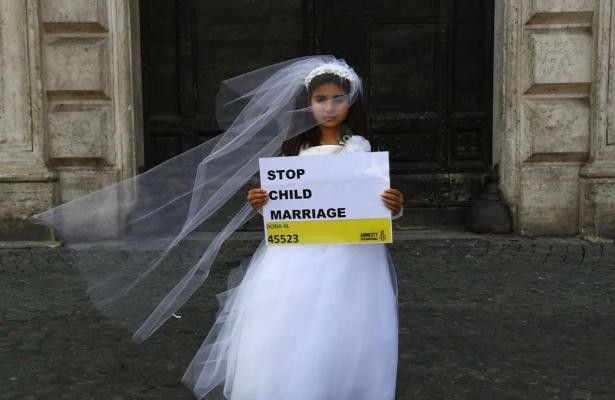
The parents said the young man seemed immature, but that their daughter insisted. The wedding took place a month later, and the bride wore a white dress.
The marriage contract was sealed by a Syrian lawyer, not a Jordanian religious court judge, meaning it was not officially recognized in Jordan.
Local law sets the minimum age of marriage for girls at 18, though Jordanian judges often allow exceptions for brides between the ages of 15 and 17.
In 2015, 11.6 percent of Jordanian females who married that year were minors, compared to 9.6 percent in 2010, indicating a slight rise that Al-Zoubi believes is caused in part to Jordanians being influenced by Syrian customs.
After marriage, the Syrian teen moved to a different town with her husband, and his promises quickly evaporated. The couple moved in with his extended clan, and the teen turned into a maid, according to her parents. The teen said her unemployed husband beat her.
Despite the abuse, she said she wanted to stay in the marriage, fearful of the shame of divorce. Her father eventually insisted on divorce to extract her from what he felt was a harmful situation.
After returning home, the teen briefly attended an informal education and children’s support program called Makani that is run by the UN child welfare agency and other aid groups at centers across Jordan. She started making friends, but stayed away again when a new group of students signed up.
Robert Jenkins, the head of UNICEF in Jordan, said that by the time girls are married, it’s often too late to get them back to education.
“Our absolute first line of defense is prevention (of early marriage),” he said, adding that the agency tries to support families and teens so they won’t opt for early marriage.
In the Zaatari refugee camp, such intervention appears to have had an impact, said Hussam Assaf, 32, who rents and sells white bridal gowns and colorful engagement dresses in the local market.
Assaf said the typical age of his customers in Zaatari is 16 or 17, compared to 14 or 15 in his hometown in rural Syria, crediting counseling programs by aid groups with the change.
The young divorcee, meanwhile, hasn’t ruled out marriage in the future. She said it’s unlikely she’ll ever go back to school because she has already missed five years of learning.
Still, she thinks about what could have been.
“If I had continued my education, it would have been better,” she said. Her trauma of her brief marriage “has made me weaker,” she said.


![]()
More Syrian child brides in Jordan amid poverty, uncertainty
More Syrian child brides in Jordan amid poverty, uncertainty
Latest updates



© 2026 SAUDI RESEARCH & PUBLISHING COMPANY, All Rights Reserved And subject to Terms of Use Agreement.