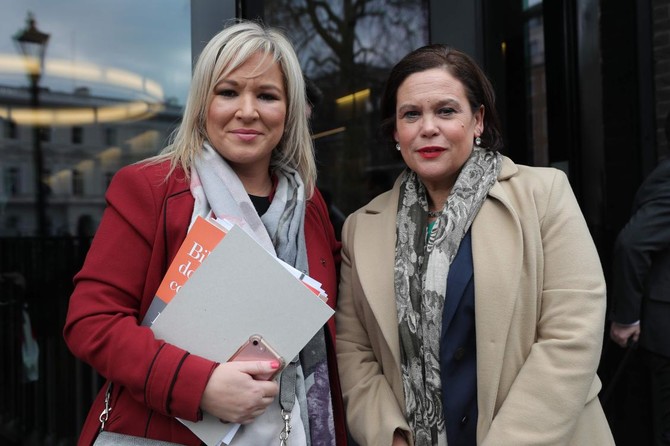
LONDON: Sinn Fein leader Mary Lou McDonald warned Thursday that Brexit was “a clear and imminent threat” to the island of Ireland and was incompatible with Northern Ireland’s two decades-old peace accord.
“The reality is that Brexit and the Good Friday Agreement are not compatible,” the Irish republican leader said, referencing the landmark 1998 accord which devolved government to the British province and ended several decades of deadly violence.
“Brexit, whether it is hard or soft, represents a clear and imminent threat to the economic, social and the political functioning of Ireland in its totality,” she added.
McDonald, speaking to reporters during her first visit to Britain since taking over from veteran Republican leader Gerry Adams earlier this month, criticized recent comments by several British lawmakers suggesting the agreement should be revisited.
Northern Ireland has been without a devolved government for more than a year after Sinn Fein and the Democratic Unionist Party (DUP) pulled out of a joint executive amid political disagreements.
Months of talks, including with British Prime Minister Theresa May this week, have so far failed to bridge their differences.
McDonald said those now coming out against the Good Friday Agreement were pursuing “their own interests” of a hard Brexit at all costs.
“That’s a deeply shocking and, in our view, deeply deeply irresponsible position for anybody to take,” she said.
McDonald warned the re-introduction of any kind of border on the Irish island must be avoided.
“There cannot be a border on the island of Ireland,” she said.
“To impose such a measure would be catastrophic in terms of our commerce, in terms of our access to services... in terms of how people live their day to day lives.”
McDonald said Northern Ireland instead should receive special designation within any future relationship agreement Britain strikes with the EU — something May has repeatedly ruled out.

Sinn Fein declares Brexit a ‘clear and imminent threat’ to Ireland
Fourth Palestine Action activist ends hunger strike in UK prison
- Amy Gardiner-Gibson began eating again after 49 days of protest
- Govt rejects claims it ignored prison safety protocols
LONDON: A fourth Palestine Action activist imprisoned in the UK has ended her hunger strike.
Amy Gardiner-Gibson, who also uses the name Amu Gib, began eating again after 49 days of fasting, the campaign group Prisoners for Palestine said.
Qesser Zuhrah, another activist, ended her hunger strike last week after 48 days but said she might resume it next year, Sky News reported.
Four Palestine Action activists have now ended their hunger strikes while in prison, while four others are continuing to fast.
All of them are in prison on remand, awaiting trial for a series of high-profile alleged break-ins and criminal damage.
Palestine Action was proscribed as a terrorist organization and banned earlier this year.
On Tuesday, Swedish climate activist Greta Thunberg was arrested in central London at a rally in support of the hunger strikers.
The protesters are demanding that weapons factories in Britain with ties to Israel be shut down, as well as the removal of Palestine Action’s proscription.
They are also calling for immediate bail to be given to imprisoned pro-Palestine activists and an end to the alleged mistreatment of prisoners in custody.
Seven imprisoned members of Palestine Action have been transferred to hospital over the course of the hunger strike campaign. Doctors have highlighted concerns about the long-term impact of fasting on the activists.
Lawyers representing the group on Monday initiated legal action against the government over its alleged failure to follow prison safety regulations.
The government, however, has rejected this accusation, Sky News reported.
A Ministry of Justice spokesperson said: “Ministers do not intervene in individual cases. Where individuals are on remand, doing so would risk prejudicing ongoing legal proceedings and undermine the independence of the justice system.
“Concerns about welfare and process can be raised through established legal and administrative channels, including prison governors and ultimately the prison and probation ombudsman.
“Healthcare decisions are taken independently by qualified NHS professionals and appropriate care and oversight frameworks remain in place.”
The activists still on hunger strike include Heba Muraisi and Teuta Hoxha. Hoxha has been on remand for 13 months and her family told Sky News they feared she would die in prison.
Another of the activists, Kamran Ahmad, is believed to have been on hunger strike for 45 days and hospitalized three times.
Lewie Chiaramello, who has Type 1 diabetes, is on day 31 of his strike and taking part by fasting every other day.