LONDON: The appearance, disappearance and reappearance of a UAE government video on YouTube attacking Al Jazeera has drawn attention to the media war being fought around the broadcaster and its Arabic and English-language versions.
The video, which accuses Doha-based Al Jazeera of “inspiring terrorism,” has reappeared on YouTube after apparently having been taken down at the request of an employee.
Why that happened is not clear, but the episode has highlighted two very different popular perceptions of Al Jazeera — one as a platform for extremist ideologies, the other as a more balanced international broadcaster.
The five-minute YouTube package splices recorded segments from the Arabic-language service of Al Jazeera with messages that present it as a platform for terror groups.
Among the footage chosen is a clip from 2015 which shows a presenter reading the results of a poll that found more than 80 percent of its viewers supported Daesh.
The overall video was pulled from YouTube after a complaint apparently raised by an Al Jazeera producer, citing copyright infringements. It was later reinstated.
Google offers some guidance on the process for handling such copyright-based requests to remove content from the video-sharing site: “When a copyright holder notifies us of a video that infringes their copyright, we remove the content promptly in accordance with the law.
A copyright strike can be resolved if the user submits a counter-notification and prevails in that process,” said a spokeswoman.
The UAE Ministry of Foreign Affairs released the video two weeks ago to coincide with a letter it sent to the UN Commissioner for Human Rights raising its concerns about Al Jazeera.
The same footage is also available to view via a paid Google ad link, where it competes with a rival package produced by Al Jazeera that features anchors and reporters from the broadcaster listing its own series of demands based around press freedom.
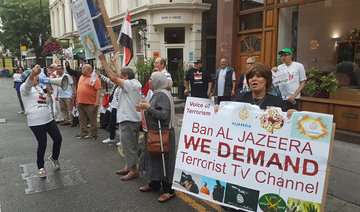
Al Jazeera is at the center of a bitter feud between Qatar and four of its neighbors that see it as an extension of Doha’s alleged support of terror groups.
The UAE, Saudi Arabia, Bahrain and Egypt cut ties with the country on June 5 and demanded the closure of the broadcaster whose English and Arabic language services have a markedly different tone.
“There is a big difference between the professional standards of Al Jazeera English versus Al Jazeera Arabic which unfortunately has been used as a tool in Qatar’s foreign policies,” said Noah Mellor, professor of media at University of Bedfordshire and author of “Voice of the Muslim Brotherhood.”
The contrast in tone and content between the English and Arabic service of Al Jazeera has been highlighted by many commentators and long before the current crisis unfolded this summer.
A 2011 article published by the Washington Institute titled “Al Jazeera: One Organization, Two Messages,” said: “At a time when Al Jazeera is polishing a new image as a champion of media reform and freedom, one of its most popular Arabic television programs is that of fundamentalist Muslim Brotherhood preacher Sheikh Yusuf Al-Qaradawi, whose twinkly grin accompanies virulently anti-American and anti-Semitic diatribes interspersed with expressions of support for censorship of “anti-Islamic” messages.
“This is not to say that Al Jazeera English is without problems of its own or that Al Jazeera Arabic is entirely flawed; the point is that the messages are often different.”
Al Jazeera did not respond to a request for comment when contacted by Arab News.