Pakistan vows to help Afghan refugees return home

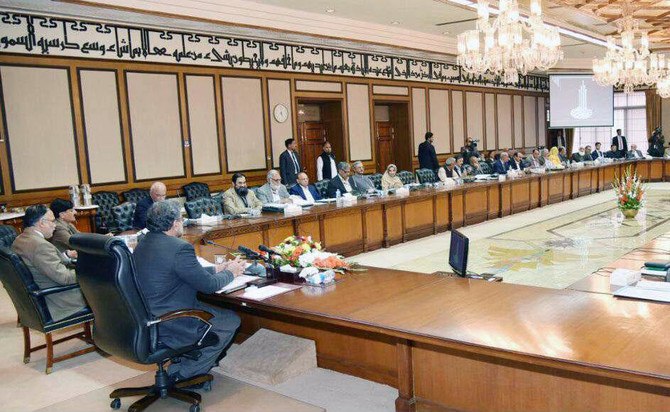
Prime Minister Shahid Khaqan Abbasi chairing a federal cabinet meeting on Feb. 20, 2018. (Photo courtesy: Press Information Department)
Updated 21 February 2018
Follow

Pakistan vows to help Afghan refugees return home

ISLAMABAD: Pakistan’s federal cabinet has vowed to extend all possible help toward the voluntary repatriation of Afghan refugees.
A meeting chaired by Prime Minister Shahid Khaqan Abbasi on Tuesday evening discussed in detail the issue of repatriation.
“The cabinet considered various recommendations for addressing the issue of Afghan refugees,” the Prime Minister’s Office said in a statement without sharing any details about the proposals.
“It was emphasized that the international community should also fulfill its obligations toward shouldering this responsibility to ensure smooth repatriation and rehabilitation of the refugees.”
According to Pakistani officials, there are currently 1.4 million registered, and an equal number of unregistered, Afghan citizens living in Pakistan.
Pakistan has consistently maintained that Afghan refugees must be encouraged to return to their homeland through the creation of necessary “pull factors” by the Afghan government.
The Pakistani cabinet earlier this month granted a 60-day stay extension for Afghan refugees. The new deadline is on March 31.


Pakistan PM orders port reforms to cut cargo delays, boost trade and growth

Updated 5 sec ago
Follow

Pakistan PM orders port reforms to cut cargo delays, boost trade and growth

  • Shehbaz Sharif orders transparent auctions of abandoned cargo and separate yards to clear port backlogs
  • Government to fast-track dredging, port expansion and rail links to handle larger vessels and inland cargo

ISLAMABAD: Prime Minister Shehbaz Sharif on Wednesday ordered wide-ranging reforms at Pakistan’s ports to reduce cargo delays, cut costs for businesses and support economic growth, directing authorities to improve coordination, infrastructure and transparency across the sector.

The instructions were issued during a meeting of a private-sector working group formed to recommend port-related reforms, as the government seeks to ease bottlenecks in trade logistics and improve competitiveness.

“Our ports play an extremely important role in expanding business and driving economic growth in the country,” Sharif said, according to a statement from his office, as he directed port-linked agencies to strengthen coordination to reduce cargo dwell time and ordered a further reduction in port charges to ease the burden on the business community.

Sharif also instructed officials to introduce a transparent system for auctioning abandoned cargo, including the creation of separate yards at ports and the use of internationally reputed firms to manage the process.

He called for faster work on dredging and expanding ports to allow larger vessels to berth and ordered improvements in rail connectivity from ports to facilitate inland cargo movement.

A briefing given to the participants of the meeting highlighted work on a National Ports Master Plan was progressing, adding that a port community system had recently become operational, and fees at several ports were being reduced, including a cut of more than 50 percent in bulk cargo charges at Port Qasim.

Officials also said an electronic bidding system for auctioning abandoned cargo would be launched soon and that tenders for expansion and dredging at Karachi’s ports had already been issued.