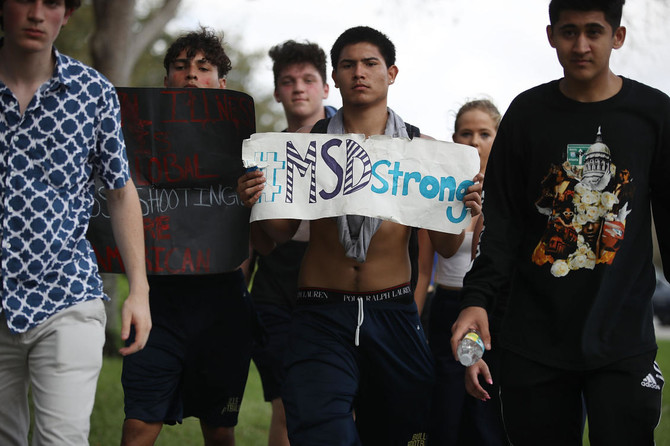
TALLAHASSEE, Florida/WASHINGTON: Dozens of teenaged survivors of the second deadliest public school shooting in US history marched on Florida’s capital on Wednesday to ask lawmakers to ban sales of assault rifles of the sort used to kill 17 students and educators last week.
Marjory Stoneman Douglas High School in Parkland, Florida, became the latest school targeted by a gunman using a semi-automatic AR-15 assault rifle, heated up the nation’s long-running debate about gun rights and public safety.
Dressed in jeans and T-shirts and carrying signs with the slogan “#Neveragain,” survivors of the Feb. 14 mass shooting met with lawmakers in Tallahassee, to ask for stricter controls on gun sales.
Investigators said the assault was carried out by 19-year-old former student Nikolas Cruz, who purchased an AR-15 nearly a year ago. Police have charged Cruz, who had been kicked out of Douglas for disciplinary problems, with 17 counts of premeditated murder.
“We want to see some common sense gun laws so this will never happen again,” said Rachel Padnis, a 16-year-old sophomore from the school near Fort Lauderdale.
She and classmates said they were dismayed but undeterred by the state’s Republican-controlled legislature’s Tuesday rebuff of a bid to bring up a bill to block sales of assault rifles.
President Donald Trump, a strong supporter of gun rights, was due to meet later Wednesday with parents, students and teachers who have been victims of gun violence, including those affected by the Valentine’s Day shooting in Florida.
The White House meeting comes a day after Trump said his administration would take steps to ban bump stocks, an accessory that enables a rifle to shoot hundreds of rounds a minute. A spokeswoman said the administration was open to the idea of setting national age limits on sales of assault rifles.
Florida state Sen. Bill Galvan, slated to be the upper chamber’s next president, has called for a bill to raise the legal age for purchasing assault rifles from 18 to 21, the same as it is for handguns.
At the Florida capital in Tallahassee, dozens of students packed into a meeting room and peppered Senate President Joe Negron, a Republican, with questions about why individuals should have continued access to assault rifles.
Negron declined to say whether he would support any specific gun control measures, saying, “That’s an issue we’re going to look at as we work to develop legislation.”
Trump talks
US President Donald Trump, a strong supporter of gun rights, was scheduled to host a “listening session” with high school students and teachers at the White House on Wednesday.
Trump’s support for any tightening of gun laws would mark a change for a Republican who was endorsed by the National Rifle Association gun lobby during the 2016 presidential campaign.
The NRA opposes an outright ban on bump stocks but has said it would be open to restrictions on the devices.
Under pressure after Parkland, the deadliest-ever shooting at a US high school, Trump on Tuesday directed the Justice Department to quickly complete a proposed rule that would treat “bump stocks” as machine guns, which could effectively outlaw them in the US.
Last October, a retired real estate investor and high-stakes gambler used multiple assault rifles equipped with bump stocks to kill 58 people at a Las Vegas outdoor concert, the deadliest attack by a single gunman in US history. Bump stocks have not played a prominent role in other recent US mass shootings.
Later this week, Trump will meet with local and state officials, and plans to talk with governors about the issue.
Trump generally favors a Senate bill on background checks, White House press secretary Sarah Sanders said Tuesday.
Calls for national student walk-outs and marches in the coming months have gained steam on social media, including the “March for Our Lives” on March 24 in Washington, spearheaded by Douglas students.
Scattered school walkouts in support of the Florida students were planned around the US on Wednesday, according to officials and local media.
The NRA has agreed to participate in a televised town hall on guns to be broadcast by CNN later today, the news network said. NRA officials did not immediately respond to requests for comment.
Gun violence on public school and college campuses has become so commonplace in the US in the last several years that administrators regularly stage drills to train students and staff in the event of a mass shooting.


Florida school massacre survivors push lawmakers for assault gun ban
Florida school massacre survivors push lawmakers for assault gun ban

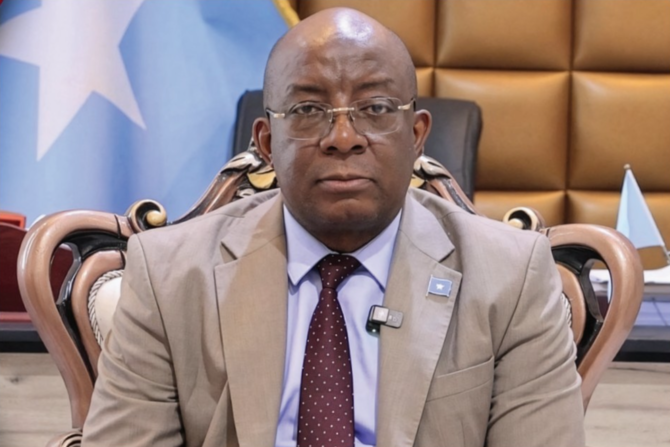
Israel is risking global security, warns Somali Information Minister
- Tel Aviv’s actions boost terror groups he tells Arab News in exclusive interview
- Jama accuses Tel Aviv of wanting to relocate Palestinians from Gaza to region
RIYADH: Israel’s recognition of Somaliland and its presence in the region risks inflaming the situation there, allowing terrorist groups to undermine regional security and stability, according to Somali Information, Culture and Tourism Minister Daud Aweis Jama.
In a special interview with Arab News, Jama insisted that Israel’s unprecedented Dec. 26 move to recognize Somaliland as a sovereign state represents a major setback for Mogadishu’s fight against terrorist organizations like Al-Shabab and Daesh.
“The presence of Israel will be used by the terrorist groups to expand their operations in the region. (They will) have a pretext to spread their ideologies in the region,” he said.
“That is another factor that is also risking global security and regional stability, because we have been in the last stage of overcoming the challenges of the terrorist groups Al-Shabab and ISIS,” he added, using another term for Daesh.
Jama added: “We have been putting all our resources and all our time into making sure that we finalize the final stages of the fight against Al-Shabab. So, if something else interrupts us, that means that we are not going to focus fully on the operations against Al-Shabab. And that means we are giving more opportunities to Al-Shabab or other organizations.”
The consequences of this hit to Somalia’s ability to fight terror will not be restricted to the country’s borders, according to Jama, but will spread across the region and beyond.
“This might invite other, external terrorist groups to the region, because they will take advantage of this crisis and will make sure that they take over all the areas that have been defeated before,” the minister said.
“We believe this has come at a time that is going to affect our security as a Somali government, the security of the Horn of Africa, the security of the Gulf of Aden, the security of the Red Sea, the security of the Middle East and global stability. This is a very important location that holds the trade of the world.”
The minister underlined that Israel’s recognition and larger presence in the region are leading to more challenges, “putting more fuel on the ongoing challenges that exist in the region, especially in Somalia.” He added: “And at this time, it is not only limited to Somalia, but it’s going to be a challenge that is going to spread like a fire all over the region and all over the world.”
Jama told Arab News that Israel has other strategic motives for its recognition of Somaliland — including the forced resettlement of Palestinians from Gaza.
“According to reliable sources that our intelligence gathered, one of the conditions that Israel put forward (for recognizing Somaliland) was to have a place that they can settle the people from Gaza,” he said.
“We find that it is a violation also of the people of Palestine, because we believe that the people of Palestine have the right to self-determination. The two-state solution that has been the call of the international community has to be adhered to and implemented.”
Israel’s coalition government, the most right-wing and religiously conservative in its history, includes far-right politicians who advocate the annexation of both Gaza and the West Bank and encouraging Palestinians to leave their homeland.
Somalia’s UN Ambassador Abukar Dahir Osman said Security Council members Algeria, Guyana, Sierra Leone and Somalia “unequivocally reject any steps aimed at advancing this objective, including any attempt by Israel to relocate the Palestinian population from Gaza to the northwestern region of Somalia.”
Israel last month became the first country to recognize Somaliland as an independent nation. In the three-plus decades since its self-declaration of independence in 1991, no state had recognized the northwestern territory as being separate from Somalia.
Mogadishu immediately rejected the Israeli move, alongside countries all over the world.
Saudi Arabia affirmed its rejection of any attempts to impose parallel entities that conflict with the unity of Somalia. It also affirmed its support for the legitimate institutions of the Somali state and its keenness to preserve the stability of Somalia and its people.
A group of foreign ministers from Arab and Islamic countries, alongside the Organization of Islamic Cooperation, also firmly rejected Israel’s announcement. In a joint statement, the ministers warned that the move carries “serious repercussions for peace and security in the Horn of Africa and the Red Sea region” and undermines international peace and security.
The 22-member Arab League rejected “any measures arising from this illegitimate recognition aimed at facilitating forced displacement of the Palestinian people or exploiting northern Somali ports to establish military bases,” the organization’s UN Ambassador Maged Abdelfattah Abdelaziz told the UN Security Council.
In the most recent development in Israel-Somaliland relations, less than two weeks after Tel Aviv’s recognition, Israeli Foreign Minister Gideon Saar visited the region on Tuesday to publicly formalize diplomatic relations.
“It was a blatant violation of Somalia’s sovereignty that Israel recognized a region within the Somali Federal Republic as an independent state,” Jama underlined. “That was a total violation of international laws. It was a violation of the territorial integrity and sovereignty of Somalia.
“From the beginning, our path was to follow diplomatic efforts. And we kind of started with a successful UN Security Council meeting that supported Somalia’s territorial integrity and sovereignty. (This was) followed by other international actors like the Arab League, the Organization of Islamic Cooperation, the African Union and regional bodies like the East African Community and IGAD.
“Also, the Peace and Security Council of the African Union has reiterated the importance of supporting Somali sovereignty and territorial integrity.”