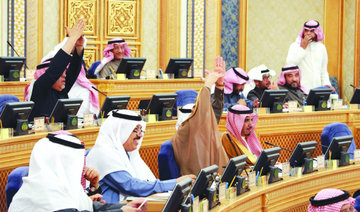
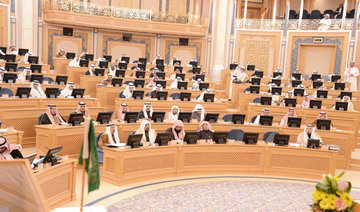
RIYADH: The Shoura Council has asked the National Anti-Corruption Commission (Nazaha) to work with relevant agencies to curb the rising number of cases involving irregularities in government purchasing.
The Council urged Nazaha to require government agencies with the highest number of bribery cases to review internal procedures in order to tackle the issue, at the19th ordinary session of the Council on Tuesday.
In another decision, the Council asked Saudi Arabian Airlines (Saudia) to consider opening centers in major cities to receive baggage and finalize travel procedures.
Later, the Council called on the Saudi Export Development Authority (SEDA) to coordinate with Saudi Arabian businesses abroad to boost exports.
In another decision, the Shoura Council asked the Saudi Geological Survey (SGS) to determine key mining opportunities and coordinate with the Ministry of Energy, Industry and Mineral Resources to provide projects as investment opportunities to public and private sector companies. It also urged SGS to complete studies on flood risks in all parts of the Kingdom.
Then the Council heard a report presented by the Committee of Hajj, Housing and Services based on the annual report of the Ministry of Municipal and Rural Affairs. The Council asked the Ministry to disclose the number of consulting contracts that had been signed to carry in different areas and to specify the salaries of non-Saudis involved in these contracts.
The Council has approved a study of an anti-obesity system, recommended by the House Health Committee, after the obesity rates rose by more than 70 percent, notably among children and youths.
It was important to combat weight problems in line with Saudi Vision 2030 and the National Transformation Program 2020, to reduce the cost of treating conditions related to obesity, the committee said.


![]()

Saudi Shoura asks National Anti-Corruption Commission to address irregularities in govt purchases
Saudi Shoura asks National Anti-Corruption Commission to address irregularities in govt purchases

Latest updates


© 2026 SAUDI RESEARCH & PUBLISHING COMPANY, All Rights Reserved And subject to Terms of Use Agreement.