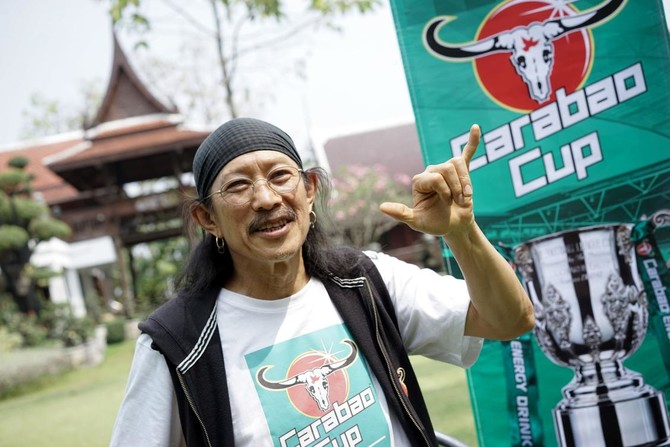
BANGKOK: On Sunday evening an aging Thai rock star with hooped earrings, signature bandana and a wispy moustache will be at the home of English football to present the Carabao Cup to either Arsenal or Manchester City.
His prominence will baffle many football fans, not to mention some of the players celebrating the first silverware of the season at London’s Wembley Stadium.
But in Thailand, the 63-year-old Yuenyong Opakul is a legend.
He is the lead singer of the band Carabao, and co-founder of the energy drink company now sponsoring the English Football League (EFL) cup.
Better known as Aed Carabao (pronounced “At“), he helped catalyze the band’s massive following into consumers of high-caffeine drinks.
Its giddying ascent since 2002 now sees Carabao outsell Red Bull in Thailand, where hundreds of millions of dollars’ worth of the sugary beverages are slurped down each year.
With an eye on new markets, Carabao has plowed cash into English football, hoping for a fast-track to global brand recognition.
The company has spent 30 million pounds ($42 million) to sponsor Chelsea’s training kit, a further 18 million pounds on a three-year EFL cup contract as well as paying to have its name emblazoned on Reading FC’s strip.
It’s been a “very successful” investment so far, says Aed.
“English people are very focused on football. They didn’t know us before but people are talking about the brand now,” he says sitting in his large garden in a Bangkok suburb.
Thai money and English football have had a strong chemistry ever since billionaire ex-prime minister Thaksin Shinawatra bought Manchester City in 2007.
He flipped it just over a year later for a handsome profit to Sheikh Mansour of Abu Dhabi whose oil fortune has hoisted City into football’s elite.
Thailand’s duty free magnate Vichai Srivaddhanaprabha was next in, buying Leicester City for about 40 million pounds ($58 million) in 2010 and clearing the club’s large debts.
Six years later the Midlands minnows stormed to the Premier League title, the players celebrating in shirts stamped with Vichai’s “King Power” brand.
Sheffield Wednesday are owned by Dejphon Chansiri of the Thai Union family — the world’s biggest tinned tuna producers — while Singha beer has partnered with Manchester United.
A commercial link with English football guarantees swift “international exposure,” says Pavida Pananond, an academic at Thammasat University’s Business School in Bangkok.
“This strategy is not new. Red Bull has done it before with Formula 1 and extreme sports,” she added of the part Thai-owned energy drinks firm.
Aed Carabao is no stranger to brand-building.
The one-time architecture student who studied in the Philippines, hence the band’s Tagalog name, has spun fame and fortune from his distinctive country-rock style, rasping voice and acerbic lyrics skewering corruption, inequality and forces of reaction.
He designed the skull-and-horns Carabao logo, which is across band paraphernalia — and even copyrighted a hand sign that represents the eponymous buffalo.
The band has toured Thailand for more than three decades cultivating a loyal base of nostalgic fans but also youngsters drawn to his stage presence and lyricism.
“Like BB King I’ll keep playing until I die,” Aed says with a smile, tucking a streak of black hair into his bandana, a Carabao-branded mug on the table in front of him.
The band emerged in the early 1980s with an unabashed pro-democracy agenda following a decade of political turbulence when crackdowns killed hundreds of student activists.
Several songs were banned by authorities, gifting Aed something of a bad-boy reputation.
But age and commercial success has diluted Aed’s taste for controversy, more so in the social media age where junta-run Thailand’s sharply polarized politics tend to chew up anyone who speaks out.
“I am not on anyone’s side,” he says, rejecting criticism he has sold out. “But if the people aren’t educated about democracy, we cannot move forward.”
Carabao is a colorful name for a trophy that has traditionally relied on more parochial sponsors, including Britain’s milk board and Rumbelows, a now-defunct white-goods retailer.
The Thai tie-up also endured an inauspicious start.
In June the EFL was forced to apologize after error-strewn graphics appeared on their online broadcast of the first-round draw for the Carabao Cup.
The third-round draw stirred more consternation after it was held in Beijing, demanding a pre-dawn wake-up by British fans to follow it live.
Yet the timings reflected Carabao’s relentless marketing push, concerned first with seeking a foothold in China’s massive market.
As he prepares to travel to London for the cup final, the genial singer is in similarly uncompromising mood.
“I’ll be dressed cool... maybe in a suit because it’s cold, but everything else the same,” he said.


![]()
Carabao: Thai rocker turned drinks mogul energising English football
Carabao: Thai rocker turned drinks mogul energising English football
Latest updates


© 2026 SAUDI RESEARCH & PUBLISHING COMPANY, All Rights Reserved And subject to Terms of Use Agreement.