

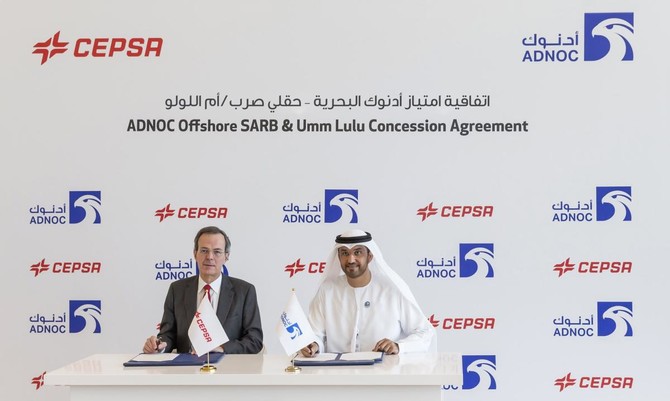
Abu Dhabi awards Spanish firm stake in oil concession

ADNOC Offshore will retain a 60 percent stake in the project while the remaining 20 percent will be awarded to another company. (ADNOC)
Updated 18 February 2018
Follow

Abu Dhabi awards Spanish firm stake in oil concession

ABU DHABI: Abu Dhabi National Oil Co. (ADNOC) said Sunday it has awarded the Spain-based Cepsa a 20 percent share in a concession of two offshore oil fields in a deal worth $1.5 billion.

The 40-year deal aims to double production at the emirate’s offshore fields of SARB and Umm Lulu to 215,000 barrels per day, state-owned ADNOC said in a statement.

Its subsidiary, ADNOC Offshore, will retain a 60 percent stake in the project while the remaining 20 percent will be awarded to another company, the statement said.

Cepsa, a global oil and gas company, is wholly-owned by Abu Dhabi’s Mubadala Investment Company which has assets worth over $125 billion.

“This long-term agreement is a milestone in the development of Abu Dhabi’s integrated oil and gas sector and in the delivery of ADNOC’s 2030 smart growth strategy,” CEO of ADNOC Sultan Al-Jaber said.

Last week, ADNOC awarded a 10 percent stake in the offshore concession of Lower Zakum to an Indian consortium led by ONGC Videsh company for $600 million.

ADNOC Offshore also retained a 60 percent stake in that concession, with plans to award the remaining 30 percent to a third company.

The aim is to more than double production at Lower Zakum to 450,000 bpd.

ONGC Videsh is the foreign investment arm of ONGC. Other members of the consortium are Indian Oil Corp. and Bharat Petro Resources Ltd, an upstream arm of refiner Bharat Petroleum Corp.

That deal marked the first time for Indian oil companies to take part in an Abu Dhabi oil and gas concession.

In August, ADNOC said it would split its ADMA-OPCO offshore concession into three areas — Lower Zakum, Umm Shaif and Nasr, and Sateh Al Razboot and Umm Lulu — with new terms to unlock greater value and increase opportunities for partnerships.

The vast majority of the UAE’s crude oil reserves are located in Abu Dhabi — capital of the Gulf emirate.

Abu Dhabi in recent years has granted concessions to ExxonMobil, Total, BP, Shell and China’s CNPC, among others, as old concessions have expired.

The new concessions have been offered at nearly half the duration of the old concessions — with ADNOC taking majority stakes in the projects.

The national company aims to increase the Abu Dhabi’s oil production capacity from 3.2 million barrels per day to 3.5 million by the end of 2018.
Saudi Arabia heading toward growth exceeding global average: McKinsey partner

Updated 5 sec ago
Follow

Saudi Arabia heading toward growth exceeding global average: McKinsey partner

RIYADH: Saudi Arabia is expected to achieve growth that exceeds the global average, thanks to Vision 2030 projects, particularly in the industrial sector, which is being fueled by the metals and mining sector, according to Jeffrey Lorsch, partner at McKinsey & Co., in comments to Al-Eqtisadiah. 

He cited the growth of the mining sector as a driver, as it is linked to strategic projects, including automotive, aerospace, space, and defense industries.

A large part of its expansion depends on these projects, according to Lorsch, who stated that the available opportunities will support Saudi Arabia in achieving an annual growth rate that exceeds the global average.

However, he also warned of the negative impact of geopolitical tensions around the world on the metals sector.

“The government of Saudi Arabia’s outlook for the mining sector is quite robust,” Lorsch said. “We’ve seen a significant uptick in the sector in the last 10 years. The output of the sector has doubled or tripled since 2015, which reflects the investor confidence that we see.”

Seeking multilateral solutions

Global geopolitical tensions form the general framework for this year’s Future Minerals Forum, according to Lorsch. They are also a key factor shaping the methodology of the Future Minerals Forum Barometer, which was launched to monitor global transformations in the mining sector.

Lorsch emphasized that the large attendance at the conference clearly reflects the growing importance of critical minerals in the context of geopolitical tensions.

One of the forum’s most prominent efforts is to find multilateral solutions to develop the mining sector, both within Saudi Arabia and globally.

The FMF Barometer will analyze the impact of these tensions on mineral value chains, including the development of local and regional supply chains, after a historical reliance on global supply chains, according to Lorsch.

The McKinsey partner also emphasized the importance of involving the “super region” to ensure that the development of mineral resources in Global South countries genuinely contributes to their growth and leads to industrial development.

The barometer does not cover Saudi Arabia alone but includes the global market, where there is a massive need to significantly increase mineral supplies.

Strong future prospects for the mining sector in Saudi Arabia

Regarding the Kingdom, Lorsch confirmed that the future prospects for the mining sector are very strong, noting that the past 10 years have seen a remarkable increase in the sector’s performance.

He expected similar growth in the gold sector. “Looking forward, we’re going to see similar growth in the gold sector,” Lorsch added, pointing to Maaden’s announcement of additional gold resources that will lead to increased production capacity, alongside significant growth opportunities in phosphate, aluminum, and steel.

The McKinsey partner described the overall outlook for the sector as “very optimistic.”

Globally, Lorsch explained that McKinsey adopts a balanced approach in its growth forecasts.

“From a global economic growth perspective, I think we’re taking a fairly balanced approach. We see growth much more centered in the 2 to 3 percent, we see the Kingdom having more of a robust outlook,” he said.