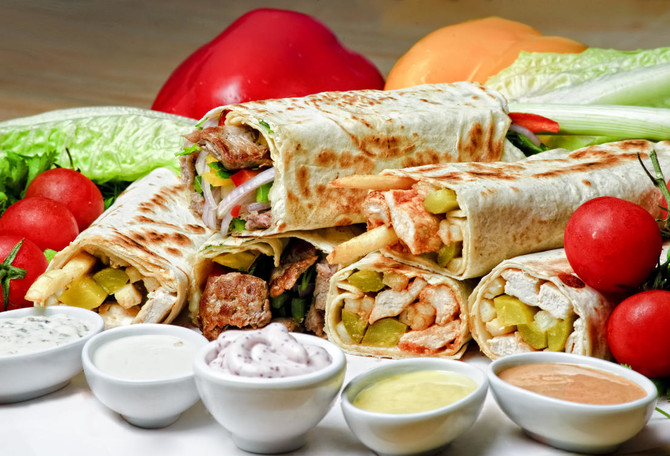
DUBAI: An Egyptian woman is ending her marriage after just 40-days because her husband refused to buy her a shawarma, Egyptian news site Masrawy reported.
The woman, Sameeha, said that when the newlyweds went out, she told her husband she wanted a shawarma, but he refused, saying they “only went out for juice.”
“We had a traditional arranged marriage, I only knew him for two months before the wedding and never noticed how stingy he was,” Sameeha told the Egyptian daily.
“During the first week of our marriage, he told me that he hates going out anywhere because that would be a waste of money,” she added.
The woman also stated that her husband accused her of “exploiting his wealth” by demanding he buy her a shawarma after he bought her juice.
The case is now in the Egyptian court and is set to wrap up in the coming weeks.

It’s a wrap: Egyptian woman files for divorce after just 40 days over shawarma
Makkah museum displays world’s largest Qur’an
MAKKAH: The Holy Qur’an Museum at the Hira Cultural District in Makkah is showcasing a monumental handwritten copy of the Holy Qur’an, recognized as the largest Qur’an of its kind in the world.
The manuscript measures 312 cm by 220 cm and comprises 700 pages, earning the museum recognition from Guinness World Records for displaying the world’s largest Qur’an, the Saudi Press Agency reported.
The manuscript is a magnified reproduction of a historic Qur’an dating back to the 16th century, the SPA stated.
The original copy measures 45 cm by 30 cm, with the chapters written primarily in Thuluth script, while Surah Al-Fatiha was penned in Naskh, reflecting the refined artistic choices and calligraphic diversity of the era.
The Qur’an is a unique example of Arabic calligraphy, gilding and bookbinding, showcasing Islamic art through intricate decorations, sun-shaped motifs on the opening folio, and elaborately designed frontispiece and title pages that reflect a high level of artistic mastery.
The manuscript was endowed as a waqf in 1883. Its original version is currently preserved at the King Abdulaziz Complex for Endowment Libraries, serving as a lasting testament to Muslims’ enduring reverence for the Qur’an and the richness of Islamic arts across the centuries.