WEST PALM BEACH, Florida: The request was simple: organize or attend a sign-waving rally supporting Donald Trump. But some of the Florida Republicans on the receiving end of those requests now know that they didn’t come from Republican allies, but from Russian adversaries.
Caught up in an elaborate Russian plot without their knowledge, a handful of these small-time Trump supporters said their votes were not swayed and they didn’t do anything they weren’t happy to do. Still, their interactions with the Russians highlight the ways, both big and small, that the nation’s campaign process was infiltrated.
“I was going to do what I was going to do anyway. I was a Trump supporter, they didn’t convince me,” said Jim Frishe, a real estate development consultant and candidate for county office, who organized a sign-waving event in Clearwater that was part of a statewide series of rallies promoted by the Russians.
The Florida rallies are one small facet of the indictment issued Friday by special counsel Robert Mueller charging 13 Russians and three Russian companies with interfering in the 2016 election. The most detailed allegation of illegal Russian meddling to date, it says they assumed US identities, sowed discord on social media, communicated with “unwitting” Americans and even set up political rallies from afar.
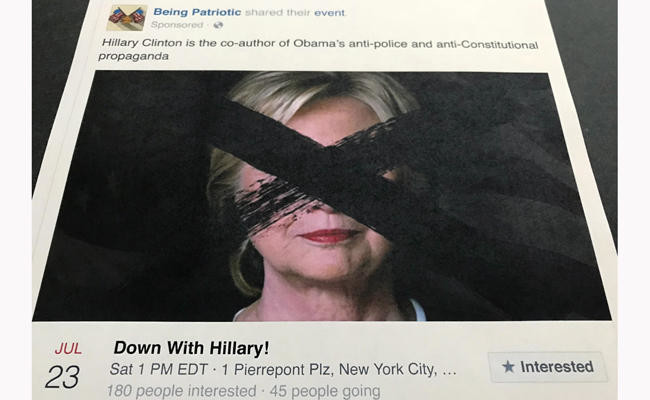
As part of that, the indictment says the Russians used a Facebook group, a Twitter account and other “false US personas” to organize coordinated “Florida Goes Trump” rallies on Aug. 20, 2016. They reached out to campaign staff, grassroots groups supporting Trump, and specific individuals to participate.
Frishe, 68, said he was called by someone identifying themselves as with a group called “Florida for Trump” and asked to organize a sign-waving rally. He said between 15 and 18 people showed up and that he didn’t receive any signs or money or other support. He never heard from them again.
He said he was not overly concerned about the indictment, or his minor role in the drama, and that Russian interference is “nothing new.”
“It’s not surprising,” Frishe said. “It doesn’t have a huge impact in this country.”
Still, the indictment details a sizable effort to disrupt the 2016 presidential election, aimed in part at helping Republican Donald Trump defeat Democrat Hillary Clinton. It involved creating Internet postings in the names of Americans whose identities had been stolen; staging political rallies while posing as American political activists; and paying people in the US to promote or disparage candidates.
Lilia Morraz was another person who put together an event. She said she got involved after she encountered the @March_for_Trump account on Twitter, one of the accounts the Russians used.
“I am really active on Twitter. They were saying Trump was not going to be elected. I happened to write to them and say it’s not true,” said Morraz, 60, of Miami.
Morraz said that from there, she was asked about good places to hold a rally in Miami and then “they told me, yes, go ahead and do it.” So she organized an event outside a restaurant that both she and @March_for_Trump promoted. She said hundreds attended and she made signs herself and received no money.
Morraz was skeptical about a Russian plot.
“I just don’t believe it. It’s like everything you see on TV. I don’t believe 90 percent of it,” she said.
Another Florida Republican, Betty Trigueiro, says she didn’t attend the Florida Goes Trump rallies. But her name and phone number were included in a Facebook post promoting the event without her permission.
Trigueiro, 62, of Bradenton, said that in August 2016 she started getting some Twitter messages from people she did not know with details on pro-Trump events. She thinks they may have gotten her contact information from her time as secretary of a local Republican club. She said she never attended any of the events.
While she was troubled that there appeared to efforts to “infiltrate and cause chaos,” Trigueiro wasn’t convinced the outcome was impacted.
“There was too many people that wanted him elected,” she said.


Russian election plot touched even minor Trump supporters
Russian election plot touched even minor Trump supporters


Kabul shakes as 5.8-magnitude earthquake hits eastern Afghanistan
- The 5.8-magnitude quake struck a mountainous area around 130 kilometers northeast of Kabul
- Earthquakes are common in Afghanistan, particularly along the Hindu Kush mountain range
KABUL: A strong earthquake rocked eastern Afghanistan including the capital Kabul on Friday, AFP journalists and residents said.
The 5.8-magnitude quake struck a mountainous area around 130 kilometers (80 miles) northeast of Kabul, the United States Geological Survey said.
The epicenter was near several remote villages and struck at 5:39 p.m. (1309 GMT), just as people in the Muslim-majority country were sitting down to break their Ramadan fast.
“We were waiting to do our iftars, a heavy earthquake shook us. It was very strong, it went on for almost 30 seconds,” said Zilgay Talabi, a resident of Khenj district near of the epicenter.
“Everyone was horrified and scared,” Talabi told AFP, saying he feared “landslides and avalanches” may follow.
Power was briefly cut in parts of the capital, while east of Kabul an AFP journalist in Nangarhar province also felt it.
Earthquakes are common in Afghanistan, particularly along the Hindu Kush mountain range, near where the Eurasian and Indian tectonic plates meet.
Haqmal Saad, spokesman for the Panjshir province police, described the quake as “very strong” and said the force was “gathering information on the ground.”
Mohibullah Jahid, head of Panjshir Natural Disaster Management agency, told AFP he was in touch with several officials in the area.
The district governor had told him there were reports of “minor damage, such as cracks in the walls, but we have not received anything serious, such as the collapse of houses or anything similar,” Jahid said.
Residents in Bamiyan and Wardak provinces, west of Kabul, told AFP they also felt the earthquake.
In Pakistan’s Khyber Pakhtunkhwa province, rescue service official Bilal Ahmad Faizi said the quake was felt in border areas.
In August last year, a shallow 6.0-magnitude quake in the country’s east wiped out mountainside villages and killed more than 2,200 people.
Weeks later, a 6.3-magnitude quake in northern Afghanistan killed at least 27 people.
Large tremors in western Herat, near the Iranian border, in 2023, and in Nangarhar province in 2022, killed hundreds and destroyed thousands of homes.
Many homes in the predominantly rural country, which has been devastated by decades of war, are shoddily built.
Poor communication networks and infrastructure in mountainous Afghanistan have hampered disaster responses in the past, preventing authorities from reaching far-flung villages for hours or even days before they could assess the extent of the damage.