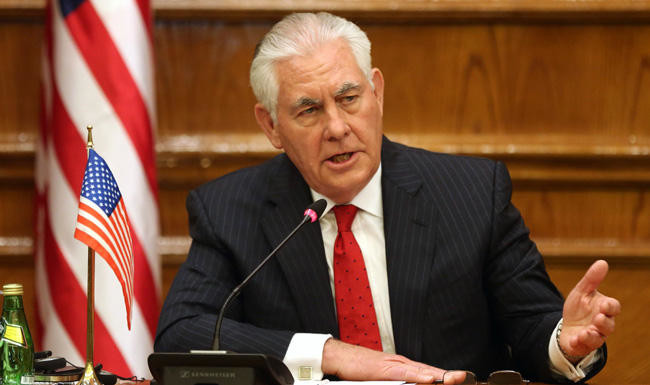
ANKARA: US Secretary of State Rex Tillerson arrives in Turkey on Thursday seeking to ease tensions with its NATO ally that have reached fresh heights over Ankara’s ongoing operation inside Syria.
During his two-day trip to the Turkish capital, Tillerson — who last visited in July 2017 — will hold talks with Foreign Minister Mevlut Cavusoglu and President Recep Tayyip Erdogan.
Turkey’s operation against a Kurdish militia in Syria has added a potentially insurmountable new problem to the litany of issues clouding the relationship between Washington and Ankara.
Analysts said the level of tension was similar to 2003 when Turkey refused to let US troops operate from its territory for the Iraq war, or even the aftermath of Ankara’s invasion of Cyprus in 1974.
Turkey’s operation against the People’s Protection Units (YPG), which Ankara blacklists as a terror group, has seen troops fighting a militia which is closely allied with the US in the battle against extremists.
And Erdogan has further upped the ante by warning US troops to steer clear of Manbij, a YPG-held town east of Afrin where the main operation is happening, raising fears of a clash.
“We are going to go to Manbij and if they are there, it’s too bad for them,” a senior Turkish official said.
When a US commander told the New York Times it would respond “aggressively” to any attack by Turkey, Erdogan didn’t mince his words.
“It’s very clear that those who make such remarks have never experienced an Ottoman slap,” he said, using the term for a backhander which, according to legend, could kill an opponent in one stroke.
For Ankara, the YPG is linked to the outlawed Kurdistan Workers’ Party, which is blacklisted as a terror outfit by the US and the EU.
But for Washington, the YPG is an ally.
On Tuesday, Tillerson said Turkey’s operation “detracted” from the fight against Daesh terrorists, saying Kurdish fighters had been “diverted” from where they were really needed in order to fight in Afrin.
Former State Department official Amanda Sloat said Washington did not appear to have “developed a clear way forward on Syria nor determined how its plans address Turkish security concerns.”
And if Ankara expected any clarity from US officials on the way forward in Syria, it would be “disappointed,” said Sloat, now a senior fellow at the US-based Brookings Institution.
Speaking ahead of the visit, a senior State Department official said “eyes had to be on” the defeat of Daesh.
“It’s complicated enough. Let’s not make it more so.”
But Cavusoglu warned Washington that ties were at a “critical point” where relations would “be fixed or... completely damaged.”
Ties were damaged after the failed coup of 2016 with Turkey stung by a perceived lack of US solidarity and angered by its intransigence over the extradition of Fethullah Gulen, a Pennsylvania-based cleric blamed for ordering the putsch.
There is still no US ambassador to Turkey after the departure of John Bass last year, and it was only in December that the two sides ended a row following tit-for-tat suspensions of visa services.
Last month, Ankara reacted furiously to the conviction in New York of Turkish banker Mehmet Hakan Atilla on charges of violating sanctions against Iran.
And Washington has expressed concern that several of its citizens, as well as Turkish employees of US missions, have been caught up in the post-coup crackdown.
Last week, NASA scientist Serkan Golge, a dual national, was jailed for seven-and-a-half years for being a member of Gulen’s movement, with the State Department saying he had been convicted “without credible evidence.”
Another case is that of US pastor Andrew Brunson, who ran a church in Izmir, who has been held on similar charges since October 2016.
Such tensions have affected the Turkish public with 83 percent holding unfavorable views of the US, a Center for American Progress (CAP) poll showed this week.
“The Turkish public has long been skeptical of the US, but Erdogan and the (ruling party) have chosen to inflame the public’s anger to score political points,” said CAP’s associate director Max Hoffman.

Tillerson heads to Turkey to ease tensions over Syria
Historic decree seeks to end decades of marginalization of Syria’s Kurds
DAMASCUS/RIYADH: A decree issued by President Ahmad Al-Sharaa on Friday marks a historic end to decades of marginalization of Syria’s Kurdish minority and seeks to open a new chapter based on equality and full citizenship in post-liberation Syria.
The presidential action, officially known as Decree No. 13, affirms that Syrian Kurds are an integral part of the national fabric and that their cultural and linguistic identity constitutes an inseparable element of Syria’s inclusive, diverse, and unified national identity.
Al-Sharaa’s move seeks to address the consequences of outdated policies that distorted social bonds and divided citizens.
The decree for the first time grants Kurdish Syrians rights, including recognition of Kurdish identity as part of Syria’s national fabric. It designates Kurdish as a national language alongside Arabic and allows schools to teach it.
Al-Sharaa’s decree came after fierce clashes that broke out last week in the northern city of Aleppo, leaving at least 23 people dead, according to Syria’s health ministry, and forced more than 150,000 to flee the two Kurdish-run pockets of the city. The clashes ended after Kurdish fighters withdrew.
The Syrian government and the Kurdish-led Syrian Democratic Forces (SDF), that controls the country’s northeast, have engaged in months of talks last year to integrate Kurdish-run military and civilian bodies into Syrian state institutions by the end of 2025, but there has been little progress.
The end of an era of exclusion
For more than half a century, Kurds in Syria were subjected to systematic discriminatory policies, most notably following the 1962 census in Hasakah Governorate, which stripped thousands of citizens of their nationality and deprived them of their most basic civil and political rights.
These policies intensified after the now-dissolved Baath Party seized power in 1963, particularly following the 1970 coup led by criminal Hafez al-Assad, entrenching a state of legal and cultural exclusion that persisted for 54 years.
With the outbreak of the Syrian revolution in March 2011, Syrian Kurds actively participated alongside other segments of society. However, the ousted regime exploited certain separatist parties, supplying them with weapons and support in an attempt to sow discord and fragment national unity.
Following victory and liberation, the state moved to correct this course by inviting the Kurdish community to fully integrate into state institutions. This approach was reflected in the signing of the “March 10 Agreement,” which marked an initial milestone on the path toward restoring rights and building a new Syria for all its citizens.
Addressing a sensitive issue through a national approach
Decree No. 13 offers a balanced legal and political response to one of the most sensitive issues in modern Syrian history. It not only restores rights long denied, but also redefines the relationship between the state and its Kurdish citizens, transforming it from one rooted in exclusion to one based on citizenship and partnership.
The decree shifts the Kurdish issue from a framework of conflict to a constitutional and legal context that guarantees meaningful participation without undermining the unity or territorial integrity of the state. It affirms that addressing the legitimate demands of certain segments strengthens, rather than weakens, the state by fostering equal citizenship, respecting cultural diversity, and embracing participatory governance within a single, centralized state.
Core provisions that restore dignity
The decree commits the state to protecting cultural and linguistic diversity, guaranteeing Kurdish citizens the right to preserve their heritage, develop their arts, and promote their mother tongue within the framework of national sovereignty. It recognizes the Kurdish language as a national language and permits its teaching in public and private schools in areas with significant Kurdish populations, either as an elective subject or as part of cultural and educational activities.
It also abolishes all laws and exceptional measures resulting from the 1962 Hasakah census, grants Syrian nationality to citizens of Kurdish origin residing in Syria, including those previously unregistered, and guarantees full equality in rights and duties. In recognition of its national symbolism as a celebration of renewal and fraternity, the decree designates Nowruz Day (21 March) as a paid official holiday throughout the Syrian Arab Republic.
A call for unity and participation
In a speech following the issuance of the decree, President Ahmad al-Sharaa addressed the Kurdish community, urging them not to be drawn into narratives of division and calling on them to return safely to full participation in building a single homeland that embraces all its people. He emphasized that Syria’s future will be built through cooperation and solidarity, not through division or isolation.
The decree presents a pioneering national model for engaging with diversity, grounded not in narrow identities but in inclusive citizenship, justice, and coexistence. The decree lays the foundations for a unified and strong Syria that respects all its components and safeguards its unity, sovereignty, and territorial integrity.