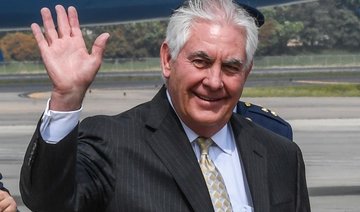
CAIRO: US Secretary of State Rex Tillerson flew into Egypt on Sunday at the start of a five-nation tour that coincides with heightened regional tension as well as unease over the Trump administration’s Mideast policies.
His arrival in Cairo came one day after Israel carried out a wave of airstrikes in Syria after intercepting an Iranian drone that had infiltrated its airspace and an Israeli F-16 was downed upon its return from Syria. It was the most serious Israeli engagement in Syria since the war there began in 2011.
In Egypt, as well as in Kuwait, Lebanon and Jordan — the tour’s other Arab stops — Tillerson will almost certainly hear misgivings about President Donald Trump’s recent decision to recognize Jerusalem as Israel’s capital, The move angered Washington’s Arab allies and undermined the chances of a timely resumption of long-stalled Israeli-Palestinian negotiations.
US officials agreed on Friday that most of Tillerson’s discussions will likely be difficult, saying those with NATO ally Turkey will probably be especially prickly given Turkish military action against US-backed Kurdish rebels in northern Syria and escalating anti-American rhetoric in Ankara. But the officials said diplomacy is necessary to cement anti-Daesh gains and restore regional stability as the administration presses other nations and private companies to help with post-war reconstruction.
Tillerson meets President Abdel-Fattah el-Sisi in Cairo on Monday, three days after the Egyptian leader ordered his security forces to launch a major offensive against militants in the Sinai Peninsula, Nile Delta and Western Desert.
Tillerson will raise human rights issues with el-Sisi, according to the US officials, who previewed the trip on condition they not be named. The timing is sensitive; El-Sisi is seeking a second four-year term in office with no serious competition in the March election. The opposition is calling for a boycott of the vote after serious challengers were either arrested or forced to quit the race.
A general-turned-president, el-Sisi is running against an obscure politician who is among his ardent supporters.
Tillerson travels to Kuwait next to lead the US delegation at two international gatherings — that of the 74 members in the US-led, anti-Daesh coalition and a conference on Iraqi reconstruction.
Tillerson will seek to focus the coalition on its priorities, many of whose members are increasingly distracted by national interests in Iraq and Syria.
The US officials said the aim was to keep the coalition focused on the complete defeat of the Daesh and other militant groups, and then rebuilding war-devastated zones to prevent extremists from regaining territory. They said the coalition would look at containment and elimination of Daesh outside of Iraq and Syria by strengthening intelligence sharing, law enforcement cooperation and counter-extremist messaging.
Tillerson will not be making any new US assistance pledges at the Iraq Reconstruction Conference, the officials said. Instead, he’ll press companies and banks to boost activities in Iraq to spur long-term development. Some 2,300 representatives from the private sector, including from more than 100 American companies, are slated to attend.
In Kuwait City, Tillerson will meet Kuwaiti officials who are attempting to mediate a resolution to disagreements between Qatar and its Arab neighbors Bahrain, Saudi Arabia and the United Arab Emirates, as well as Egypt. All four nations complain that Qatar was moving too close to Iran and supporting militant groups. Doha denies the accusations.
In Jordan, Tillerson will be doing damage control after President Trump’s recognition of Jerusalem as Israel’s capital and his administration’s subsequent decision to withhold aid money from the UN agency assisting Palestinian refugees. Jordan, which has a large Palestinian population, including refugees, is among the most concerned. In Amman, Tillerson is expected to sign a multiyear, multibillion dollar US aid package with Jordan to shore up the relationship.
Tillerson concludes the trip in Ankara with talks with Turkish President Recep Tayyip Erdogan which are expected to be tense. The US officials said Tillerson will repeat warnings for Turkey to show restraint in military operations in Kurdish areas of Syria.


![]()

US Secretary of State in Egypt at start of Mideast tour
US Secretary of State in Egypt at start of Mideast tour
Latest updates


Recommended


© 2026 SAUDI RESEARCH & PUBLISHING COMPANY, All Rights Reserved And subject to Terms of Use Agreement.