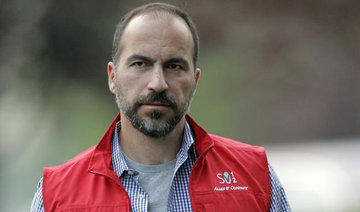
SAN FRANCISCO: Uber CEO Dara Khosrowshahi is focused on cutting the company’s massive losses and “getting the love back” after a year of damaging revelations about the ride-hailing service’s sometimes heartless treatment of its employees, drivers, regulators and rivals.
“We strive to be and should be a brand that is as beloved as Amazon and Google,” Khosrowshahi said late Wednesday during an appearance at a Goldman Sachs technology conference. “We have a long way to go, but we have to re-earn our consumer and driver trust. Just getting the love back is a very important priority for us.”
The job is proving to be even more difficult than Khosrowshahi anticipated five months ago after Uber lured him away from online travel agency Expedia to replace its embattled co-founder, Travis Kalanick, as CEO.
Khosrowshahi inherited a mess after Uber acknowledged rampant sexual harassment within its ranks and its use of duplicitous software to thwart government regulators while dealing with the fallout from a video that captured Kalanick berating one of its own drivers.
To make matters worse, Khosrowshahi discovered that Uber had covered up a computer break-in that stole personal information about millions of riders and drivers. He also landed in the midst of a court battle that pitted Uber against a Google spinoff alleging that the ride-hailing service had conspired to steal its self-driving car technology while Kalanick was running things.
“It looked messy and it was messy,” Khosrowshahi said.
As part of the cleanup, Uber last week agreed to pay $245 million to settle the trade secrets case brought by Waymo, the company spawned by a self-driving car project started by Google. The settlement came after four days of trial testimony that included a dramatic appearance by Kalanick, who fended off accusations of orchestrating a elaborate high-tech heist during more than two hours on the witness stand.
“I thought Travis was terrific,” Khosrowshahi said. “I thought he really held up well, and spoke his mind. I think that helped us get to the settlement.”
Uber didn’t acknowledge any wrongdoing in the settlement that gave Waymo’s corporate parent, Alphabet Inc., more stock in the ride-hailing service. Google, which is also owned by Alphabet, had already accumulated Uber stock as one of the company’s early investors.
Alphabet and other investors stand to reap big gains on their stakes if Uber files for an initial public offering of stock next year, as Khosrowshahi plans. But how well Uber’s stock fares on Wall Street will likely be tied to whether the company proves it can make money — something it isn’t close to doing now.
Uber lost $4.5 billion in 2017, widening from a $2.8 billion setback in the previous year. The results released earlier this week showed Uber pared its fourth-quarter loss by 25 percent from the third quarter, a modestly encouraging sign.
Gross revenue for the year rose 85 percent over 2016, to $37 billion.
Uber’s results are difficult to decipher because it only divulges pieces of data, taking advantage of its status as a privately held company. Khosrowshahi detailed them on a conference call with investors Tuesday, and the company disclosed some data to a website called The Information.
A person briefed on the results provided some numbers and confirmed the accuracy of The Information’s story to The Associated Press on Wednesday. The person didn’t want to be identified because Uber remains a private company.
In a sign that the negative publicity surrounding its problems alienated many consumers, Uber’s share of the ride-hailing market in the US fell from 82 percent at the start of last year to 70 percent in the fourth quarter. People’s view of Uber has become “appropriately negative,” Khosrowshahi conceded Wednesday.
Those numbers underscore Uber’s tenuous position, despite its pioneering role in the ride-hailing industry that enabled it to build a substantial lead over rivals such as Lyft, said Stephen Beck, managing partner of cg42, a management consulting firm. “Their app is just a download away from people moving on to a competitor,” he said.
In his appearance, Khosrowshahi said Uber could quickly reverse its losses by retreating from less-developed markets outside the US and reducing the money it pours into expensive projects like its work on self-driving cars. That, he said, is something Uber isn’t ready to do yet.
“I am pretty confident that we can turn the knobs to make this business profitable, but it would sacrifice growth and innovation,” Khosrowshahi said.
While Uber’s losses are significant, the company appears to be on the right track under Khosrowshahi’s leadership, said Rohit Kulkarni, managing director of SharesPost, a research group focused on privately held companies. “If you draw that out further, a year from now, this could be a significant IPO waiting to happen,” he said.


![]()
Uber CEO aims to pare losses and get ‘the love back’
Uber CEO aims to pare losses and get ‘the love back’

Latest updates




© 2026 SAUDI RESEARCH & PUBLISHING COMPANY, All Rights Reserved And subject to Terms of Use Agreement.