

Football provides solace for those left without limbs by Syria war

1 / 4
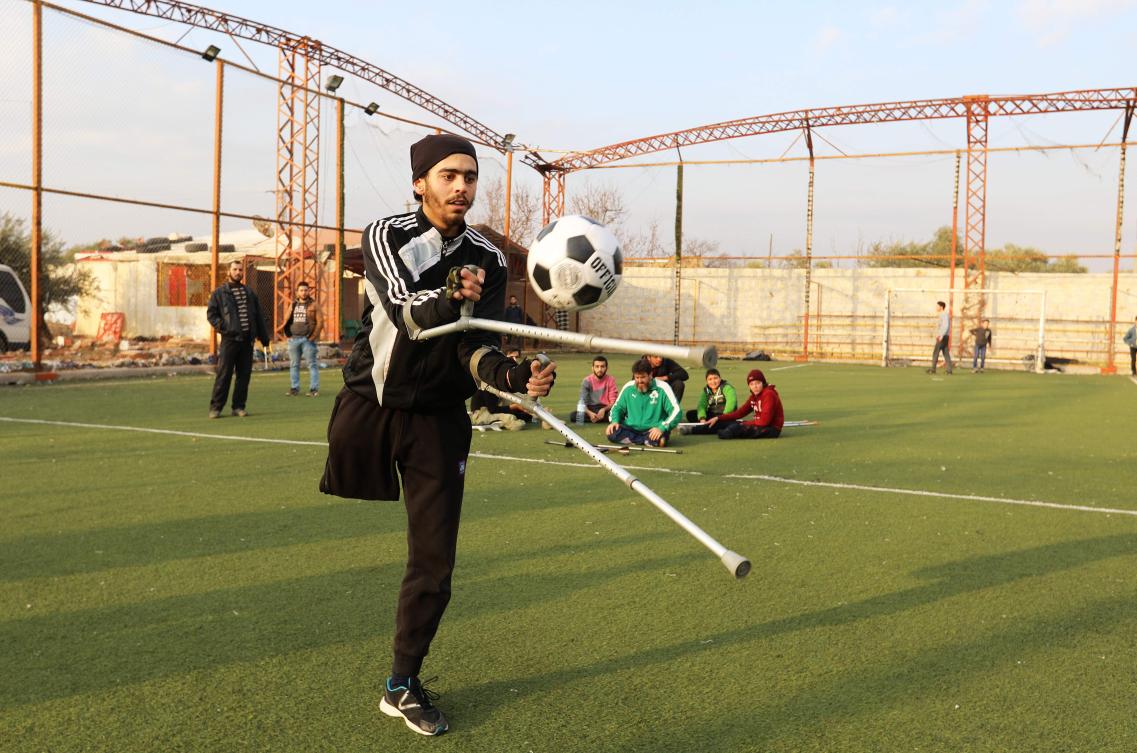
Syrian amputees who were handicapped in the war warm up prior to competing in a football match organized by a center for physical therapy in Idlib, the last province in the country outside the government's control. For the past month, a physiotherapy center in Syria's northwest province has been training 19 war-wounded men and boys to establish a football team. (AFP)
2 / 4
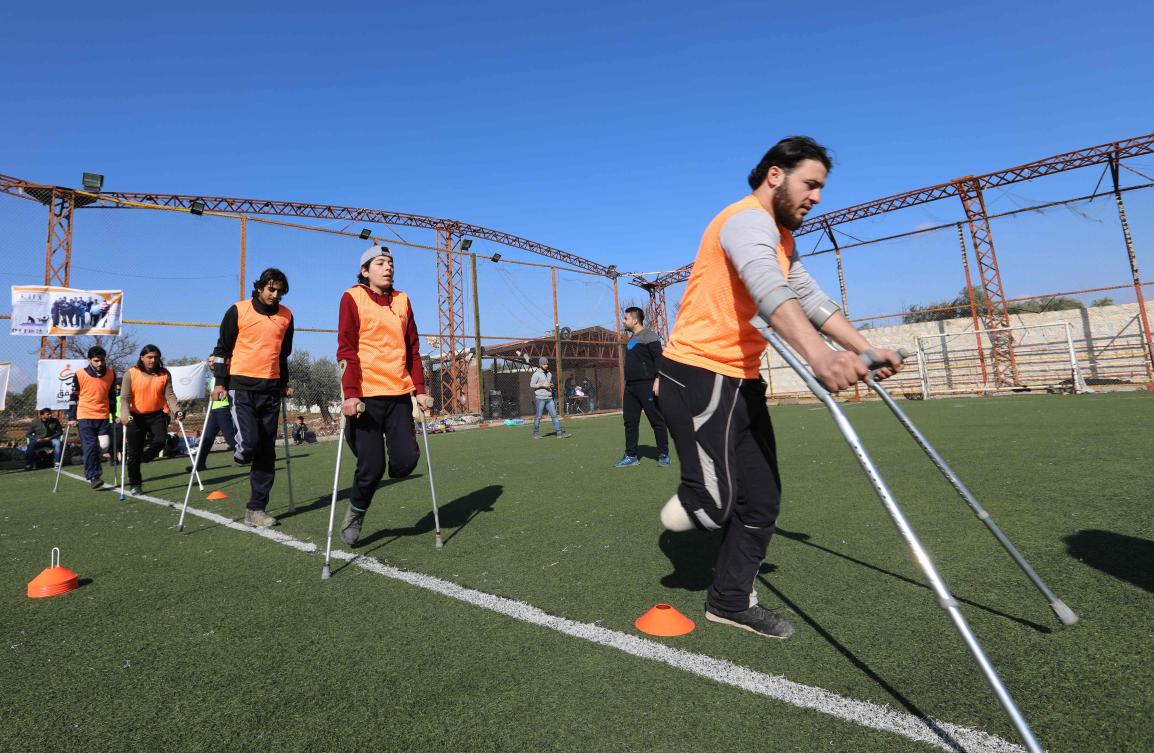
Syrian amputees who were handicapped in the war take part in a football training session organised by a centre for physical therapy at a pitch on the outskirts of Idlib, the last province in the country outside the government's control, on January 12, 2018. For the past month, a physiotherapy center in Syria's northwest Idlib province has been training 19 war-wounded men and boys to establish a football team. / AFP / OMAR HAJ KADOUR
3 / 4
Syrian amputees who were handicapped in the war warm up prior to competing in a football match organised by a centre for physical therapy in Idlib, the last province in the country outside the government's control, on January 15, 2018. For the past month, a physiotherapy center in Syria's northwest Idlib province has been training 19 war-wounded men and boys to establish a football team. / AFP / OMAR HAJ KADOUR
4 / 4
Syrian amputees who were handicapped in the war take part in a football match organised by a centre for physical therapy in Idlib, the last province in the country outside the government's control, on January 15, 2018. For the past month, a physiotherapy center in Syria's northwest Idlib province has been training 19 war-wounded men and boys to establish a football team. / AFP / OMAR HAJ KADOUR
Updated 15 February 2018
Follow

Football provides solace for those left without limbs by Syria war

IDLIB, Syria: At the referee’s whistle, the young forward leans on his crutches and punts the football with his only leg, kicking off a match between war amputees in Syria’s battered northwest.
What follows is a different take on the beautiful game: Men of all ages, some using crutches, deftly pass the ball back and forth as they sail across the field.
The ball reaches the attacker, who steadies himself on his crutches and uses his sole leg to send it flying toward the goal.
The keeper, who is missing his right arm, dives to his knees to make a save, but the ball bounces past him into the net amid cheers and whistles.
For the past month, a physiotherapy center in Syria’s northwest Idlib province has been training 19 war-wounded men and boys to establish a football team.
Idlib is the last province in Syria still outside government control and has faced a weeks-long regime assault backed by Russia.
Some players are civilians, others are fighters — but they have been brought together by their impairments and their shared love for football.
“Sometimes, the ball crosses right in front of me and I want to shoot it with my left leg, then I feel sorry for myself because my leg’s amputated,” said Salah Abu Ali, sitting on the sun-soaked edge of the football pitch.
“Some things are still hard, like running or being fast.”
The 23-year-old player was wounded nearly a year ago in a bombardment on his native Raqqa, a northern Syrian city recaptured.
He woke up in the hospital to find his leg had been amputated and decided to seek safety to the west in rebel-held territory.
“When I first arrived in Idlib, I didn’t know anyone. I just thought of the past. I didn’t want to work, go out. I didn’t like to see people or let them see me,” said Abu Ali.
But when he found the football team, he said, it was like getting “a new life.”
“I lost a limb but life goes on -— I want to live my life as positively as possible. I want to play football, swim, come and go.”
Founded just over a year ago, the rehabilitation center that runs the football sessions is housed in Idlib’s Specialist Hospital.
It has treated some 900 war-wounded, including men and women of all ages with injuries ranging from simple fractures to amputations, said physiotherapist Mohammad Marea.
“We had a psychological objective in training these guys but also wanted to target their morale,” Marea told AFP.
“Thank God, they responded quickly and happily, accepting the idea wholeheartedly,” said Marea.
Next the center plans on setting up bodybuilding and swimming classes. Footballers train two or three times a week, for sessions of up to two hours.
Those that have prosthetic legs prop them up against the metal fence — they move faster without them — and wrap amputated limbs in protective gauze.
At a recent friendly match, opposing players wearing mint-green and red jerseys grappled over the ball on a pitch set up by charity association Shafak.
“Ole, ole, ole!” team members cheered, their arms around each other’s shoulders and hopping on one leg.
Added to the usual cacophony of cheers and referee whistles was the clinking of crutches as players darted across the field.
At home after his match, Abdulqader Al-Youssef drapes his medal around his toddler son’s head.
“Look at what Daddy won today!” said the beaming 24-year-old, a lifetime football lover who played on his local team.

Youssef hails from Homs, a central Syrian city known as “the capital of the revolution” that erupted across the country in 2011.
He joined the uprising as a rebel fighter and even played football on breaks from the front, but he lost his right leg in clashes against government troops in 2015.
“Being wounded was a huge shock to me. There were so many things I could do before my injury that I couldn’t do afterwards,” said Youssef, his dark curly hair pulled back by a black headband.
Carrying groceries seemed an impossible task, until he joined the physiotherapy football team.
“Since beginning training, I can do things I couldn’t do before. I used to say it was too hard, but now I can lift a gas canister and other things,” he said proudly.
“Life doesn’t stop at an injury. Don’t lose hope or get sad at losing a limb,” he added.
“As our trainers told us today, there’s no handicap of the body — just of the mind.”
Still, war is never far away. Last month, one trainee player was killed in a bomb blast in Idlib city.
Iva Jovic received tips from Novak Djokovic, but those couldn’t help her against Sabalenka

Updated 9 sec ago
Follow

Iva Jovic received tips from Novak Djokovic, but those couldn’t help her against Sabalenka

  • They helped until Tuesday when top-seeded Aryna Sabalenka defeated the 18-year-old American 6-3, 6-0 to end her run in Melbourne
  • Predicted rankings published by the WTA showed her climbing to No. 20 — her highest spot
Iva Jovic has received playing tips throughout the Australian Open from Novak Djokovic. They worked very well until Tuesday, when top-seeded Aryna Sabalenka defeated the 18-year-old American 6-3, 6-0 to end her run at Melbourne Park.
“Hopefully throughout the year I can keep having more moments with him because it’s been amazing,” Jovic said of Djokovic, the star Serbian who has won 24 Grand Slam singles titles, 10 of them at the Australian Open.
But even Djokovic could not have saved Jovic against Sabalenka in the quarterfinal match.
To be fair, Jovic has been doing just fine on her own, rising quickly in the WTA rankings.
She finished 2024 ranked just inside the top 200. Predicted rankings published Tuesday by the WTA showed her climbing to No. 20 — her highest spot.
Jovic had a chance against Sabalenka in the first set. Sabalenka took a 3-0 lead, but Jovic stayed in the set and had three breakpoint chances in the ninth game trailing 5-3. She lost 6-3 and lost her momentum, losing the second set 6-0.
Jovic referred to a comment that she attributed to Andre Agassi speaking about Djokovic, noting his ability to change styles and keep opponents off balance.
She said Agassi compared Djokovic with “a boxer and the way that he’s going in for punches and then faking them out a little bit. I think the way (Djokovic) approaches the match is very impressive.”
Jovic is the California-born daughter of a Serbian father and Croatian mother who immigrated to the United States.
It was Jovic’s first appearance in a Grand Slam quarterfinal, but she seemed poised from the start.
“I think that I kind of went into the match obviously not knowing too much about how it was going to look like in person, having not really hit with her in the past,” Jovic said. “Our first meeting as well.”
“I kind of tried to just bring that middle ground, and I think I have to be able to adapt to the game and what’s necessary for different play styles. I wasn’t able to do that” against Sabalenka.
Jovic revealed her conversations with Djokovic earlier in the tournament. Djokovic confirmed he gave the young American some feedback, saying he was happy to help a player with Serbian heritage.
The 38-year-old Djokovic has stayed in touch.
“Yes, he did text me with some more tips throughout the rounds. I don’t even know what day it is anymore!” Jovic said. “So we’ve been in communication, and I feel like we’ve built a little bit of a relationship now, which is amazing, and I wish him all the best for the rest of the tournament.”
She plans to have more opportunities of her own at Grand Slams in the future.
‘It’s the quarterfinals but, you know, ultimately I hope to be in many quarterfinals,” she said. “So I don’t think this win or loss today is going to make or break my career.”