Kosovo president slams international war crimes court

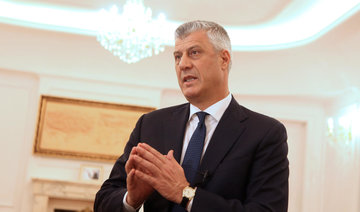
Kosovo President Hashim Thaci speaks during an interview with AP on Wednesday Feb. 14, 2018, in Kosovo capital Pristina. (AP)
Updated 14 February 2018
Follow

Kosovo president slams international war crimes court

PRISTINA, Kosovo: Kosovo's president on Wednesday called an international war crimes court with jurisdiction over potential Kosovar suspects a "historical injustice," adding his government only reluctantly accepted it as the "price for its liberty."
In an interview with The Associated Press ahead of the 10th anniversary of Kosovo declaring independence from Serbia, Hashim Thaci slammed the court, based in The Hague, Netherlands, as akin to creating a court to judge Jews who were persecuted by the Nazis in World War II.
"Kosovo held a defensive war for its existence as a nation and attacked no one," he said. "We have nothing to hide."
Kosovo's bloody war for independence ended with a 78-day NATO air campaign in June 1999, which stopped a bloody Serbian crackdown against ethnic Albanian separatists. The war left 13,000 dead and 20,000 Albanian women raped, according to Thaci.
Under U.S. and European pressure, Kosovo's government agreed in 2015 to set up the Kosovo war crimes court, known as the Special Chambers, to confront allegations that fighters with the Kosovo Liberation Army committed war crimes against ethnic Serbs from 1998 to 2000. The court, which has jurisdiction over Kosovo citizens, has yet to hear any cases.
U.S Ambassador to Kosovo Greg Delawie said Wednesday the court was meant to provide justice to the victims.
"The special court is not about whether the Kosovo Liberation Army struggle was right or not, if the KLA was good or was bad. It is about crimes committed by individual people against other individual people and the victims were all ethnic groups," he told the AP.
Thaci said war crimes by the Serb army, paramilitary and police have remained uninvestigated.
Some Kosovar lawmakers tried last year to amend the law and extend the court's jurisdiction over Serbs, their former adversaries in the war, but they appear to have stopped the efforts since.
Kosovo declared independence from Serbia in 2008, recognized by 115 nations but not by Serbia.


International baby milk recall leads to French legal action

Updated 2 sec ago
Follow

International baby milk recall leads to French legal action

  • Eight French families have joined a lawsuit filed by Foodwatch
  • The complaint, while not naming the manufacturers or government agencies, calls for a legal investigation

PARIS: A recall of potentially contaminated infant milk formula in some 60 countries has taken a legal turn in France after a watchdog and eight families filed a lawsuit accusing manufacturers and the government of acting too slowly.
Eight French families, who said their babies suffered severe digestive problems after drinking formula named in the recall, have joined a lawsuit filed by Foodwatch, which AFP has seen.
The complaint, while not naming the manufacturers or government agencies, calls for a legal investigation.
Foodwatch, a European consumer association, believes that producers could not have ignored the risks to babies by leaving their milk on sale in France and in more than a dozen European countries, as well as in Australia, Russia, Qatar or Egypt.
Several manufacturers, including giants like Nestle, Danone, and Lactalis have issued recalls of infant formula in more than 60 countries, including France, since December due to a risk of cereulide contamination.
Cereulide, a toxin produced by certain bacteria, is “likely to cause primarily digestive problems, such as vomiting or diarrhea,” according to the French health ministry, though it said last week it so far had not determined a link to the symptoms experienced by the infants.
In the complaint, Foodwatch accuses milk powder manufacturers of delaying action between the initial warnings in December and the recalls, some of which were not widely publicized. They became more widespread in January.
Foodwatch believes that parents were told too little, too late, and in a confusing manner. French agriculture minister Annie Genevard said however that procedures had been “very well followed.”
Two separate criminal investigations have already been opened in France following the deaths of two infants who consumed infant formula recalled by Nestle due to “possible contamination” by a bacterial substance, although no “causal link” has yet been established, according to authorities.
Authorities are accused in the Foodwatch complaint of delaying action and of deficiencies in their controls.
The European Food Safety Authority (EFSA) announced meanwhile that it had been asked by the European Commission to establish a standard for cereulide in children’s products. It will issue an opinion on February 2.